Thursday, May 30, 2024

Atari Jaguar #7: Checkered Flag

Developer: Rebellion Developments

Publisher: Atari

Release Date: November 1994
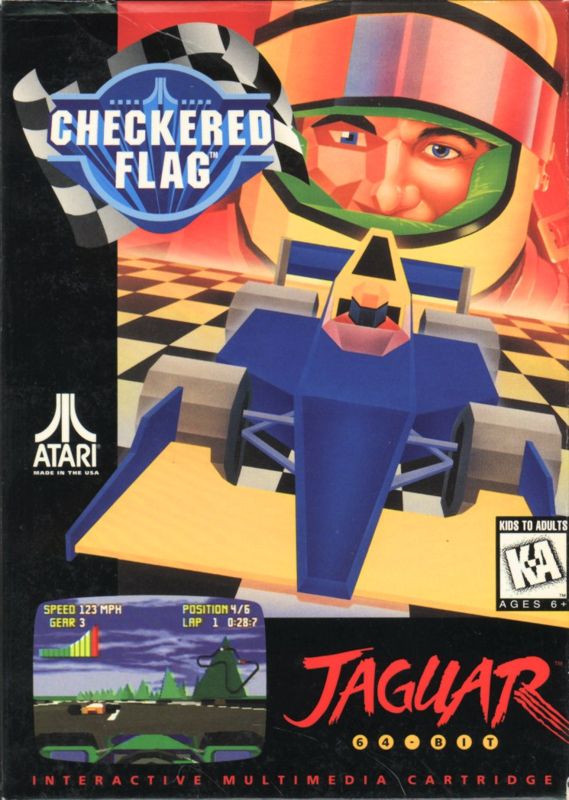


The second half of 1994 saw the Atari Jaguar coming the closest it ever would to being an actual contender. Several of their most high-profile games would be released during this time. They already had Tempest 2000 and Wolfenstein 3D in stores, and they would get other high-profile titles like Alien vs. Predator and Iron Soldier out before the end of the year. However, there were still some very troubling signs. The Jaguar’s soft launch was in November 1993, and the Christmas season of 1994 would be the most prolific time the Jaguar would ever have. Despite the national launch, however, they still only managed to have 17 games out by the end of 1994. That’s not as many games as the NES had on its very first day. It is hard to succeed with such a tiny library of games unless every game is a masterpiece. Nintendo 64 had a similarly tiny library in its early days, but Nintendo still had the SNES and Game Boy to help keep them in the market. Atari didn’t have that kind of safety net and needed to impress with each and every game. So, if they were to release two similarly terrible games at the same time in a month that only saw the release of three games it would be concerning indeed. That’s just what happened when Atari released the twin driving horrors of Club Drive and Checkered Flag. I’ve already written about Club Drive on here. It’s an absolute mess with terrible graphics, bad controls, confusing goals, and ultimately boring gameplay. It fails on ever level. By comparison Checkered Flag looks like a winner. It looks nice and is easy to understand. It’s a real racing game with actual computer opponents. There was even a version released on Atari Lynx a couple of years prior, and that game was pretty good. How could they go wrong with an enhanced sequel? Of course, if you actually play Checkered Flag than you will quickly see how it can all go wrong. Checkered Flag reveals so many of Jaguar’s flaws that it should be called Red Flag instead. It’s an ineptly made racer disguised as an eye-popping next-gen game.  
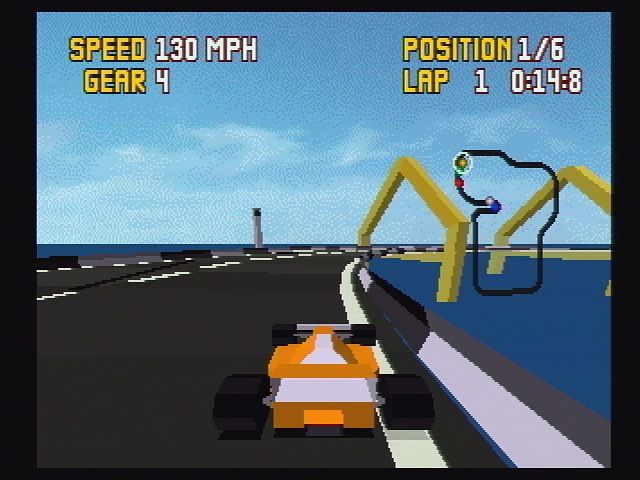


I’m just going to get right to the flaws this time. Why waste time pretending like this is going to end up as a positive review? Checkered Flag is an incredibly shallow game with some truly awful controls. When you first start up the game you are treated to a menu screen with different categories to adjust However, it’s all just for show. If you’re playing tournament mode all you get is a choice between a red car and a black car. No difficulty settings, no manual transmission, no nothing. Even the most rudimentary racing games will have different cars with their own strengths and weaknesses. In Checkered Flag they’re nothing but weaknesses. If you are going to play Checkered Flag, be prepared to drive into the wall. You will be driving into the wall at practically every turn. I spent a lot of time getting unstuck from the scenery. Not all of the scenery is bad though. Objects on the side of the road like rocks and trees can be driven right through, but structures like bridges and tunnel entrances are like spider webs to bugs. It’s hard not to get stuck on them. Also, if you get too far off the track the game will automatically put you back on the road, but it feels like the time it takes is random. Sometimes I felt like I was put back on instantaneously and sometimes it would put me well behind some of the other cars. It didn’t make much sense. This is bad in a game where it’s so hard to stay on the road in the first place. When I found out that the second race is in the rain, I thought it was all over, but inexplicably the rainy and snowy tracks controlled much better. I think it’s because the top speeds were lower in general on the extreme weather tracks. Have you ever played a racing game where the sunny tracks are slippery, and the icy tracks are smooth? If you play Checkered Flag, get used to experiencing the opposite of everything that should happen.
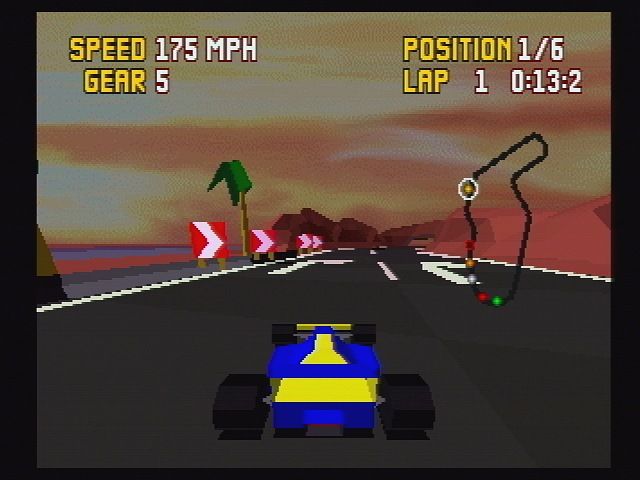


And the oddest thing is that even with the bad controls, I could often win races by a minute or more. The tournament has to be played through in one long, hour plus slog where all ten races have a ridiculous number of laps. We’re talking about double digit laps. No non-simulation racing game should have that many laps. The computer cars are mindless drones that just drive, usually in one big clump. So, once you’re past the clump of cars you can just drive and drive. They seem to have just as much trouble on curves because even with all the slipping and sliding it’s easy to get way ahead. I actually got a little relieved sometimes when I would get stuck on the scenery, because the thought of a challenging race was exciting. I can’t believe Atari didn’t put a password in this game. Or be like every other racing game and split it up into circuits with saves between them. Beating Checkered Flag was one of the most boring endurance tests I have ever experienced in a video game, but at least I was able to beat it. There’s not that much else to do in the game either. There’s no two-player mode, and you can play individual races with more options, but I don’t think many people are going to torture themselves with more Checkered Flag than what is absolutely necessary. Maybe if this was 1994 and you only had this and Cybermorph to play you might try to put more into it, but I don’t write for time travelers. If this is any year before 2024, please stop reading. I write for people who live in the present, and in the present day there is no reason to play Checkered Flag unless you are a completionist like me.


I know it doesn’t seem like it, but I really do enjoy playing and reviewing Jaguar games. I know it’s been a bit bottom heavy so far, but I want to get some of the lesser titles out of the way before I get to the more prominent titles. I’m not expecting anything great, but maybe it will at least have a 10% good rate before I’m done. Something about Checkered Flag rubbed me the wrong way, and I think most gamers agree this one is a dud. It seems like reviewers wanted the Jaguar to succeed and gave some of the early games overly good reviews. Checkered Flag got some good scores, but the reviewers didn’t have that many good things to say about it. It seems like they had to reach to find the positive, and it mostly came down to speed and graphics. The graphics do look nice, but not good enough to hide the bad gameplay. It’s yet another sub-par Jaguar racing game. Seriously, did they ever release a good one? I’ve still got a few to play so there’s still hope I suppose. I liked it better than Club Drive because at least it feels like a real racing game and the graphics are decent, but it’s still way down at #135 overall. We’ve been seeing a lot of red lately, so hopefully that changes soon. If I want to turn things around, however, I should probably quit playing so many Jaguar games.


Atari Jaguar Quality Percentage: 1/7 or 14.28%


(Images are from mobygames.com)

Tuesday, May 21, 2024

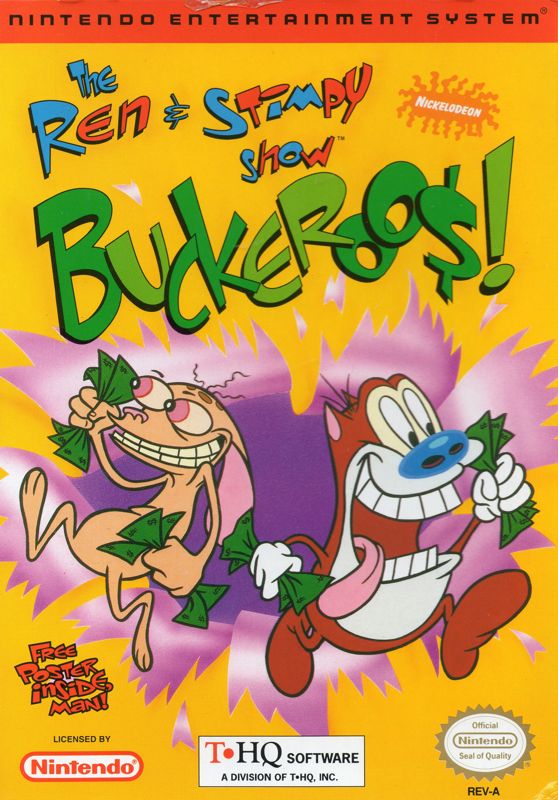
NES #46: The Ren and Stimpy Show: Buckaroo$

Developer: Imagineering

Publisher: THQ

Release Date: November 1993


I saved The Ren and Stimpy Show: Buckaroo$ for last for a few reasons. For one thing I didn’t want to type out that clunky title over and over again. It’s just going to be Ren and Stimpy from now on. Also, it’s always a little awkward talking about beloved childhood franchises with problematic creators. And it doesn’t get much more problematic that John Kricfalusi, the creator of Ren and Stimpy. He was gone and then some by the end of 1993, but it’s hard to write about his show without thinking of all the baggage that comes along with it. That’s one of the many difficult things about being an older millennial. You have to spend a lot of time distancing yourself from your childhood heroes. The final reason I saved it for last on my THQ journey is because it is an incredibly late release. I can’t get the exact dates, but it came out the same month as Wayne’s World, which would put them both among the last NES games ever released. November of 1993 would be the last month there would be more than three NES games released. After those six games, NES output would slow down to a trickle. 1994 would see eleven games released in all at ending with Wario’s Woods in December. It would be one last Christmas present from Nintendo for NES fans. I’m oddly fascinated with later releases on consoles, so I was saving Ren and Stimpy for last because I was hoping it would be interesting to talk about. Luckily, I was correct, and this is an interesting game. When I first played it years ago it didn’t impress me much, but maybe I was in a better mood this time around because this may be the best THQ game on the NES.


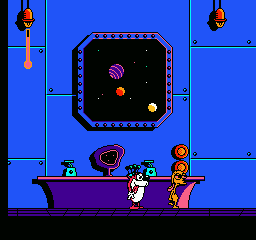
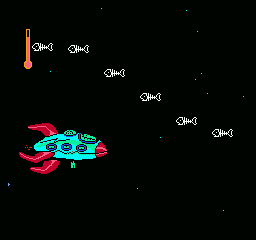
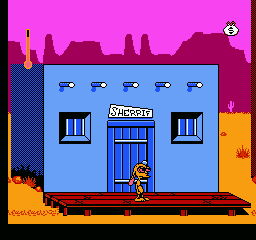
If you are a Ren and Stimpy fan than you probably expect certain things in a video game adaptation. Most obviously it needs to look good and be weird. There had never been a children’s cartoon quite as strange as Ren and Stimpy. It was also famous for its great animation. For once Imagineering actually delivers, at least as much as they can on the 8-bit NES. Of course we’re not going to get any grotesque freeze frames, but it is colorful and well-defined. It is refreshing after playing so many ugly THQ games to finally get one that is visually interesting. It is also fairly strange. It’s the rare game where I’m not upset to see killer hats and deadly chickens. It’s supposed to be weird, so it makes sense that the enemies would be weird too. Now I wouldn’t say it’s a particularly funny game, but humor was hard on the NES, and it’s probably for the best they didn’t lean into the humor aspect too much. Now I’m trying to think of what the funniest NES game is. Oh, maybe Star Tropics. Yeah, Ren and Stimpy doesn’t make me laugh, but it still manages to feel like the source material.


This is, however, a jarring game to play. The levels themselves are fun, but they can sometimes feel like they belong to completely different games. The sudden changes in setting fits with the anarchic spirit of the show, and they are all based on actual episodes, but it can be strange to go from space shooter to wild west side scrolling so suddenly. Thankfully, the levels are designed well enough that it mostly works. The two characters will alternate levels with Stimpy having a projectile weapon but Ren moving faster. Some levels have posters that allow you to switch characters, and I like this system because switching restores your health. This is a strategic move which keeps you from playing as one character for the whole level. Still, it’s much better to end up at boss sections with Stimpy rather than Ren. There are weapons and other powerups to collect along the way, and while they are limited, they tend to be everywhere. I don’t remember many times where I followed a different path and didn’t find an item.


Ren and Stimpy also highlights why it pays to throw in a few continues. This is not an easy game, and I still haven’t been able to finish it. However, it has some continues and fairly easy to collect extra lives. Because of this I was able to experience most of the game without spending a ridiculous amount of time becoming an expert. The levels are fun enough that I want to go back and get better, and it’s forgiving enough that even with eventual permadeath, I didn’t feel that all was hopeless if I made a few mistakes along the way. This is why I can’t stand a game like Swamp Thing being so stingy with its lives. I feel completely hopeless playing such a stingy game, and it makes me not even want to try. It’s not hard to see why this type of challenge was already dying out. It’s no fun only being able to play the first five minutes of a game. I think I’m going to try again with Ren and Stimpy, and I am hopeful that I will eventually finish it.


Of course, seeing so much of the game does highlight its flaws as well. I sound like I’m gushing a bit, but after so many bad THQ games it’s nice to play a decent one. Still, it is merely a good game and not a great one. Ren having no projectile attack is more annoying than I led on before, and he has more solo action levels than Stimpy does. This means I spent more time with Ren’s short-range slap attack than Stimpy’s superior spitball. They should have reversed the setup and had the better attacker do most of the attacking. There are also objects that can take damage but can’t be defeated and this can be annoying. I don’t always know what I can get rid of and what I have to avoid. The thing that leads to the cheapest deaths, however, is the camera’s inability to keep up with a falling character. Ren and Stimpy has many sections that take place in the sky without any clear way down. Sometimes I just have to jump for it, and sometimes my character will fall below the screen and I will die. This can happen even when I know there is solid ground below me. It might be acceptable if this was a design choice, but it’s obviously a bug. There is no fall damage in Ren and Stimpy, so the fall deaths are a case bad programming. Cheap deaths are no fun even with extra continues.


I might sound like I’m overrating this game just a bit, but I’m excited to find an NES game that I actually enjoyed again after so many stinkers. It’s not going to rank too high in the good column, but it’s Super Mario Bros. 3 compared to some of the other THQ games. I’m ranking it at #75 overall which puts it near the bottom of the good section, but it sure is nice to see green again regardless. Hey, I thought it was better than Bible Buffet, so it’s not the lowest ranked good NES game either. It was a pleasant surprise and a nice way to finish my THQ journey. They managed to publish one halfway decent game at the very end of the console’s life. That’s not a very good track record, and I have no idea how they were able to turn this into a long, successful career in the game industry. Perhaps their games get better on the 16-bit systems, but that’s a story for another day. I think it’s time to go down some different paths for a while.


NES Quality Percentage: 22/46 or 47.82%


https://docs.google.com/document/d/1G01RKJ7-caaal5lgFfGgPfZRGcqWlv4E3E2E615UYKg/edit?usp=sharing

Wednesday, May 15, 2024

NES #45: Swamp Thing

Developer: Imagineering

Publisher: THQ

Release Date: December 1992


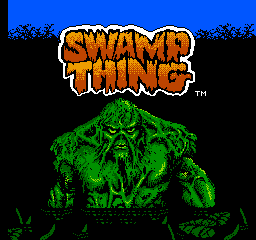
After so many strange detours, it’s odd to play something from THQ that’s just a regular game. Swamp Thing isn’t bizarrely terrible. It doesn’t try new things and fail. It’s just a typical side-scroller. This is probably the type of game that you’re thinking of when you’re thinking of licensed NES titles. It plays decently, it’s competently made, and it’s completely forgettable. It’s such a typical game that I feel the need to pad out this introduction. I would go into the history of Swamp Thing, but I don’t even know that much about Swamp Thing. I feel like that is a common situation. Most people have heard of Swamp Thing, but few know that much about him. I know that there was a Swamp Thing tv show airing on USA at the time. I also know that there was a long running Swamp Thing comic at the time  which ran for 171 issues and had garnered some acclaim in the mid 80s when Alan Moore was the writer. He was long gone by 1992, but Swamp Thing was still a fairly popular character, so adapting him for an NES game made sense. I could do a whole series on comic book games for NES, because outside of Batman they were pretty dire. Some of the worst games I’ve ever played are NES super hero games. Luckily Swamp Thing doesn’t sink quite so low, but it probably won’t surprise anyone to find out that it’s not a hidden gem either. Still, I think it is slightly better than what most critics say. Maybe that’s just because I’ve been playing so many terrible THQ games. Hopefully I can be objective in my review.


They certainly weren’t counting on people knowing much about Swamp Thing, because the game starts with one of the longest intros I can think of in an NES action game. It really gives you the whole backstory in nice looking but lightly animated scenes. The game itself is pretty standard side-scrolling action. You might even say bog standard. Get it, because it’s Swamp Thing? The first level is a sprawling swamp with the typical NES trappings. Platforms pile up into the sky, so there is some exploring to be done. The ultimate goal is to get to the part of the level where it stops scrolling and walk into the offscreen void, but all the platform jumping is nice for variety. There are projectiles and other powerups to collect, but there’s not that much to find out there. I like how most of the cabins have an endless supply of knives flying out of the door. It reminds me that Swamp Thing is one of those characters who is a hero but seen by normal people as a villain. Of course, these same knives tend to hit me and kill me, but I can still enjoy annoying things.


If you’re wondering why I’m spending so much time describing the first level than let me tell you about the game’s biggest flaw. Swamp Thing is way too hard. There are few lives and no continues, and almost anything that moves is deadly. This might not even be so bad if the levels were shorter, but the first level is so long that traversing it over and over really drains the fun out of the game. The second level makes things even harder by adding bouncy skulls, deadly pits, little demons that are too short to hit, deadly bubbles, and lava pits. Level two is as far as I have been able to get. I’m sorry if this makes me a bad reviewer, but I’m only human. It’s a bit of a shame because the rest of the game at least looks interesting. I like the macabre setting of level three’s graveyard. It definitely doesn’t look like it ever gets any easier though, and of course with a game over I’d have to start all over again. It seems like by 1992 almost every game had at least a continue or two. It’s really a flaw in my book. You don’t have to dumb yourself down too much Swamp Thing, I just want to experience your game.


So, this review is a bit of a short one. And by short I of course mean just about the same length as all my other reviews. Maybe I just mean short in content. There’s just not that much to say about Swamp Thing. It’s a typical 8-bit side scroller that looks fairly nice but is way too difficult. The gameplay isn’t dynamic enough to support the difficulty, so I can’t say I recommend this one. I’ll probably keep trying to play through it, but I’m a masochist who wants to finish every game I encounter. Having said that, however, it’s still one of the better THQ games on NES. I thought it might rise all the way up to the purple section, but instead it’s in the upper part of the bad section at 132. It’s one of the better bad games I have played which has to be good for something I suppose. Thankfully I only have one THQ game to go and then I might take a break from NES reviews for a while. Maybe there’s a good PlayStation RPG out there I can play. That would certainly be a nice change of pace.


NES Quality Percentage 21/45 or 46.66%


Ranking List.docx


Wednesday, May 8, 2024

NES #44: James Bond Jr.

Developer: Eurocom

Publisher: THQ

Release Date: November 1992


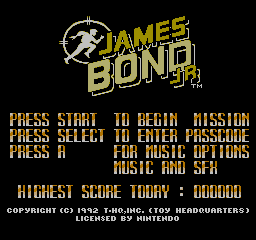
This is the final THQ game left that is based on a semi-obscure cartoon, but at least it’s a cartoon based on a franchise everyone has heard of. Hey it’s good ol’ James Bond! That’s a franchise perfect for video games. There have been a ton of Bond games over the year running the entire spectrum from classic to garbage. For the curious, the first was the 1982 ZX Spectrum text adventure Shaken but not Stirred. Maybe I’ll get to that one if I ever have time to start reviewing old computer games. Of course James Bond Jr. is a bit different in that it was based on the syndicated 1991 cartoon which featured the adventures of Bond’s hip young nephew. I know that James Bond should probably have dozens of illegitimate children out there, but they make sure and remind you over and over the he is James Bond’s nephew, and not his son. The cartoon itself seems decent enough if you can handle bad British accents. Hey why get actual British teenagers when you could have American adults who sound like they’re sucking on helium balloons? Anyway, I’m getting distracted. After all the episodes were produced and were being syndicated ad-nauseum on local affiliates for kids to watch on sick days, THQ released a video game. Eurocom developed it, and they seemed like a good choice despite being a relatively new developer a the time. They would be extremely prolific for the next two decades, and largely specialize in licensed properties. They would end up making a bunch of James Bond games, but not the most famous ones. Of course this is THQ on NES, so you have to keep your expectations low.

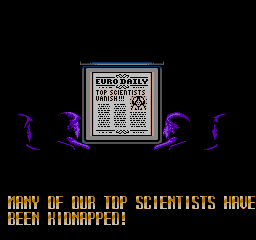
(Hey, it's only many of your top scientists. Some of them are still free. You should look on the bright side!)

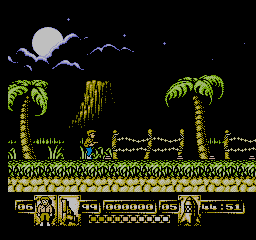
Right when I started playing James Bond Jr. I knew it was going to annoy me. I could tell by the confusing layout that this wasn’t going to be a game I could play for fifteen minutes and fake my way through the review. This isn’t a bad game that’s bad in a normal way. It’s a game trying to be good that ends up finding its own special ways to be bad. It really feels like they were trying too. The game is split up into large levels with specific goals to meet. It’s not a game about going from point a to point b. The first level, for example, has James exploring a mostly subterranean world looking for missiles to diffuse. It’s a game that actually requires exploration which is always welcome in the NES era. The levels are diverse, and it shows that some actual work was put into them. It’s not quite the quickie cash-in that so many of these THQ games have been. Still, it all falls apart in the execution.


 There are just too many little annoyances in James Bond Jr. The most obviously annoying part is the combat. James’ gun is just too weak. Even the most standard enemies take a dozen or more hits. This makes for some very tedious battles. I stand there and shoot while knowing that I should dodge sometimes, but there’s a clock constantly counting down. I can’t waste time with strategy when I have to spend so much time shooting. I actually enjoy the timer. I think it adds some needed tension to the game. I just wish that the boring combat didn’t waste so much of the time.  There are also mini bosses that take even more shots. None of them are fun to encounter and just have me spamming when I should be engaging.


The controls are annoying as well. The game is not bogged down by commands, but there are still some strange choices. Sometimes James has to log into a computer, so pushing the up button makes him face the front to do so. Unfortunately, this also makes him face forward even when he’s not in front of a computer. If James could point his weapon up with the button instead the game would be much improved. Unfortunately, he can only shoot straight ahead. There is also a truly baffling command where instead of pressing select to toggle through items you have to push select and down at the same time. I have no idea why it is like this. Select isn’t mapped to any other command. Why not just have select do this? I would never have figured this out if I didn’t look at the manual online. How can you make such a vital command so hard to figure out? And you have to figure it out soon because James has to switch to his scuba gear to go underwater. Movement underwater is also quite annoying because instead of just using the control pad to get around you have to tap A to have him swim. This makes swimming harder than it needs to be, but the whole game is harder than it needs to be.


Even without the major annoyances, though, I still don’t think it would end up in the good section. That’s because the more I play it the more it bugs me. Is there anything worse than sliding puzzles? Well James Bond Jr. has sliding puzzles that also include a loud, beeping alarm. This is just unpleasant on unpleasant. It’s hard to even think with the alarm constantly going off, and the puzzles are actually fairly difficult. I appreciate that they were trying to do things besides side-scrolling and boss fights, but sadly it just doesn’t work. Still, THQ could do a lot worse.


So as much as I dislike James Bond Jr. I appreciate the ambition and think it’s one of the better THQ games. It’s not soul-crushingly awful, it’s just an averagely bad game that misses the mark. I suppose they were trying to make something like Impossible Mission for kids. Unfortunately, it ends up being too hard for kids and too annoying for adults. It comes in at #130 on the list which means it’s not quite the cellar dweller that so many THQ games have been. In fact, it’s the second-best THQ game so far. With only two to go it’s likely to stay that way, but you never can tell. I’m just happy that I only have two more games to go before I can play something else. Maybe I’ll play something good after this, but that does seem a bit out of character these days. This makes seven bad games in a row. Of course, since I decide what I’m going to review around here there’s nobody to blame but myself. I hope you are enjoying reading these as much as I have not enjoyed playing them.


NES Quality Percentage: 21/44 or 47.72%


(Images are from mobygames.com again.)


Ranking List.docx

Tuesday, April 30, 2024

NES #43: Attack of the Killer Tomatoes

 Developer: Imagineering

Publisher: THQ

Release Date: January 1992


In a way Attack of the Killer Tomatoes is the opposite of Home Alone 2: Lost in New York. With Home Alone 2, Imagineering made a completely bonkers game out of a standard, boring kids movie. It’s a bad game, but killer suitcases and homicidal maids are more memorable than watching Kevin order too much room service and bugging an unusually boring Tim Curry. Attack of the Killer Tomatoes is a true oddball. The original movie came out in 1978 and was basically a cult classic by design. It was made cheaply, savaged by critics, not liked that much more by audiences, but somehow spawned a minor media franchise including the Saturday morning cartoon this game was based on. The movies were not made with children in mind but turning weird non-kids' movies into cartoons wasn’t that unusual at the time. This is the same era that gave us Toxic Crusaders after all. The show was surprisingly strange and irreverent being mostly based on the more comedic sequel, Return of the Killer Tomatoes. It was full of meta humor and odd characters. I was hoping for a weird game to go along with the weird franchise. Well, this time around Imagineering made one of the most normal games they could possibly make. It’s so normal that it is a bit hard to write about. It’s the type of 8-bit platformer that I’ve played hundreds of times. Normal is not bad in itself, so does Attack of the Killer Tomatoes have anything to offer besides mild nostalgia?


Well, it’s not unpleasant to play at least. The controls are decent, and the graphics are fine. It’s not offensively terrible like certain other licensed NES titles. It’s just that there’s so little to get excited about. Most of the game is walking to the right and jumping on tomatoes. I know it’s accurate to the show, but there really are a lot of generic tomato enemies. Most of them are normal looking tomatoes that you just have to jump on once. Somehow this ends up being more difficult than it sounds, and I found myself frequently getting injured during my tomato stomping. There are some less common variations like bats and worms, but they don’t show up nearly as much as the normal mutated tomatoes. Every so often there will be a larger semi-boss, but they don’t add much to the experience. They mostly wander without much purpose, and some of them can be skipped entirely. The levels are somewhat maze-like, but all of the branching paths just lead to more tomatoes or various health restorers. None of the attempts at depth really work. Most of the time my attempts to collect more health just led to me getting hurt even more, and there’s just nothing else to find down all those branching paths.


It’s also a game that is stunningly short. I know length is relative in 8-bit games because they tend to be difficult and full of permadeath. Contra may be only about twenty minutes in length, but it will take many attempts for a player to get good enough to actually finish. Attack of The Killer Tomatoes is a fairly difficult game. It took me several attempts to progress past the sewer section. Still, the entire game only takes about eleven minutes. That’s just not enough for any amount of difficulty to justify. And those first couple levels are not fun enough to be played so many times. It is slightly longer than it appears, however, because the game has a fake-out ending. This is a fun meta-nod to the kooky source material that I approve of. I might have been a little annoyed if it was a longer game that I thought I had finally finished. Still, this clever trick doesn’t hide the briefness of the overall experience. The short length just makes it feel like another cheap cash-in.


 Attack of the Killer Tomatoes is yet another forgotten THQ game released after a Christmas season which saw many households upgrading to a 16-bit system. It came out with little fanfare while nobody was paying attention and never gained a cult following like some of the other THQ games. They just didn’t do a bad enough job to make a memorable game or a good enough job to make a decent one. I am putting it just a notch above Home Alone 2 because it is a better made game, and there is a chance that people might feel compelled to actually play it and not gawk it at. Still, that’s about as much good as I can say about Attack of the Killer Tomatoes. For a game made from such an interesting IP it sure doesn’t make much of an impression.


Overall Rank: 143/164

NES Rank: 39/43

NES Quality Percentage: 21/43 or 48.83%


(screenshots are from mobygames.com. I tried to take my own this time, but for some reason they didn't save. I'm still learning how to use my new computer.)

Thursday, April 18, 2024

NES #42: Home Alone 2: Lost in New York

 NES #42: Home Alone 2: Lost in New York


Developer: Imagineering

Publisher: THQ

Release Date: October 1992


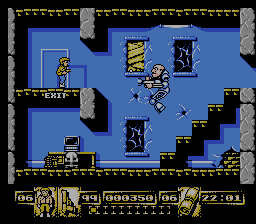
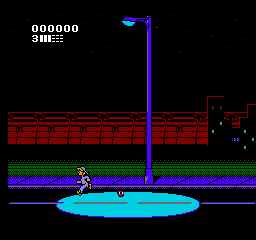
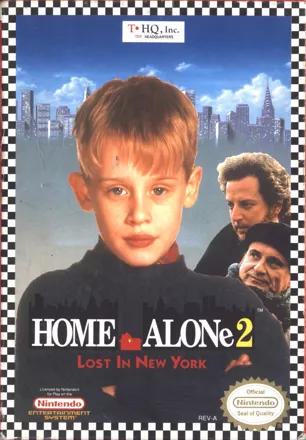
When I am playing a bad game, which seems to be my normal state of existence these days, I often ask myself if it is Ed Wood bad or Coleman Francis bad. Their terrible movies are two sides of the same unfortunate coin. Coleman Frances’ trilogy of movies gave the viewer a glimpse into his dark vision. They are poorly lit movies full of barely speaking characters constantly looking sad. No joy permeates their beings, and since they were mostly shot silently and dubbed in later, they are often not even facing the camera. His movies make me feel sad and empty. That’s how I feel playing a soulless game like Wayne Gretzky Hockey. On the other side of the coin, we have Ed Wood. His movies are equally inept if not more so, but they are also lively and funny. He takes us to bizarre worlds filled with puzzling eccentrics played by actual puzzling eccentrics. I live for this type of bad game, as does just about anyone reviewing old games. Home Alone 2: Lost in New York certainly leans into Ed Wood territory. Although the ineptitude makes me a little bit sad, there’s enough downright strangeness to make it entertaining. This is a weird one.


The original Home Alone on NES is a terrible game in its own right, but I will give it some credit. At least Bethesda only used the part of the movie that works in a game. A game based on eluding burglars in your house makes sense. What doesn’t make sense is spending so much time wandering around in a hotel. A hotel is not automatically a terrible setting for a video game, but I don’t remember Kevin doing much in the actual hotel besides ordering too much room service and annoying Rob Schneider. The developers compensated for this lack of action by making every person and inanimate object act like they have been taken over by evil spirits. There are evil moving suitcases. There are deadly floating brooms. Little old ladies will stomp on your head. Every maid in every open door is waiting to ambush you with killer pillows. It is worked into the plot of the game that everyone is searching for Kevin, but it’s still jarring to see. The movie only has two actual villains, so if you want a more traditional game with challenging levels than you have to pull some enemies out of thin air. The first game wisely avoided awkward levels from the first hour of the movie. They didn’t tack on a grocery store level with Kevin fighting evil cashiers while avoiding floating shopping carts. It’s ironic because the developers of Home Alone 2 wanted to make a more traditionally structured game with normal levels and enemies. Instead everything just feels wrong. The end of the level is the strangest part of all. The boss is an angry chef who you have to slide into until he loses all his clothes. Then he runs away leaving behind his hat which you have to jump on until it turns into a pizza. Collect the pizza and you win. You know, just like in the movie.


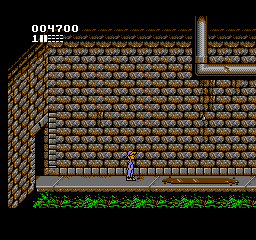
In addition to being strange, the first level is confusing as well. I had to spend way too much time pushing elevator buttons while dodging luggage. There’s no clear indication of what makes the elevator go where it is supposed to, so I kept ending up in the same place. Even if you know what you are doing the first level can take almost half of a playthrough. The rest of the game is faster paced and at least slightly more sensible. I really wish they would’ve kept it weird, because it quickly becomes repetitive. It’s like they went over budget on the first level and had to rush out the rest. Central Park becomes a generic tree-lined street and The Uncle’s Townhouse level is a barren building with the same features over and over. The giant Christmas tree at the end looks fairly nice, but once again the gameplay is a bit awkward. Home Alone 2 either looks decent and plays poorly or looks lousy and plays decently.  


Okay so I’m trying to wrap this review up and tie it back to whatever I was talking about at the beginning, but I still keep wanting to talk about that first level. Did I mention the one couch that bounces you way up into the air when none of the other ones do? There is also a desk clerk who throws generic objects at you until a key falls down. You know what happens if you touch the key? It just hurts you like everything else. It’s just a piece of debris in the midst of a bunch of random blobs. If you stand at the starting point for more than a couple of seconds a bellhop wrings your neck like Homer Simpson. The pillows the maids throw at you have weird red patterns that look like blood. Killer pillows are weird enough, but ones with blood stains are just too much. Also, Kevin can collect a bell that gives him a screw attack ability like Samus in Super Metroid. Does anyone remember the part of the movie where Kevin spins around in the air like a buzz saw? I know that a game doesn’t have to follow the source material exactly, but it’s strange when they take a franchise that is essentially grounded in reality and give the main character superhuman powers, especially when the character is a little kid. How many maids did you kill with your spinning death technique, Kevin? There is blood on your hands.


So, I’m just going to call this one before it gets out of hand. The more I play this game the more I want to talk about how weird it is. The developer, Imagineering, seemed to specialize in mediocre licensed titles, and for about three years they were really cranking them out. It certainly implies a quantity over quality approach. Also, aren’t Imagineers the people who build Disney attractions? They were totally trying to fool people with that name. I had trouble ranking this one because all the THQ games are starting to get clumped together in my brain.  I did like it a little bit better than Wayne’s World, so it’s raising all the way up to #143 just below Burly Men at Sea. Actually, playing all these terrible 8-bit games makes Burly Men at Sea seem much better. Why did I dislike that game so much? Anyway, I think I’m just changing the subject, so I don’t have to talk about THQ anymore. Six of the seven lowest rated NES games are all by the same cursed publisher. Only Bad Street Brawler has the stuff to hang out with the worst of the worst. I only have three more to go, so I don’t think I’m going to lose any more of my sanity, but I really need to play something better when I’m done. Are there any good NES games out there?


NES Quality Percentage: 21/42 or 50%


Wednesday, March 27, 2024

NES #41: Fox's Peter Pan and the Pirates

Developer: Equilibrium

Publisher: THQ

Release Date: January 1991. Dang, just missed Christmas


If nothing else, Fox’s Peter Pan and the Pirates is a good nostalgia bomb. It takes me back to the golden age of weekday cartoons. I was obsessed with cartoons as a kid, so I’m lucky I grew up in the days when regular broadcast tv would show cartoons both in the morning and afternoon on weekdays. Some of the best cartoons from the era were on during weekdays. We got classics like DuckTales, Tiny Toon Adventures, and Batman: The Animated Series. Most of the weekday cartoons had NES counterparts, but of course THQ wasn’t going to get one of the good ones. While most of the big licenses went to Capcom and Konami, THQ was left with one of the worst and least remembered of the early 90s weekday cartoons. I remember that my brother enjoyed the show while I didn’t like it at all. So there was always a bit of conflict of what we were going to watch in the afternoon. We had to alternate days, but if the bus dropped me off too late my parents would let him keep watching Peter Pan and I would get super upset. But I am going to play this game with an open mind even if it does bring up conflicts from the past. Besides, I love playing old video games based on obscure franchises. So, did THQ finally release a game that is at all playable?


(The whole show is Peter getting fooled by grownup tricks)


The answer to that is a relative yes. Before you get too excited, however, be warned that this is not going to break THQ into the good column. However, it is playable, and it feels like a real NES game that some effort was put into. The developers decided to keep it simple and made it a side scrolling action game. The gimmick is that you have to take out a certain number of pirates in every level before reaching the end. I’m so used to avoiding trouble in these old games that I had to remind myself to fight sometimes. There’s not much variety here. There are only a couple different types of pirates, and they either shoot at you or sword fight with you. Still, it’s nice when a game gives you a reason to actually experience the levels. Peter can fly in the game, but his flying power is limited, and restoring items don’t respawn if you die. They compensated by giving Peter a leaping jump that can clear just about any gap. This can still lead to trouble, however. If you die near the end of a level and have already collected all the items, it can be hard to make your way back. It’s not as bad as in Rocky and Bullwinkle, but it’s still annoying when your character’s defining trait is so limited. Of course, in the cartoon Peter’s defining trait was his obnoxious smugness which is almost 100% absent from the game. At least they got something right.

(One thing this game has in common with Citizen Kane is that they both feature pterodactyls) 


Sadly, the laziness shines through if you play Peter Pan long enough. The main problem is the level design. Individually the levels are okay, but there are basically three designs that get reused over and over. And I don’t mean the graphics get reused, but the actual platforms and structures. I can hardly tell the difference between some of them outside of the background colors. The pirates may be in different places, but I certainly got some deja vu playing through it. At least in the first half of the game they alternate between caves and forests. The last three levels, however, are basically identical ship levels. Perhaps they thought five-year-olds in 1991 wouldn’t get that far, but it really is lazy programming. One of my pet peeves in NES games is repetition. It was fairly common for level motifs to get repeated later in games. I don’t know if I’ve ever played another NES game that basically had the same level three times in a row, however. That takes repetition to the extreme. I also dislike how the goal at the end of the ship levels is somewhat unclear. In the earlier levels you just walk to the edge of the screen and the level ends. In the ship levels the edge features the curved front of a ship and a gap in front with open water. What you have to do is stand on the little edge on the front of the ship, but even after I figured this out, I would sometimes miss. You can fall right into a crocodile’s mouth if you’re not careful, and there’s nothing worse in this game than dying right at the end. There are probably no health items left making it very hard to get back. You might as well reset if this happens. If the developers knew what they were doing this wouldn’t have been possible. Sadly, even with a bit more polish than the other THQ games, the cracks still show. This is still lazy shovelware made to promote a lousy cartoon.


(Rendered in beautiful Action 52 Green)


Well Fox’s Peter Pan and the Pirates almost broke the top 100. That’s a minor victory for a THQ game. Of course, the games in the upper half of the list are getting better and better so perhaps the news isn’t quite so bad. On the NES list it is #28 out of 41 which really is the buffer zone between the pretty good and straight up bad. I have one more famously bad THQ game left to review plus a handful of more obscure games, so perhaps I’ll get through this journey with my sanity intact. I just hope the quality percentage doesn’t suffer too much. Hey maybe I’ll go completely off the rails and review LJN games next. I might as well do all the bad game first, right?


NES Quality Percentage: 21/41 or 51.21%


Ranking List.docx