Tuesday, July 9, 2024

Atari 2600 #20: CocoNuts


Developer: Telesys
Publisher: Telesys
Release Date: October 1982
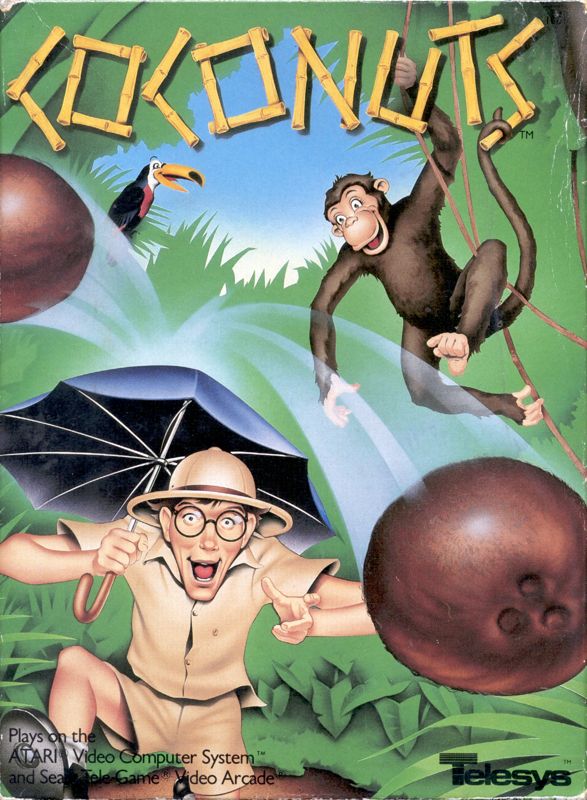


Telesys was one of the many publishers that showed up during Atari's boom years and then completely disappeared. The Atari 2600 existed for almost 15 years and had a very large library of games, but the majority of them came out between 1981 and 1983. In these years third party publishers were sprouting up everywhere and trying to find a gimmick. Telesys decided they were going to make funny games, and you can tell the games were going to be funny just by the names. See, it looks like the game is called coconuts like the tropical fruit, but there's an extra capital letter so it's actually called CocoNuts. Well, that implies this game is actually about mentally unstable people and not tropical fruit. Now that's funny! And just as a bonus it is also about coconuts. Coconuts are by far the funniest drupes. How could a game with such a wacky name not be a total romp? 

Well, the reason for that is because CocoNuts is an Atari 2600 game, and there's just not the processing power for games to be that funny. Oh, people tried, but about the best anyone could do was to make a typical generic blob actually look like something. When Megamania came out it won an award for being the funniest game of the year simply by having the player shoot at telephones and burgers instead of ships. That's about as funny as Atari games could get. Megamania is still a good game though because the developers remembered the gameplay. Fast Eddie was also fun even though its attempts at humor fell a bit flat. Telesys didn't have the talent of Activision or Sirius though, and so CocoNuts ends up being memorable but not particularly playable.
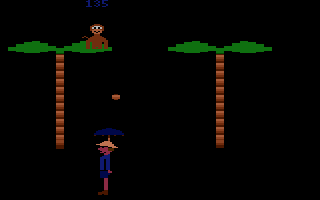


I will admit that it does look funny at firsts. You play as a man wearing both a pith helmet and an umbrella, and the trees look quite nice. The whole object of the game is to avoid coconuts being dropped by a monkey in the trees. If you get hit once you lose your umbrella, if you get hit twice you lose your helmet, and if you get hit a third time it's all over. Atari 2600 has several "avoid the falling objects" games with Kaboom! being most famous. Most of them were twitchy, high-speed paddle games. CocoNuts uses the regular controller and moves much slower. It doesn't even use the button for anything, so the whole game is just moving back and forth. It's easy to tell where the coconuts are going to fall from because they will drop below the monkey, but I still found it challenging. 

The very obvious problem with CocoNuts is that it is extremely repetitive, even by Atari standards. The coconuts get faster, and earning points will eventually earn extra lives, but there's never anything else on the screen. For CocoNuts to work it needed to be exciting to make up for the simplicity. In this regard it fails. Dodging coconuts gets old pretty quick. It might look fun and silly when you first turn it on, but it never changes. Even just having the monkey drop bonus points or objects with different speeds would've been a big improvement. 
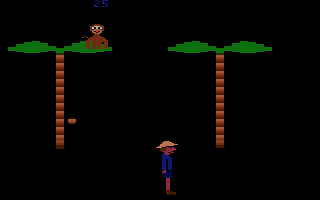


Still, I will admit that I had fun with CocoNuts for a few minutes, so it wasn't a complete loss. I've been reviewing some bad games lately, so it's refreshing having one that goes into the purple okay section. It feels like that hasn't happened in a while. I've ranked some odd Atari games, so it's not even that low on the Atari specific list. Right now, it falls in at #116 on the overall list and 13 out of 20 on the Atari list. If you're a classic game collector you'll probably buy this one for a few dollars because it looks silly, play it for a few minutes, and then put it on the shelf forever. That's the fate that befalls so many Atari games, but there are worse fates for 40-year-old video games. At least it looks good on the shelf.

Atari Quality Percentage 9/20 or 45%


Monday, July 1, 2024

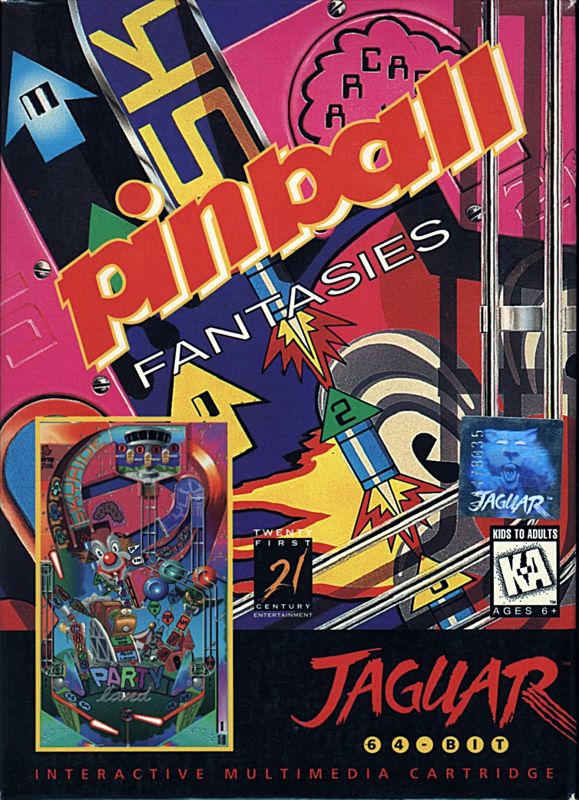
Atari Jaguar #9: Pinball Fantasies


Developer: Spidersoft
Publisher: Computer West
Release Date: June 9, 1995


I love console pinball games, so I decided to check out Pinball Fantasies in order to rehabilitate Atari Jaguar somewhat. It's no secret that the Jaguar has had a very low batting average so far, and I have been focusing on many of the famously bad games because they are fun to write about. I'm still sitting on a few of the stinkers, but it's probably time to diversify and talk about some decent Jaguar games. In many ways Pinball Fantasies is the opposite of the Jaguar's other pinball game, Ruiner Pinball. While Ruiner Pinball featured outlandish effects that could only be done in video games, Pinball Fantasies strives for grounded, realistic play. I like how the two Jaguar pinball games are polar opposites, but I'm not sure which is the winner. Pinball Fantasies is definitely the type of game where there are good points and bad points which I need to be described in review form. Well, it's a good thing I am here then, because that's just what I do.


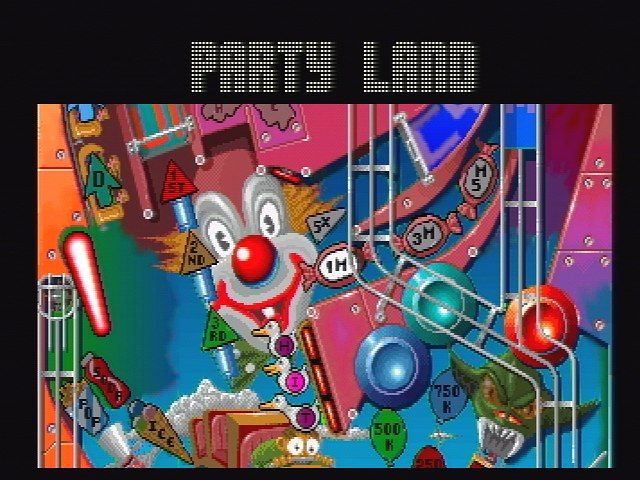
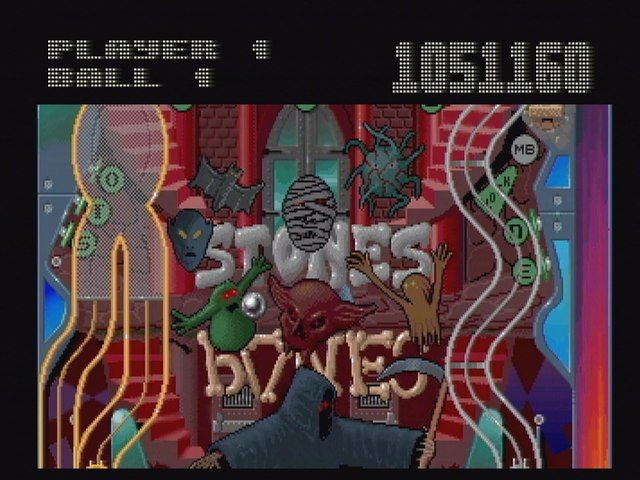
Pinball Fantasies is certainly the more generous of the two games. It has four tables compared to Ruiner's two. They are not officially based on any particular pinball machines, but their themes would be very familiar to anyone who remembers the days before tables were all licensed properties. The themes are amusement park, car racing, cheesy game show, and spooky. I think it's a law that you have to throw in a spooky table in your pinball video game. At the very least it should be. However, the tables are not quite as distinct as they could be. The two tables in Ruiner Pinball look like they could be from completely different worlds, but the tables in Pinball Fantasies all look a bit similar. It's not too egregious, but pinball tables usually feel fairly unique. I'm sure that there are common pieces that get used over and over, but I appreciate the illusion. Still, if I didn't know what any of the tables were called, I would still be able to figure out the themes. So, presentation still leans slightly positive.

The tables do have a bit of sameness to them, but I can't deny that they are fun to play. Pinball Fantasies definitely went for accuracy over frills and for the most part it works. If you are only familiar with modern pinball machines then the ones offered here might seem primitive, but they remind me of some of my favorite mid 80s tables. They are full of ramps and light-up targets. I'm sure I could play each table for hours and hours without doing everything there is to do, and for the most part I would want to. This is a game that I wanted to play more than just for my review. That's a big compliment for a Jaguar game thus far. Considering I could write a whole book about how bad most of these games have been and Pinball Fantasies leaves me at a bit of a loss for words is a good sign. It's a pleasantly bland game. I could see me and my family having a lot of fun with it back in the day. 


I just wish I had more to say about Pinball Fantasies. Jaguar reviews have been some of my favorite to write so far. They are always weird and interesting, and many of the games I have written about so far have been of the hilariously bad type. Funny reviews of poorly made media is what keeps reviewers like me in business. Pinball Fantasies is just a decently made game that I enjoyed. It doesn't stand out, but it doesn't make any serious errors either. I almost hate to say it, but this perfectly normal game is the best one I've played on Jaguar so far. Hopefully something weirder will dethrone it eventually, but every console needs a good comfort game, and on Jaguar I suppose this is it. It's ranking at #75 on the overall list and of course #1 on the Jaguar list. I hope there are some more good Jaguar games, but sadly there aren't any more pinball games. Will they be able to succeed at another genre? Only time will tell. 

Jaguar Quality Percentage: 2/9 or 22.22%


Friday, June 14, 2024

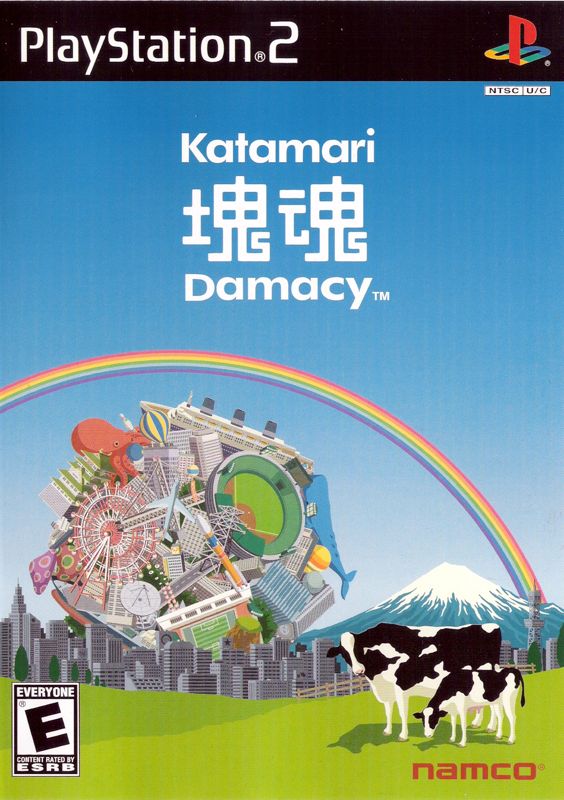
PlayStation 2 #1: Katamari Damacy


Developer: Namco
Publisher: Namco
Release Date: 3-18-2004


`

For as long as Japan had been a major player in the video game industry, there had been attempts to translate their unique sense of humor to American audiences. Many of these games are forgotten curios at best and insulting failures at worst. It's hard to play a game like Panic! and not feel some secondhand embarrassment for Japanese gamers. It's like if the Japanese only knew American humor from Friedberg and Seltzer parody films. You never want to be represented by the lowest of the cultural low. The problem with so many of these early attempts is that "wacky Japanese" was the entire game. Developers thought they could get by on mere curiosity. Luckily, Namco saw things differently. Namco, of course, made some of the greatest games of all time. They brought the world Pac-Man, Galaga, and Dig Dug just to name a few. In fact, my original goal for this blog was to rank all the Namco Museum games from the PlayStation series. That is yet another project I didn't quite finish, but Namco has still been all over my blog from the beginning. So, Namco was the prefect company to bring quirky Japanese humor into the mainstream. I suppose it might be a bit of a stretch to call Katamari Damacy mainstream, but it certainly graduated from cult classic status and spawned numerous sequels and remakes. It also spawned a whole slew of copycats, and much like Tetris many of the copycats are actually good. I don't know if there's a truer measure of success than inspiring good games. Of course, there is probably one more important reason that Katamari Damacy is successful. It is also a whole lot of fun.


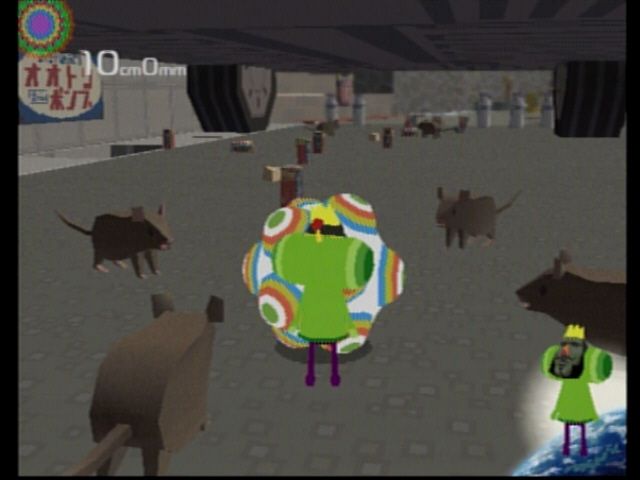
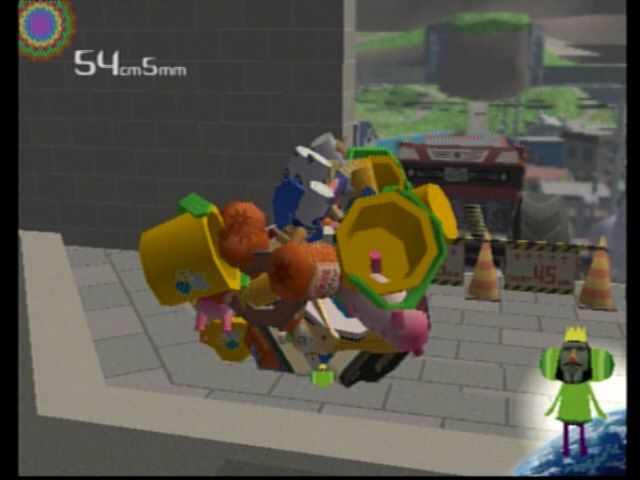
Make no mistake, Katamari Damacy is funny and weird. You can't write about this game without talking about how strange it is. Katamari Damacy is also proudly Japanese. Most of the levels take place in Japanese houses and streets full of local products and objects. They didn't even change the Japanese name. However, if everything in the game was sanded down smooth, and the game was played with circles and blobs it would still be fun. This is thanks to the simple yet addictive goal. You start with something tiny and try to make something huge. In this case you are the Prince of All Cosmos tasked by your father to remake stars. You do so by rolling your sphere, the Katamari of the title, over anything you can find. Any object smaller than your Katamari will stick to it while anything larger will either harmlessly stay put or, in the case of a moving target, knock objects off. Levels will usually have a certain size goal to reach within a time limit, so you spend your time rolling around and getting bigger and bigger. In the beginning you're collecting thumbtacks and mahjong tiles, but by the end you're collecting whole continents. 

It sounds almost too simple, but it's oddly addictive. There's just something about watching your sphere grow. The goals are modest in the beginning, but each level gets bigger. The main challenge comes in finding a logical path through the levels. If you are not careful you can end up in a dead zone without much to pick up. It's also extremely satisfying when a large object you've had your eye on finally becomes collectable. And the levels are absolutely filled with all manner of items to pick up including animals and people. Katamari Damacy manages to keep its light tone even while sending droves of people into the cold vacuum of space to become stars. Of course, much of the humor comes from how oblivious the rest of the world is to what is happening. After the final level there's not much left in the world besides oceans but still nobody seems to care much. It still manages to stay light and fun, and the always increasing growth meant that I never felt like a level was hopeless. I may only be at about 50% with a couple minutes to go, but there's still a chance that I'm going to be picking up skyscrapers. This is gameplay designed by arcade experts. 


Of course, all this rolling can get a bit repetitive. It can be a little tricky when a game only has one goal, but it is still set up in a traditional, level-based way. The classic arcade days were long gone by this point, so it couldn't be a game where you just made a bigger and bigger ball until you died. They try to balance it out by also including levels with different goals. In some you have to roll up specific objects. In others you have to find the largest of a specific object. This is good in theory, but these levels can't actually be lost. Can't lose levels are one of my least favorite video game features. It feels meaningless when the stakes are so low. They could've easily put minimums in these levels and improved things significantly. This also makes Katamari Damacy a very short game, especially by PS2 standards. It can easily be finished in 2-3 hours, and that's a bit brief for a full-priced 21st century game. Of course, you can go back and play the levels again, and you will probably want to for at least some of them, but it's still a bit on the short side. My completion rate for PlayStation 2 is terrible though, so it's nice having some games that are fun and relatively short.  

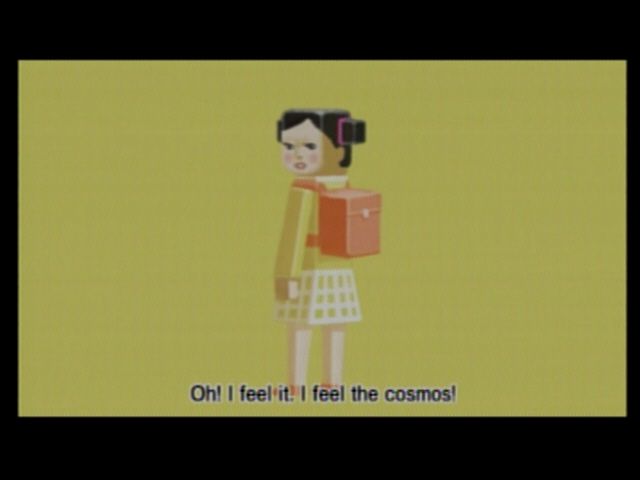
I'm not going to complain too much, however, because it is an entertaining game from start to finish. It is a fun game that is boosted by the presentation. For once, the developers were trying to be funny, and it actually worked. The King of All Cosmos can be dismissive and somewhat cruel to his son, but his dialogue is always funny. The character designs and rainbow motif are fun as well. I'm still singing the wonderfully simple theme song to this day. There is also an oddly animated side story with a pair of kids worried about their astronaut father. In another game it would seem completely out of place, especially considering how fun the story already is. It's a welcome bit of weirdness though, and it makes the game feel even more complete. Is this actually a game about absentee parents disguised as a wacky arcade game? The mere fact that I'm even asking that question shows how well made this game is. Or maybe it just means that I take everything too seriously. Either way, it's a job well done. 


So, my journey into the PlayStation library is off to a good start. Since the first game I'm reviewing is good, I can only assume that all of the 1900 or so games I need to review will also be good. Anyone know if that's true or not? Katamari Damacy ranks all the way up at #25. That's just ahead of the NES version of Galaga, which is another Namco game. Honestly, I wasn't expecting it to rank quite so high. I guess I need to start ranking more of the heavy hitters, but I'm still having fun going slightly more obscure. There will probably be a day when Katamari Damacy isn't even in the top 100, especially if I get desperate for views and start writing about all the Mario and Zelda games. As far as cult classics go though, it's hard to do much better.

Wednesday, June 5, 2024

Atari Jaguar #8: Attack of the Mutant Penguins

Developer: Sunrise Games

Publisher: Atari

Release Date: March 15, 1996


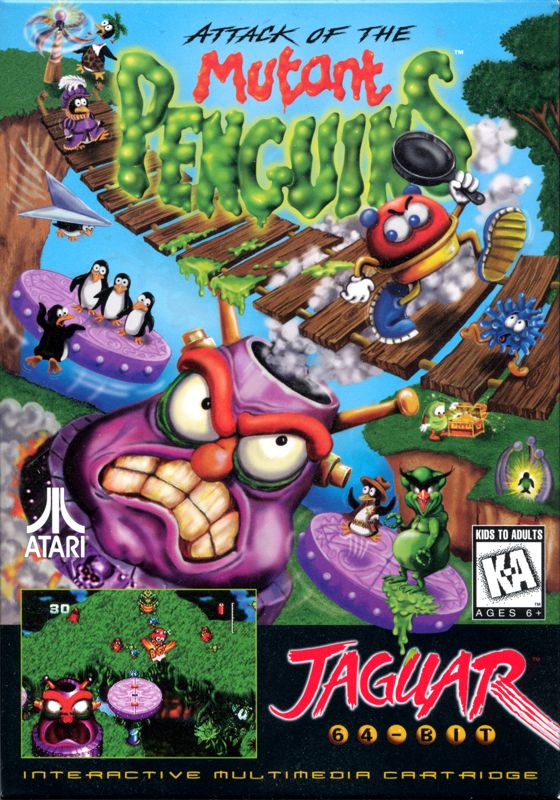
How difficult were things getting for Atari in 1996? They released a game called Attack of the Mutant Penguins. Who wants to play a game called Attack of the Mutant Penguins? That name reeks of desperation. What they want you to think reading a name like that is “this is a fresh and wacky game full of ideas.” But what it actually says is “we wanted Lemmings but couldn’t get it.” I thought of Lemmings so much while I was playing that I just assumed Attack of the Mutant Penguins was an obscure DOS port. One of Atari's main goals was bringing PC games over to console, and I thought by this point they were looking for cheaper, lesser-known titles. But no, it was proposed to Atari after they opened up a European division to produce Jaguar games. Atari had all different companies submit games to them, and Attack of the Mutant Penguins is the one they liked. I would sure love to see some of the failed submissions, because it’s hard to see why Atari thought this was a good idea. The Jaguar was fading fast by this point, and what they saw in this confusing mess is anybody’s guess. Perhaps it sounded better on paper, or maybe Atari realized they couldn’t compete by making games like everyone else and decided to try to invent all new types of games. Well Attack of the Mutant Penguins was not going to come in at the last minute and save the day. I don’t think it’s going to appeal to anyone who doesn’t thirst for penguin blood. This might appeal to an orca, but it’s a hard sell to a human.


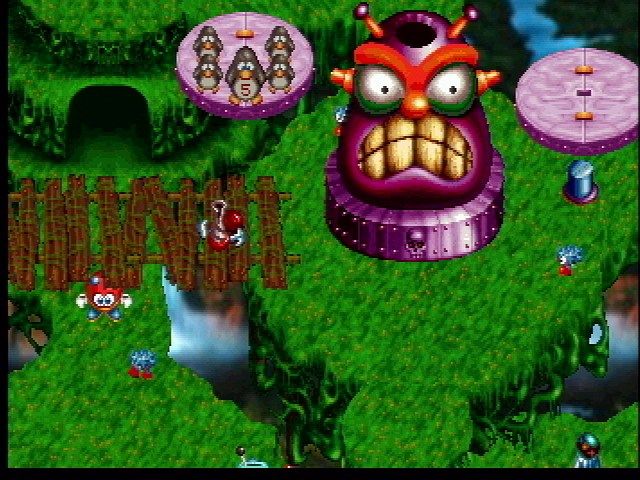
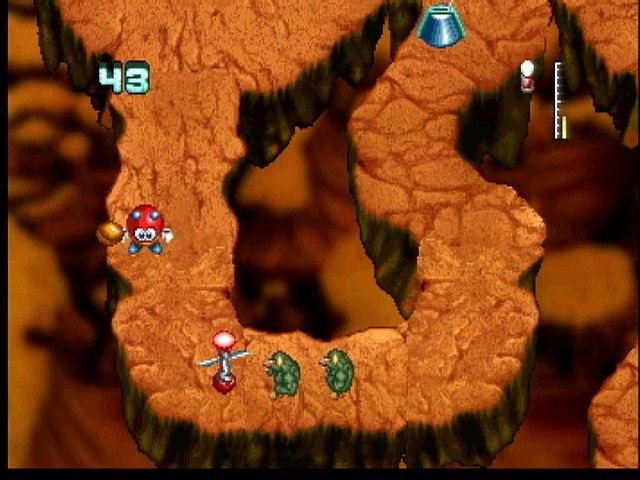
Attack of the Mutant Penguins is a frantic mess disguised as a Lemmings inspired action puzzle game. Lemmings really did try to do for action puzzlers what Tetris did for traditional puzzle games. A whole slew of games popped up in Lemmings’ wake trying to get a piece of that sweet action puzzle money. There were some successful games for PC, but consoles didn’t produce many popular follow-ups. Trying to come up with cute characters, challenging puzzles, and odd, sometimes violent humor wasn’t easy. And it sure wasn’t easy for the developers of Attack of the Mutant Penguins. Where most action puzzle games start you out small, Mutant Penguins plops you down in what feels like the midpoint of the level. Penguins are marching, little blue guys are bouncing around, there’s treasure chests but no keys, and you just know you’re going to have to do many things very quickly. Basically, it works like this: collect the blue guys, use the blue guys to open chests, find letters in the chests that spell out your weapon, hit enough smaller penguins to collect energy, and use your energy shot to destroy the mutant penguins before they tip the scale and outweigh the good penguins. Also, a lot of other things happen that make even less sense.


As you can probably tell, this game is frantic, and I wouldn’t call it frantic in a good way. It’s not an excitingly paced arcade game. It’s a game that is supposed to be about planning and puzzle solving. Those penguins just keep on marching, and I could see this as being a reverse-lemmings that is more about setting traps and disrupting progress. Instead, it’s a game where you just run as fast as you can and hope you find what you need while there’s still time. There’s no time to figure out what everything in the level even does, and it’s very easy to lose without knowing why. Really the whole game goes by without knowing why. I feel like you could play this whole game without explaining any particular action outside of penguin bludgeoning. Frantic is one thing, but Attack of the Mutant Penguins only takes a couple of minutes to become downright annoying. Chests will have items instead of letters in them which are no help at all because there’s not enough time to figure out what any of them do. There will be a set of good penguins to slow down the bad ones, but it’s hard to tell who's who, and they will often go through a zapper that turns them evil anyway. The evil penguins are mostly passive enemies, so the combat isn't even fun. You just stand there and kill them as they walk by. The game gives you clever clues at the beginning of levels just like in Lemmings, but I wasn’t able to get much help from them. The second level is called “A Little Ropey,” but I couldn’t find any use for that rope except to slow me down. “A little ropey” isn’t even a thing people say. Even the clues are random and confusing.


I gave this one my best attempt, but I couldn’t make it past the second level. I can’t tell you if the dynamic changes as you go along, but the basic goal seems to stay the same. There are action-based mini games between the levels which aren't that fun but are a nice change of pace. Also, there is a level select which I believe lets you play any levels you have already completed, so at least you don’t have to start from the beginning after every game over. Attack of the Mutant Penguins is certainly the type of game that only appeals to obsessives and collectors. It marks the beginning of the final wave of Jaguar games which are all rare and obscure. The prices have gone down somewhat in the last year or so, but a copy of this one can still run you about $90 loose. I would say that there are many better things to spend your money on, but of course I have a copy of Attack of the Mutant Penguins. I bought it many years ago, so it wasn't that expensive, but I get it. No judgement here. Just remember that it is as weird and pointless as the title makes it seem.


Ranking Jaguar games is getting a little tricky and not in the way I would like it to be. The bad games are starting to distinguish themselves so much that I really have to sort through the degrees of badness to make my decisions. Attack of the Mutant Penguins is not as offensively bad as the worst Jaguar games, but it's definitely a mile below something like Atari Karts that is boring but sensible as a game. Honestly, I think I'd even rather play Checkered Flag. That game is bad, but I knew I was I was doing and felt accomplished when it was finished. Attack of the Mutant Penguins just leaves me with an empty frustrated feeling. So, it's #6 of eight on my Jaguar list and overall, #137 on the complete list. It's right behind a couple of 2600 games, Pac-Man and Space Jockey, that I at least have some nostalgia for. I try not to rate games by nostalgia, but nobody's perfect. So, it's another loser on Jaguar. At least by the time it came out nobody had any expectations. Jaguar fans were probably playing the last few good releases and hoping that maybe the Jaguar 2 would become a real thing. It didn't of course, but Atari would find a strange new niche in a couple of years when greatest hits compilations would start to become popular on newer consoles. Atari would start to release new versions of old games which is something they would have quite a bit of success with. It didn't work on Jaguar, but the Atari name would be a mainstay on other contemporary consoles. Atari hasn't been a major cultural force since 1983, but I feel like they'll still be around even after cockroaches have died out. Who knows, maybe someday we'll see Revenge of the Mutant Penguins. I wouldn't be a bit surprised. 


Jaguar Quality Percentage: 1/8 or 12.5%


Atari Jaguar Rankings

  1. Ruiner Pinball 

  1. Cybermorph 

  1. Trevor McFur in the Crescent Galaxy 

  1. Atari Karts 

  2. Checkered Flag

  3. Attack of the Mutant Penguins

7.   Club Drive 

8.   Fight for Life 


Thursday, May 30, 2024

Atari Jaguar #7: Checkered Flag

Developer: Rebellion Developments

Publisher: Atari

Release Date: November 1994


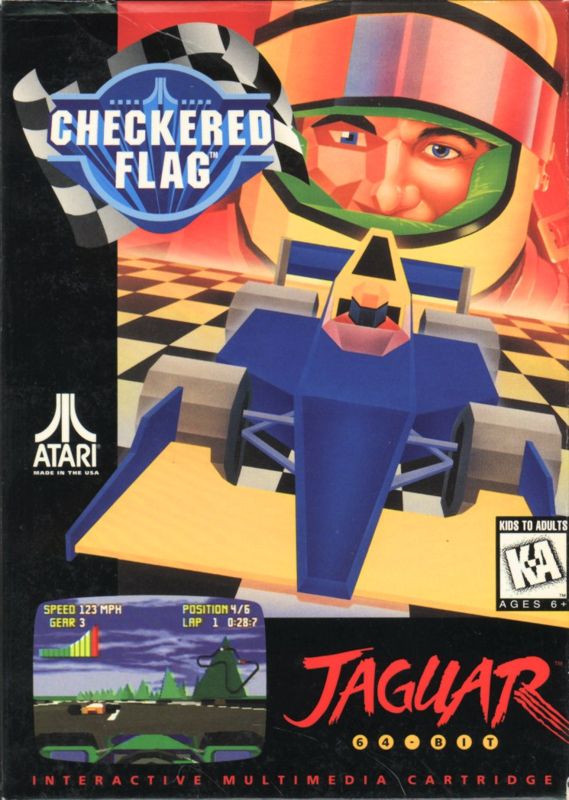
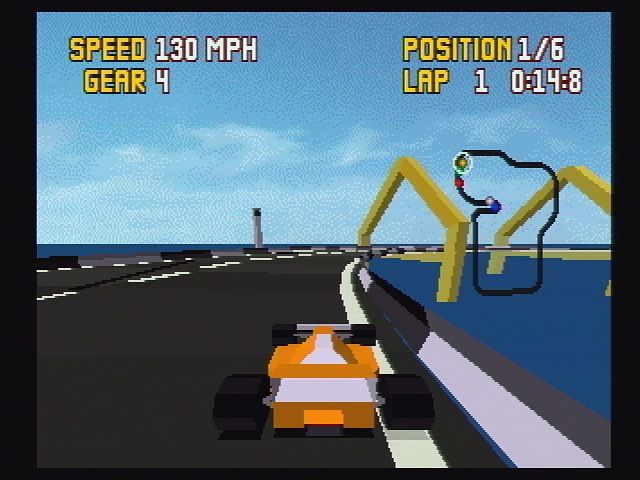
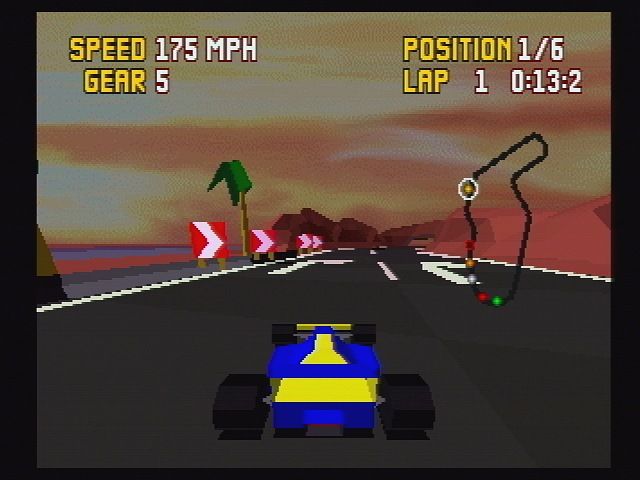
The second half of 1994 saw the Atari Jaguar coming the closest it ever would to being an actual contender. Several of their most high-profile games would be released during this time. They already had Tempest 2000 and Wolfenstein 3D in stores, and they would get other high-profile titles like Alien vs. Predator and Iron Soldier out before the end of the year. However, there were still some very troubling signs. The Jaguar’s soft launch was in November 1993, and the Christmas season of 1994 would be the most prolific time the Jaguar would ever have. Despite the national launch, however, they still only managed to have 17 games out by the end of 1994. That’s not as many games as the NES had on its very first day. It is hard to succeed with such a tiny library of games unless every game is a masterpiece. Nintendo 64 had a similarly tiny library in its early days, but Nintendo still had the SNES and Game Boy to help keep them in the market. Atari didn’t have that kind of safety net and needed to impress with each and every game. So, if they were to release two similarly terrible games at the same time in a month that only saw the release of three games it would be concerning indeed. That’s just what happened when Atari released the twin driving horrors of Club Drive and Checkered Flag. I’ve already written about Club Drive on here. It’s an absolute mess with terrible graphics, bad controls, confusing goals, and ultimately boring gameplay. It fails on ever level. By comparison Checkered Flag looks like a winner. It looks nice and is easy to understand. It’s a real racing game with actual computer opponents. There was even a version released on Atari Lynx a couple of years prior, and that game was pretty good. How could they go wrong with an enhanced sequel? Of course, if you actually play Checkered Flag than you will quickly see how it can all go wrong. Checkered Flag reveals so many of Jaguar’s flaws that it should be called Red Flag instead. It’s an ineptly made racer disguised as an eye-popping next-gen game.  


I’m just going to get right to the flaws this time. Why waste time pretending like this is going to end up as a positive review? Checkered Flag is an incredibly shallow game with some truly awful controls. When you first start up the game you are treated to a menu screen with different categories to adjust However, it’s all just for show. If you’re playing tournament mode all you get is a choice between a red car and a black car. No difficulty settings, no manual transmission, no nothing. Even the most rudimentary racing games will have different cars with their own strengths and weaknesses. In Checkered Flag they’re nothing but weaknesses. If you are going to play Checkered Flag, be prepared to drive into the wall. You will be driving into the wall at practically every turn. I spent a lot of time getting unstuck from the scenery. Not all of the scenery is bad though. Objects on the side of the road like rocks and trees can be driven right through, but structures like bridges and tunnel entrances are like spider webs to bugs. It’s hard not to get stuck on them. Also, if you get too far off the track the game will automatically put you back on the road, but it feels like the time it takes is random. Sometimes I felt like I was put back on instantaneously and sometimes it would put me well behind some of the other cars. It didn’t make much sense. This is bad in a game where it’s so hard to stay on the road in the first place. When I found out that the second race is in the rain, I thought it was all over, but inexplicably the rainy and snowy tracks controlled much better. I think it’s because the top speeds were lower in general on the extreme weather tracks. Have you ever played a racing game where the sunny tracks are slippery, and the icy tracks are smooth? If you play Checkered Flag, get used to experiencing the opposite of everything that should happen.


And the oddest thing is that even with the bad controls, I could often win races by a minute or more. The tournament has to be played through in one long, hour plus slog where all ten races have a ridiculous number of laps. We’re talking about double digit laps. No non-simulation racing game should have that many laps. The computer cars are mindless drones that just drive, usually in one big clump. So, once you’re past the clump of cars you can just drive and drive. They seem to have just as much trouble on curves because even with all the slipping and sliding it’s easy to get way ahead. I actually got a little relieved sometimes when I would get stuck on the scenery, because the thought of a challenging race was exciting. I can’t believe Atari didn’t put a password in this game. Or be like every other racing game and split it up into circuits with saves between them. Beating Checkered Flag was one of the most boring endurance tests I have ever experienced in a video game, but at least I was able to beat it. There’s not that much else to do in the game either. There’s no two-player mode, and you can play individual races with more options, but I don’t think many people are going to torture themselves with more Checkered Flag than what is absolutely necessary. Maybe if this was 1994 and you only had this and Cybermorph to play you might try to put more into it, but I don’t write for time travelers. If this is any year before 2024, please stop reading. I write for people who live in the present, and in the present day there is no reason to play Checkered Flag unless you are a completionist like me.


I know it doesn’t seem like it, but I really do enjoy playing and reviewing Jaguar games. I know it’s been a bit bottom heavy so far, but I want to get some of the lesser titles out of the way before I get to the more prominent titles. I’m not expecting anything great, but maybe it will at least have a 10% good rate before I’m done. Something about Checkered Flag rubbed me the wrong way, and I think most gamers agree this one is a dud. It seems like reviewers wanted the Jaguar to succeed and gave some of the early games overly good reviews. Checkered Flag got some good scores, but the reviewers didn’t have that many good things to say about it. It seems like they had to reach to find the positive, and it mostly came down to speed and graphics. The graphics do look nice, but not good enough to hide the bad gameplay. It’s yet another sub-par Jaguar racing game. Seriously, did they ever release a good one? I’ve still got a few to play so there’s still hope I suppose. I liked it better than Club Drive because at least it feels like a real racing game and the graphics are decent, but it’s still way down at #135 overall. We’ve been seeing a lot of red lately, so hopefully that changes soon. If I want to turn things around, however, I should probably quit playing so many Jaguar games.


Atari Jaguar Quality Percentage: 1/7 or 14.28%


(Images are from mobygames.com)

Tuesday, May 21, 2024

NES #46: The Ren and Stimpy Show: Buckaroo$

Developer: Imagineering

Publisher: THQ

Release Date: November 1993


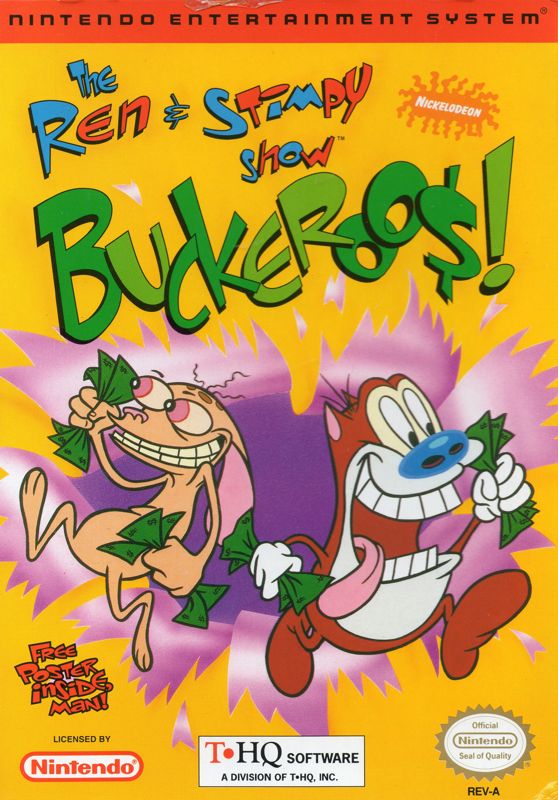
I saved The Ren and Stimpy Show: Buckaroo$ for last for a few reasons. For one thing I didn’t want to type out that clunky title over and over again. It’s just going to be Ren and Stimpy from now on. Also, it’s always a little awkward talking about beloved childhood franchises with problematic creators. And it doesn’t get much more problematic that John Kricfalusi, the creator of Ren and Stimpy. He was gone and then some by the end of 1993, but it’s hard to write about his show without thinking of all the baggage that comes along with it. That’s one of the many difficult things about being an older millennial. You have to spend a lot of time distancing yourself from your childhood heroes. The final reason I saved it for last on my THQ journey is because it is an incredibly late release. I can’t get the exact dates, but it came out the same month as Wayne’s World, which would put them both among the last NES games ever released. November of 1993 would be the last month there would be more than three NES games released. After those six games, NES output would slow down to a trickle. 1994 would see eleven games released in all at ending with Wario’s Woods in December. It would be one last Christmas present from Nintendo for NES fans. I’m oddly fascinated with later releases on consoles, so I was saving Ren and Stimpy for last because I was hoping it would be interesting to talk about. Luckily, I was correct, and this is an interesting game. When I first played it years ago it didn’t impress me much, but maybe I was in a better mood this time around because this may be the best THQ game on the NES.


If you are a Ren and Stimpy fan than you probably expect certain things in a video game adaptation. Most obviously it needs to look good and be weird. There had never been a children’s cartoon quite as strange as Ren and Stimpy. It was also famous for its great animation. For once Imagineering actually delivers, at least as much as they can on the 8-bit NES. Of course we’re not going to get any grotesque freeze frames, but it is colorful and well-defined. It is refreshing after playing so many ugly THQ games to finally get one that is visually interesting. It is also fairly strange. It’s the rare game where I’m not upset to see killer hats and deadly chickens. It’s supposed to be weird, so it makes sense that the enemies would be weird too. Now I wouldn’t say it’s a particularly funny game, but humor was hard on the NES, and it’s probably for the best they didn’t lean into the humor aspect too much. Now I’m trying to think of what the funniest NES game is. Oh, maybe Star Tropics. Yeah, Ren and Stimpy doesn’t make me laugh, but it still manages to feel like the source material.


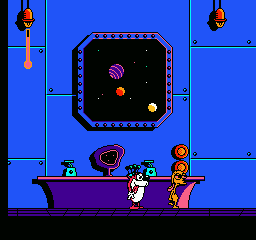
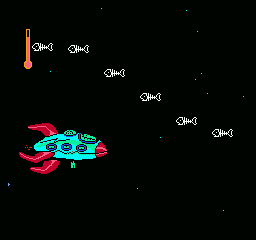
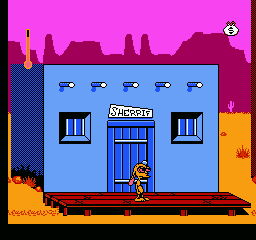
This is, however, a jarring game to play. The levels themselves are fun, but they can sometimes feel like they belong to completely different games. The sudden changes in setting fits with the anarchic spirit of the show, and they are all based on actual episodes, but it can be strange to go from space shooter to wild west side scrolling so suddenly. Thankfully, the levels are designed well enough that it mostly works. The two characters will alternate levels with Stimpy having a projectile weapon but Ren moving faster. Some levels have posters that allow you to switch characters, and I like this system because switching restores your health. This is a strategic move which keeps you from playing as one character for the whole level. Still, it’s much better to end up at boss sections with Stimpy rather than Ren. There are weapons and other powerups to collect along the way, and while they are limited, they tend to be everywhere. I don’t remember many times where I followed a different path and didn’t find an item.


Ren and Stimpy also highlights why it pays to throw in a few continues. This is not an easy game, and I still haven’t been able to finish it. However, it has some continues and fairly easy to collect extra lives. Because of this I was able to experience most of the game without spending a ridiculous amount of time becoming an expert. The levels are fun enough that I want to go back and get better, and it’s forgiving enough that even with eventual permadeath, I didn’t feel that all was hopeless if I made a few mistakes along the way. This is why I can’t stand a game like Swamp Thing being so stingy with its lives. I feel completely hopeless playing such a stingy game, and it makes me not even want to try. It’s not hard to see why this type of challenge was already dying out. It’s no fun only being able to play the first five minutes of a game. I think I’m going to try again with Ren and Stimpy, and I am hopeful that I will eventually finish it.


Of course, seeing so much of the game does highlight its flaws as well. I sound like I’m gushing a bit, but after so many bad THQ games it’s nice to play a decent one. Still, it is merely a good game and not a great one. Ren having no projectile attack is more annoying than I led on before, and he has more solo action levels than Stimpy does. This means I spent more time with Ren’s short-range slap attack than Stimpy’s superior spitball. They should have reversed the setup and had the better attacker do most of the attacking. There are also objects that can take damage but can’t be defeated and this can be annoying. I don’t always know what I can get rid of and what I have to avoid. The thing that leads to the cheapest deaths, however, is the camera’s inability to keep up with a falling character. Ren and Stimpy has many sections that take place in the sky without any clear way down. Sometimes I just have to jump for it, and sometimes my character will fall below the screen and I will die. This can happen even when I know there is solid ground below me. It might be acceptable if this was a design choice, but it’s obviously a bug. There is no fall damage in Ren and Stimpy, so the fall deaths are a case bad programming. Cheap deaths are no fun even with extra continues.


I might sound like I’m overrating this game just a bit, but I’m excited to find an NES game that I actually enjoyed again after so many stinkers. It’s not going to rank too high in the good column, but it’s Super Mario Bros. 3 compared to some of the other THQ games. I’m ranking it at #75 overall which puts it near the bottom of the good section, but it sure is nice to see green again regardless. Hey, I thought it was better than Bible Buffet, so it’s not the lowest ranked good NES game either. It was a pleasant surprise and a nice way to finish my THQ journey. They managed to publish one halfway decent game at the very end of the console’s life. That’s not a very good track record, and I have no idea how they were able to turn this into a long, successful career in the game industry. Perhaps their games get better on the 16-bit systems, but that’s a story for another day. I think it’s time to go down some different paths for a while.


NES Quality Percentage: 22/46 or 47.82%


https://docs.google.com/document/d/1G01RKJ7-caaal5lgFfGgPfZRGcqWlv4E3E2E615UYKg/edit?usp=sharing

Wednesday, May 15, 2024

NES #45: Swamp Thing

Developer: Imagineering

Publisher: THQ

Release Date: December 1992


After so many strange detours, it’s odd to play something from THQ that’s just a regular game. Swamp Thing isn’t bizarrely terrible. It doesn’t try new things and fail. It’s just a typical side-scroller. This is probably the type of game that you’re thinking of when you’re thinking of licensed NES titles. It plays decently, it’s competently made, and it’s completely forgettable. It’s such a typical game that I feel the need to pad out this introduction. I would go into the history of Swamp Thing, but I don’t even know that much about Swamp Thing. I feel like that is a common situation. Most people have heard of Swamp Thing, but few know that much about him. I know that there was a Swamp Thing tv show airing on USA at the time. I also know that there was a long running Swamp Thing comic at the time  which ran for 171 issues and had garnered some acclaim in the mid 80s when Alan Moore was the writer. He was long gone by 1992, but Swamp Thing was still a fairly popular character, so adapting him for an NES game made sense. I could do a whole series on comic book games for NES, because outside of Batman they were pretty dire. Some of the worst games I’ve ever played are NES super hero games. Luckily Swamp Thing doesn’t sink quite so low, but it probably won’t surprise anyone to find out that it’s not a hidden gem either. Still, I think it is slightly better than what most critics say. Maybe that’s just because I’ve been playing so many terrible THQ games. Hopefully I can be objective in my review.


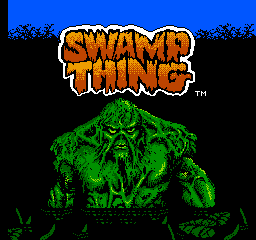
They certainly weren’t counting on people knowing much about Swamp Thing, because the game starts with one of the longest intros I can think of in an NES action game. It really gives you the whole backstory in nice looking but lightly animated scenes. The game itself is pretty standard side-scrolling action. You might even say bog standard. Get it, because it’s Swamp Thing? The first level is a sprawling swamp with the typical NES trappings. Platforms pile up into the sky, so there is some exploring to be done. The ultimate goal is to get to the part of the level where it stops scrolling and walk into the offscreen void, but all the platform jumping is nice for variety. There are projectiles and other powerups to collect, but there’s not that much to find out there. I like how most of the cabins have an endless supply of knives flying out of the door. It reminds me that Swamp Thing is one of those characters who is a hero but seen by normal people as a villain. Of course, these same knives tend to hit me and kill me, but I can still enjoy annoying things.


If you’re wondering why I’m spending so much time describing the first level than let me tell you about the game’s biggest flaw. Swamp Thing is way too hard. There are few lives and no continues, and almost anything that moves is deadly. This might not even be so bad if the levels were shorter, but the first level is so long that traversing it over and over really drains the fun out of the game. The second level makes things even harder by adding bouncy skulls, deadly pits, little demons that are too short to hit, deadly bubbles, and lava pits. Level two is as far as I have been able to get. I’m sorry if this makes me a bad reviewer, but I’m only human. It’s a bit of a shame because the rest of the game at least looks interesting. I like the macabre setting of level three’s graveyard. It definitely doesn’t look like it ever gets any easier though, and of course with a game over I’d have to start all over again. It seems like by 1992 almost every game had at least a continue or two. It’s really a flaw in my book. You don’t have to dumb yourself down too much Swamp Thing, I just want to experience your game.


So, this review is a bit of a short one. And by short I of course mean just about the same length as all my other reviews. Maybe I just mean short in content. There’s just not that much to say about Swamp Thing. It’s a typical 8-bit side scroller that looks fairly nice but is way too difficult. The gameplay isn’t dynamic enough to support the difficulty, so I can’t say I recommend this one. I’ll probably keep trying to play through it, but I’m a masochist who wants to finish every game I encounter. Having said that, however, it’s still one of the better THQ games on NES. I thought it might rise all the way up to the purple section, but instead it’s in the upper part of the bad section at 132. It’s one of the better bad games I have played which has to be good for something I suppose. Thankfully I only have one THQ game to go and then I might take a break from NES reviews for a while. Maybe there’s a good PlayStation RPG out there I can play. That would certainly be a nice change of pace.


NES Quality Percentage 21/45 or 46.66%


Ranking List.docx