Monday, July 29, 2024
Atari 2600 #21: Fast Food
Thursday, July 25, 2024
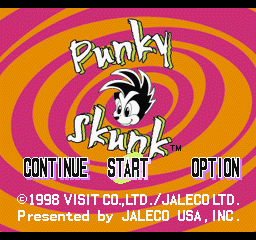
Playstation #3: Punky Skunk
Developer: Ukiyotei
Publisher: Jaleco
Release Date: February 14, 1998
I will always be fascinated by the early days of PlayStation. It came into a world still dominated by Super Nintendo and Sega Genesis trying to succeed where every other disc-based system had failed. Sony had a great strategy of just releasing every kind of game. It was an unprecedented quality and quantity approach that had never really been seen before. No matter what kind of gamer you were there would be something for you on PlayStation. This means that in addition to games like Twisted Metal and Battle Arena Toshinden we also got 16-bit holdovers like Cool Spot and more than one Tiny Toon Adventures game. That's where a game like Punky Skunk fits in. It was the mid 90s so people were still playing character-based side scrollers. Punky Skunk feels like it should've been on an earlier console, but that was nothing unusual for a game released so early during PlayStation's run. It was so early that it was release #409. Wait, that's not an early game at all. That's right in the middle. It came out a couple weeks after Final Fantasy Tactics and just before SaGa Frontier. What's a game like Punky Skunk doing coming out even after Sonic the Hedgehog had started to fade? I need to look this up.
Okay so Punky Skunk was originally meant to be a Super Nintendo game, but the developers started a bit too late and had to move it over to PlayStation. It was released in 1996 in Japan but not until early 1998 in North America. I have no idea why it took so long, but that definitely wasn't in Punky Skunk's favor. Maybe the publisher Jaleco saw the success of Crash Bandicoot and thought that there was still some life in mascot games and so they decided to take a chance on an already made side-scroller. Whatever the reason, Punky Skunk is definitely an oddity in a year that saw PlayStation release some of the greatest games of all time. 1998 was the year of Gran Turismo and Metal Gear Solid. Going forward Sony would certainly encourage more games like those instead of talking skunk games. I suppose it's good to have kid friendly games that aren't based on existing properties, so that's a point in Punky Skunk's favor. But is it actually a quality kids' game?
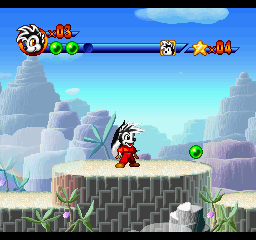
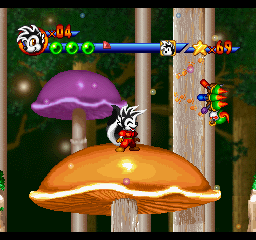
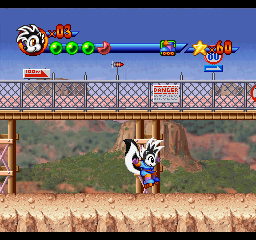
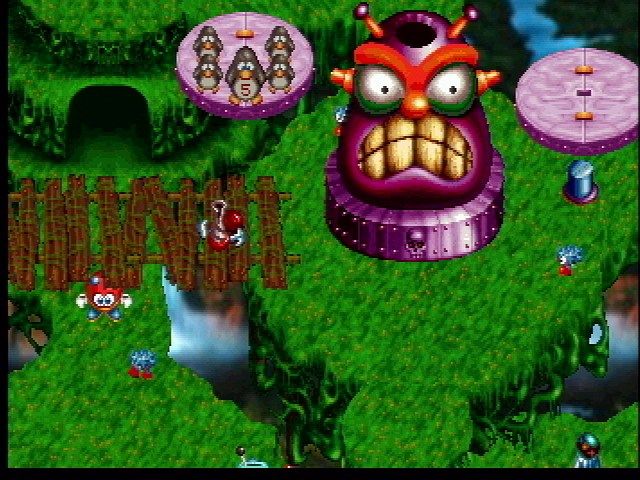
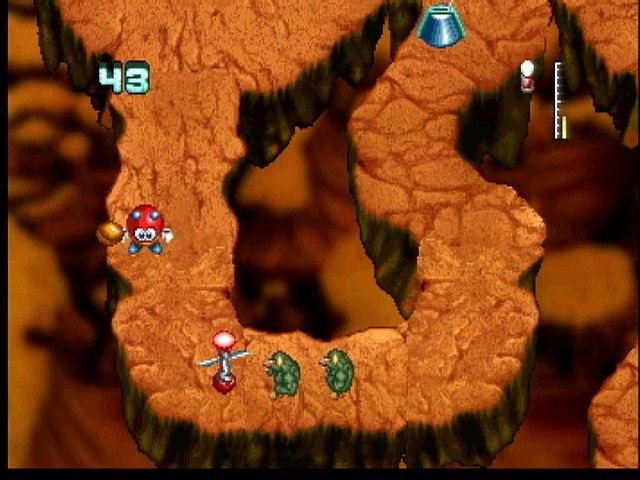
Well, that's hard to say. Punky Skunk is a game of modest pleasures that is mostly fun if you like throwbacks. Of course this is a skunk with an attitude. Of course he attacks by shooting stinky clouds at the enemies. The graphics do not look very good for 1998, but oddly enough they would fit in perfectly in 2024. They just have a wonderful 16-bit look to them. It feels like I'm playing a long-lost PC Engine game. It even has a world map which you know I love. The major gimmick is that Punky can find powerups that give him different abilities. There is a pogo stick that allows him to jump high and a parachute that allows him to glide for example. He can only have one ability at a time, but he can switch between normal attack mode and special item mode. This is important since many of the transformations don't come with an attack. The levels are largely centered around the abilities, but it can still be annoying switching back and forth to avoid damage.
There are a few other annoyances that keep Punky Skunk from being a true winner. The biggest problem is the somewhat bland level design. There aren't that many levels that stick out in my mind after playing them. They mostly boil down to finding the special item and using it to find the end. Many of the early levels are very short. And it's not the type of game that encourages exploration. Most of the items are just for gaining extra lives. It's not the type that encourages going for 100%. There are some mini games that can eventually lead to more hit points, but the game is easy enough that they are purely optional. I wouldn't say it's too easy though. I got some game overs as I played and had to grind for lives a few times. I just with the levels had been designed with a bit more care.
This is one of those situations where the more I thought about the game I was reviewing the more I liked it. I hadn't initially expected to give Punky Skunk a very good review, but its modest charms have won me over somewhat. I think it's been helped by the passage of time. It didn't fit in during PlayStation's heyday, but 25 years later and the charms stand out more than the drawbacks. I can't deny that I had some fun while I was playing it even if I did tend to play it in chunks. I played about a third of it at a time over the course of a few months. That's not the most responsible way to review a game, but it does show that I couldn't quite take myself away from it. I would move on to bigger and better things, but Punky Skunk would always find its way back into my brain.
I am a bit of a failure as a list maintainer. I switched laptops recently, and for whatever reason my list didn't want to come along. If there's anyone out there who knows a good way for me to present it on my blog, please let me know. I haven't made a spreadsheet since my college technology class 20+ years ago, so I don't know what I'm doing. The list does still exist though, and Punky Skunk made it into the green section at #69. I have rated 169 games so far which means there are at least 100 games worse than Punky Skunk. Not bad for a skunk with attitude.
PlayStation Quality Percentage 2/3
Tuesday, July 9, 2024
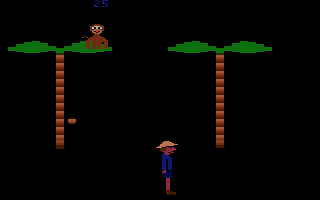
Atari 2600 #20: CocoNuts
Monday, July 1, 2024
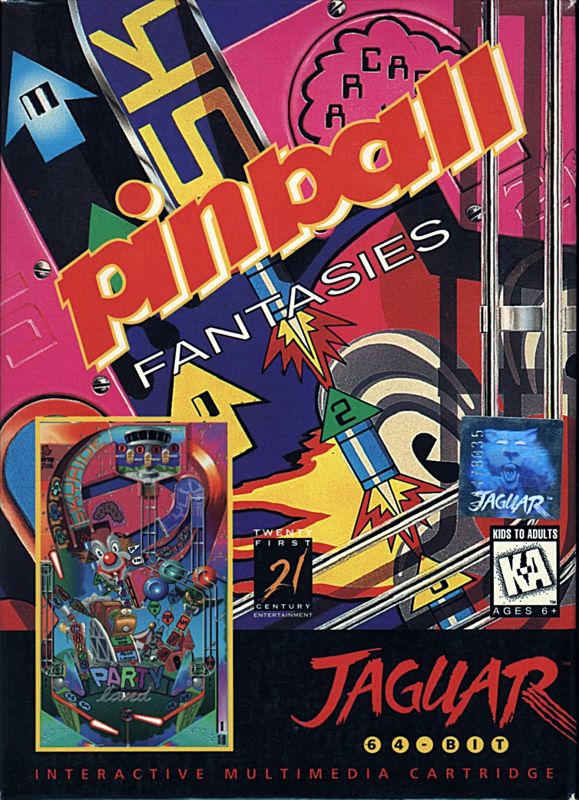
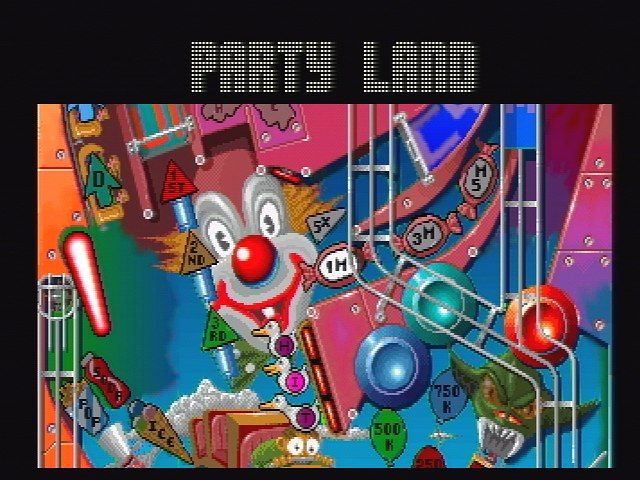
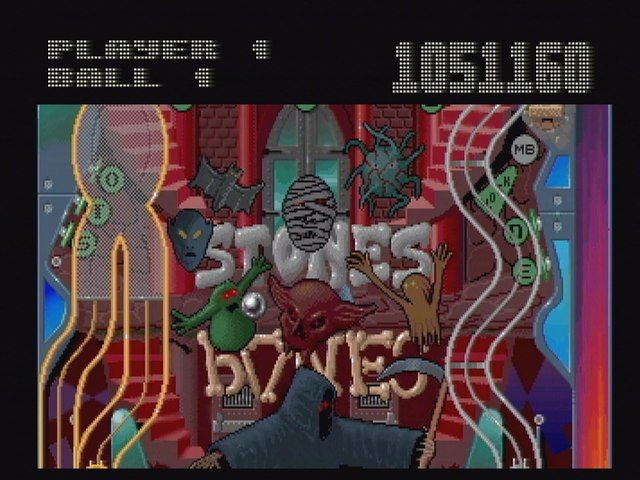
Atari Jaguar #9: Pinball Fantasies
Friday, June 14, 2024
PlayStation 2 #1: Katamari Damacy
Wednesday, June 5, 2024
Atari Jaguar #8: Attack of the Mutant Penguins
Developer: Sunrise Games
Publisher: Atari
Release Date: March 15, 1996
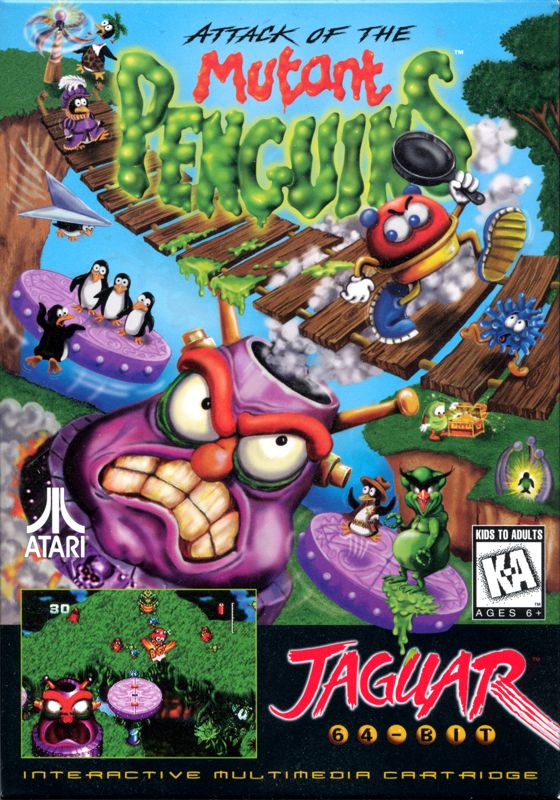
How difficult were things getting for Atari in 1996? They released a game called Attack of the Mutant Penguins. Who wants to play a game called Attack of the Mutant Penguins? That name reeks of desperation. What they want you to think reading a name like that is “this is a fresh and wacky game full of ideas.” But what it actually says is “we wanted Lemmings but couldn’t get it.” I thought of Lemmings so much while I was playing that I just assumed Attack of the Mutant Penguins was an obscure DOS port. One of Atari's main goals was bringing PC games over to console, and I thought by this point they were looking for cheaper, lesser-known titles. But no, it was proposed to Atari after they opened up a European division to produce Jaguar games. Atari had all different companies submit games to them, and Attack of the Mutant Penguins is the one they liked. I would sure love to see some of the failed submissions, because it’s hard to see why Atari thought this was a good idea. The Jaguar was fading fast by this point, and what they saw in this confusing mess is anybody’s guess. Perhaps it sounded better on paper, or maybe Atari realized they couldn’t compete by making games like everyone else and decided to try to invent all new types of games. Well Attack of the Mutant Penguins was not going to come in at the last minute and save the day. I don’t think it’s going to appeal to anyone who doesn’t thirst for penguin blood. This might appeal to an orca, but it’s a hard sell to a human.
Attack of the Mutant Penguins is a frantic mess disguised as a Lemmings inspired action puzzle game. Lemmings really did try to do for action puzzlers what Tetris did for traditional puzzle games. A whole slew of games popped up in Lemmings’ wake trying to get a piece of that sweet action puzzle money. There were some successful games for PC, but consoles didn’t produce many popular follow-ups. Trying to come up with cute characters, challenging puzzles, and odd, sometimes violent humor wasn’t easy. And it sure wasn’t easy for the developers of Attack of the Mutant Penguins. Where most action puzzle games start you out small, Mutant Penguins plops you down in what feels like the midpoint of the level. Penguins are marching, little blue guys are bouncing around, there’s treasure chests but no keys, and you just know you’re going to have to do many things very quickly. Basically, it works like this: collect the blue guys, use the blue guys to open chests, find letters in the chests that spell out your weapon, hit enough smaller penguins to collect energy, and use your energy shot to destroy the mutant penguins before they tip the scale and outweigh the good penguins. Also, a lot of other things happen that make even less sense.
As you can probably tell, this game is frantic, and I wouldn’t call it frantic in a good way. It’s not an excitingly paced arcade game. It’s a game that is supposed to be about planning and puzzle solving. Those penguins just keep on marching, and I could see this as being a reverse-lemmings that is more about setting traps and disrupting progress. Instead, it’s a game where you just run as fast as you can and hope you find what you need while there’s still time. There’s no time to figure out what everything in the level even does, and it’s very easy to lose without knowing why. Really the whole game goes by without knowing why. I feel like you could play this whole game without explaining any particular action outside of penguin bludgeoning. Frantic is one thing, but Attack of the Mutant Penguins only takes a couple of minutes to become downright annoying. Chests will have items instead of letters in them which are no help at all because there’s not enough time to figure out what any of them do. There will be a set of good penguins to slow down the bad ones, but it’s hard to tell who's who, and they will often go through a zapper that turns them evil anyway. The evil penguins are mostly passive enemies, so the combat isn't even fun. You just stand there and kill them as they walk by. The game gives you clever clues at the beginning of levels just like in Lemmings, but I wasn’t able to get much help from them. The second level is called “A Little Ropey,” but I couldn’t find any use for that rope except to slow me down. “A little ropey” isn’t even a thing people say. Even the clues are random and confusing.
I gave this one my best attempt, but I couldn’t make it past the second level. I can’t tell you if the dynamic changes as you go along, but the basic goal seems to stay the same. There are action-based mini games between the levels which aren't that fun but are a nice change of pace. Also, there is a level select which I believe lets you play any levels you have already completed, so at least you don’t have to start from the beginning after every game over. Attack of the Mutant Penguins is certainly the type of game that only appeals to obsessives and collectors. It marks the beginning of the final wave of Jaguar games which are all rare and obscure. The prices have gone down somewhat in the last year or so, but a copy of this one can still run you about $90 loose. I would say that there are many better things to spend your money on, but of course I have a copy of Attack of the Mutant Penguins. I bought it many years ago, so it wasn't that expensive, but I get it. No judgement here. Just remember that it is as weird and pointless as the title makes it seem.
Ranking Jaguar games is getting a little tricky and not in the way I would like it to be. The bad games are starting to distinguish themselves so much that I really have to sort through the degrees of badness to make my decisions. Attack of the Mutant Penguins is not as offensively bad as the worst Jaguar games, but it's definitely a mile below something like Atari Karts that is boring but sensible as a game. Honestly, I think I'd even rather play Checkered Flag. That game is bad, but I knew I was I was doing and felt accomplished when it was finished. Attack of the Mutant Penguins just leaves me with an empty frustrated feeling. So, it's #6 of eight on my Jaguar list and overall, #137 on the complete list. It's right behind a couple of 2600 games, Pac-Man and Space Jockey, that I at least have some nostalgia for. I try not to rate games by nostalgia, but nobody's perfect. So, it's another loser on Jaguar. At least by the time it came out nobody had any expectations. Jaguar fans were probably playing the last few good releases and hoping that maybe the Jaguar 2 would become a real thing. It didn't of course, but Atari would find a strange new niche in a couple of years when greatest hits compilations would start to become popular on newer consoles. Atari would start to release new versions of old games which is something they would have quite a bit of success with. It didn't work on Jaguar, but the Atari name would be a mainstay on other contemporary consoles. Atari hasn't been a major cultural force since 1983, but I feel like they'll still be around even after cockroaches have died out. Who knows, maybe someday we'll see Revenge of the Mutant Penguins. I wouldn't be a bit surprised.
Jaguar Quality Percentage: 1/8 or 12.5%
Atari Jaguar Rankings
Ruiner Pinball
Cybermorph
Trevor McFur in the Crescent Galaxy
Atari Karts
Checkered Flag
Attack of the Mutant Penguins
7. Club Drive
8. Fight for Life
Thursday, May 30, 2024
Atari Jaguar #7: Checkered Flag
Developer: Rebellion Developments
Publisher: Atari
Release Date: November 1994
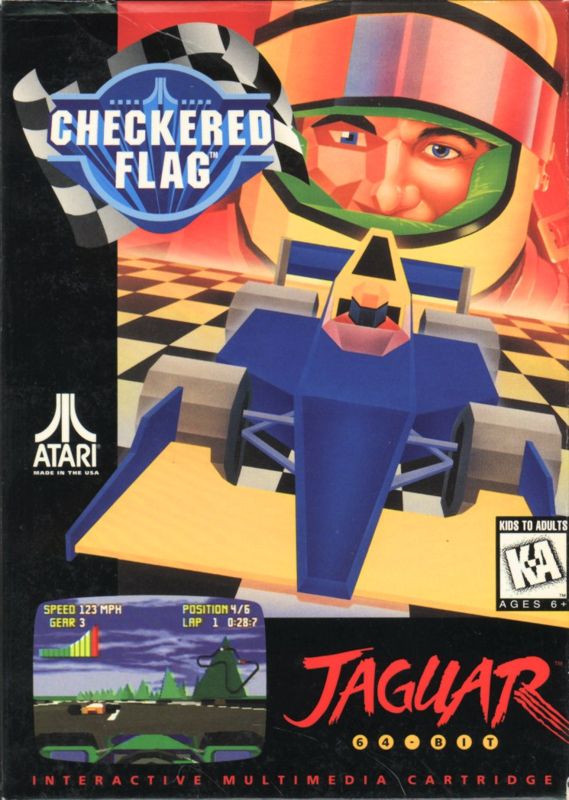
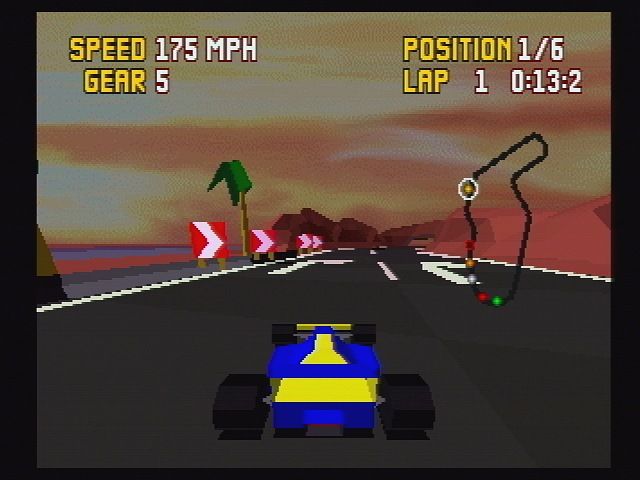
The second half of 1994 saw the Atari Jaguar coming the closest it ever would to being an actual contender. Several of their most high-profile games would be released during this time. They already had Tempest 2000 and Wolfenstein 3D in stores, and they would get other high-profile titles like Alien vs. Predator and Iron Soldier out before the end of the year. However, there were still some very troubling signs. The Jaguar’s soft launch was in November 1993, and the Christmas season of 1994 would be the most prolific time the Jaguar would ever have. Despite the national launch, however, they still only managed to have 17 games out by the end of 1994. That’s not as many games as the NES had on its very first day. It is hard to succeed with such a tiny library of games unless every game is a masterpiece. Nintendo 64 had a similarly tiny library in its early days, but Nintendo still had the SNES and Game Boy to help keep them in the market. Atari didn’t have that kind of safety net and needed to impress with each and every game. So, if they were to release two similarly terrible games at the same time in a month that only saw the release of three games it would be concerning indeed. That’s just what happened when Atari released the twin driving horrors of Club Drive and Checkered Flag. I’ve already written about Club Drive on here. It’s an absolute mess with terrible graphics, bad controls, confusing goals, and ultimately boring gameplay. It fails on ever level. By comparison Checkered Flag looks like a winner. It looks nice and is easy to understand. It’s a real racing game with actual computer opponents. There was even a version released on Atari Lynx a couple of years prior, and that game was pretty good. How could they go wrong with an enhanced sequel? Of course, if you actually play Checkered Flag than you will quickly see how it can all go wrong. Checkered Flag reveals so many of Jaguar’s flaws that it should be called Red Flag instead. It’s an ineptly made racer disguised as an eye-popping next-gen game.
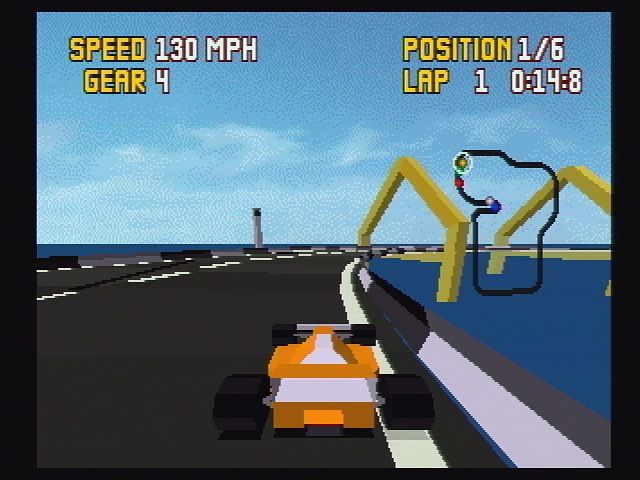
I’m just going to get right to the flaws this time. Why waste time pretending like this is going to end up as a positive review? Checkered Flag is an incredibly shallow game with some truly awful controls. When you first start up the game you are treated to a menu screen with different categories to adjust However, it’s all just for show. If you’re playing tournament mode all you get is a choice between a red car and a black car. No difficulty settings, no manual transmission, no nothing. Even the most rudimentary racing games will have different cars with their own strengths and weaknesses. In Checkered Flag they’re nothing but weaknesses. If you are going to play Checkered Flag, be prepared to drive into the wall. You will be driving into the wall at practically every turn. I spent a lot of time getting unstuck from the scenery. Not all of the scenery is bad though. Objects on the side of the road like rocks and trees can be driven right through, but structures like bridges and tunnel entrances are like spider webs to bugs. It’s hard not to get stuck on them. Also, if you get too far off the track the game will automatically put you back on the road, but it feels like the time it takes is random. Sometimes I felt like I was put back on instantaneously and sometimes it would put me well behind some of the other cars. It didn’t make much sense. This is bad in a game where it’s so hard to stay on the road in the first place. When I found out that the second race is in the rain, I thought it was all over, but inexplicably the rainy and snowy tracks controlled much better. I think it’s because the top speeds were lower in general on the extreme weather tracks. Have you ever played a racing game where the sunny tracks are slippery, and the icy tracks are smooth? If you play Checkered Flag, get used to experiencing the opposite of everything that should happen.
And the oddest thing is that even with the bad controls, I could often win races by a minute or more. The tournament has to be played through in one long, hour plus slog where all ten races have a ridiculous number of laps. We’re talking about double digit laps. No non-simulation racing game should have that many laps. The computer cars are mindless drones that just drive, usually in one big clump. So, once you’re past the clump of cars you can just drive and drive. They seem to have just as much trouble on curves because even with all the slipping and sliding it’s easy to get way ahead. I actually got a little relieved sometimes when I would get stuck on the scenery, because the thought of a challenging race was exciting. I can’t believe Atari didn’t put a password in this game. Or be like every other racing game and split it up into circuits with saves between them. Beating Checkered Flag was one of the most boring endurance tests I have ever experienced in a video game, but at least I was able to beat it. There’s not that much else to do in the game either. There’s no two-player mode, and you can play individual races with more options, but I don’t think many people are going to torture themselves with more Checkered Flag than what is absolutely necessary. Maybe if this was 1994 and you only had this and Cybermorph to play you might try to put more into it, but I don’t write for time travelers. If this is any year before 2024, please stop reading. I write for people who live in the present, and in the present day there is no reason to play Checkered Flag unless you are a completionist like me.
I know it doesn’t seem like it, but I really do enjoy playing and reviewing Jaguar games. I know it’s been a bit bottom heavy so far, but I want to get some of the lesser titles out of the way before I get to the more prominent titles. I’m not expecting anything great, but maybe it will at least have a 10% good rate before I’m done. Something about Checkered Flag rubbed me the wrong way, and I think most gamers agree this one is a dud. It seems like reviewers wanted the Jaguar to succeed and gave some of the early games overly good reviews. Checkered Flag got some good scores, but the reviewers didn’t have that many good things to say about it. It seems like they had to reach to find the positive, and it mostly came down to speed and graphics. The graphics do look nice, but not good enough to hide the bad gameplay. It’s yet another sub-par Jaguar racing game. Seriously, did they ever release a good one? I’ve still got a few to play so there’s still hope I suppose. I liked it better than Club Drive because at least it feels like a real racing game and the graphics are decent, but it’s still way down at #135 overall. We’ve been seeing a lot of red lately, so hopefully that changes soon. If I want to turn things around, however, I should probably quit playing so many Jaguar games.
Atari Jaguar Quality Percentage: 1/7 or 14.28%
(Images are from mobygames.com)