Tuesday, September 10, 2024

Atari 2600 #23: Demolition Herby


Developer: Telesys

Publisher: Telesys

Release Date: 1983
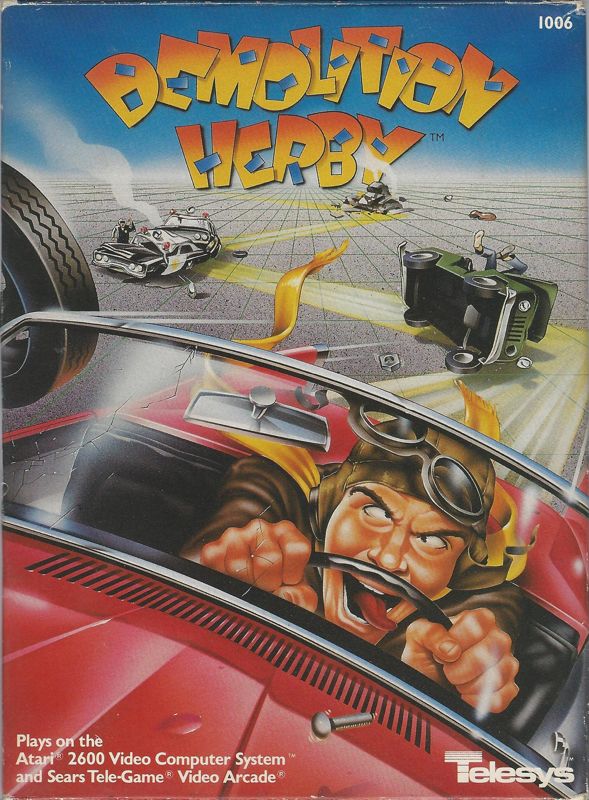


Telesys pivoted very quickly from their original strategy of doing uniquely funny games. That's not necessarily a bad thing considering the quality of their first three. Instead, they decided to go with the strategy of so many third-party publishers and just copy an already popular arcade game. The game in question is Amidar. Although not as remembered as some of the other arcade greats, Amidar was one of Konami's most popular and influential early games. It's a Pac-Man influenced game that has the player moving around a grid while collecting dots and filling in squares. It's an addictive game that launched its own subgenre of grid capture games. Pepper II for Colecovision is an excellent example. Atari 2600 saw several variations on the grid capture formula including an official version of Amidar released by Parker Brothers in November of 1982. MobyGames has the release date for Demolition Herby as February of 1983. That certainly sounds like they were trying to cash in on a trend. Thankfully Demolition Herby isn't an exact clone. It makes some changes to the formula which are both positive and negative. At least it keeps up with the Telesys trend of having a funny title, and Don Ruffcorn even used his full name. That's already two points in its favor. Well, metaphorical points anyway. I am not going to start doing a point system for these reviews. 
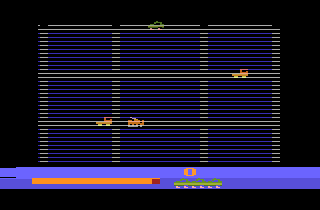


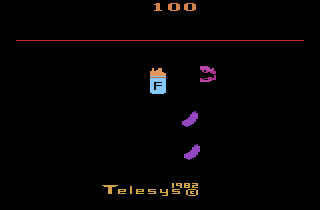
The biggest difference between Demolition Herby and Amidar is the speed. Amidar is surprisingly slow even in its arcade incarnation. It's a game more about careful planning than twitchy reflexes. Demolition Herby ramps up the speed to an almost frantic pace. The dots are gone making Demolition Herby much more about escaping from danger. You play as the titular Herby being chased by other cars on a perfectly rectangular grid. The goal is to fill in rectangular sections of the grid by driving over all four sides. There are no power-ups to fight off enemies with, but holding down the button will make Herby move even faster. The catch is that turbo mode won't fill in squares and fuel drains faster. If you run out of fuel, you lose a life. The only way to regain fuel is to fill in grid sections. You get a bigger bonus if you fill in two squares at once, and this is basically the whole goal of the game. I appreciate the extra speed, but there is a problem with the design.


Demolition Herby is fast, but this necessitates a somewhat tedious design. Usually, grid capture games will have more varied and interesting maps. Amidar features rectangles of all different sizes and multiple screens. The more varied gameplay helps keep things from geting boring. Demolition Herby features the same shapes set up in the same way forever. This caused me to play every section of every level in basically the same way. Sure, there are enemies to avoid, but they feel more like nuisances than challenges. You can't really do much with them, just speed away. I wish there was some sort of powerup that allowed me to attack the enemies. The games needs about 50% more demolition and 50% less Herby. Alright, so maybe I don't actually have a problem with the amount of Herby. I just want some more variety.
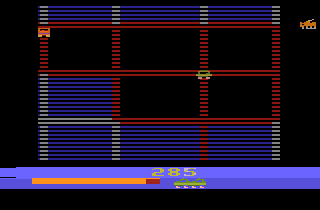


I know that all the Telesys games have been inspired by other games so far, but Demolition Herby is the one that can't hide behind quirky originality. Cosmic Creeps stood out as an original game despite it being mostly a Space Invaders clone. Demolition Herby is a better game than Cosmic Creeps, but the inevitable comparisons to Amidar make the flaws really stand out. I had some fun playing Demolition Herby, but it was a fun that didn't last very long, and I don't think this is a game I am going to take out and play very often when I get the urge to play Atari. Honestly, I liked Fast Food just a little bit better because it was so distinct and had fun graphics. It's that classic battle of burgers vs rectangles. It comes up a lot, but burgers win every time. In this case it's more of a moral victory since they're both stuck in the purple section. They're a couple of middling games coming in at 107 and 108 overall. I can't say what people were doing on Saturday afternoons in 1983 because I wasn't born yet, but I bet there were better things to do than play Demolition Herby. 

Atari Quality Percentage: 9/23 or 39.13%

Thursday, August 22, 2024

Atari 2600 #22: Cosmic Creeps


Developer: Telesys
Publisher: Telesys
Release Date: 1982


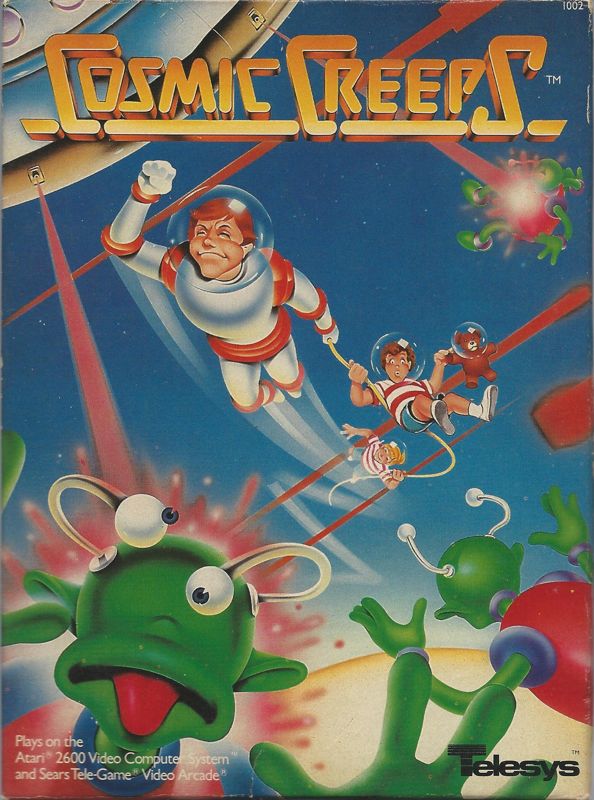
(At least it has A+ box art)


Oddly this is the second Atari 2600 game I've written about so far that has the word Cosmic in the title and is about futuristic mass transit. That's not something I would have expected. It's not like the word cosmic automatically implies futuristic space busses. Hopefully the other cosmic Atari games explore some different themes. I think I still have about a half dozen to play. Initially I wrote about Cosmic Commuter, which is a game that I played even before I had my own Atari 2600 and therefore has some nostalgia attached to it. For that reason, Cosmic Creeps will always feel like the copycat. That may be a little bit unfair considering Cosmic Creeps is older, but it's hard to top Activision. Actually, Cosmic Creeps is hard to date exactly, and this is one of the things that makes writing about Atari difficult. Nobody was paying that much attention at the time, and so many game companies were gone without a trace before reviews could even appear. I've looked at several sources and they all seem to give different dates for the release of the Telesys games. They might've been released in one big chunk at the end of 1982, or they could've trickled out into 1983. Cosmic Creeps is probably the third game they released, but the serial number implies that it was the second they started working on. I can say that the first three (CocoNuts, Fast Food, and Cosmic Creeps) are very common while the last three (Ram It, Stargunner, and Demolition Herby) are all fairly rare. I'm guessing their first three games didn't sell as well as they expected so they had to cut back on production for the last three. Games like Cosmic Creeps probably didn't give consumers much hope, either. The credits also imply that Cosmic Creeps wasn't thought of very highly. Don Ruffcorn is credited with designing three Telesys games. The other two games have his full name in the manual. In Cosmic Creeps he is cryptically credited as Donyo. I have a feeling this was an Alan Smithee situation, and he was trying to distance himself from the game. There's no way to know for sure, but after playing Cosmic Creeps I can see why it could be true. 


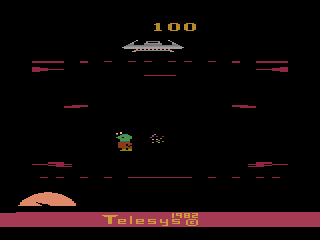
(Putting their name at the bottom of the screen is a good early example of "not the flex you think it is")


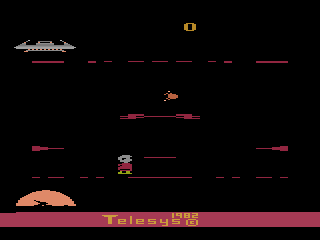
Cosmic Creeps is one of those boring Atari games that also doesn't make much sense. If you were to get this game in the wild and try to play it, you would probably die over and over again without accomplishing anything. Of course, you won't feel that accomplished after you have figured out how to play it either, but I'm not going to worry about that too much. I think the developers made it strange to hide the fact that it's very boring to actually play. I call this the Donyo Effect. The game consists of two screens. On the first you have to race from the bottom of the screen to the top while avoiding ambiguous space stuff. Third party games got really random with their graphics sometimes. This part can be tricky because you, the player, are in control. You control when the character pops onto the screen. Be careful because if you push up on the controller you will touch a red barrier and float away forever. It took me a while to figure out that the moving planet on the bottom of the screen determines where the character would pop up. It can still be tricky because sometimes there are tiny bits of red that are easy to miss, and there are also what appear to be comets flying by. However, complete your arduous trek to the spaceship at the top of the screen and you are rewarded with a very appropriate prize: nothing whatsoever. That's right, you earn no points for completing the first half of the game. That is pure laziness during an era where high scores were everything. Would it have been so hard to include a timed bonus or even a preset number of points? Even just an arbitrary 100 points would've been somewhat satisfying. This screen is confusing, overly difficult, and pointless both figuratively and literally. 


(Maybe it's called Cosmic Creeps because of the way the aliens slowly creep up the screen)

The second section of the game is where the action is because it actually lets you shoot at something and earn points. It now plays like a stripped-down Space Invaders with a couple of aliens chasing after a child moving up the screen. If the child makes it to the ship without being captured by the alien or taken out by friendly fire, then you get 1500 points. Don't worry though. If you accidentally shoot one of the space children, they are merely "bopped". I'm not sure what that means, but at least the people who wrote the manual cared enough to make sure their video game didn't have you unintentionally murdering children. This part could be fun if there was a bit more to it. The aliens don't do anything except move up the screen, and they are large targets. I had to make myself not shoot at them to see what would happen if they made it to the top. My game was over, but it never happened organically. I just stayed in one spot and shot aliens until time ran out. I must've done something wrong though because the manual says the game continues if you get 5000 points before the sun sets, but I achieved that almost every time I played, and it was still game over. I tried to find a YouTube playthrough but of course they all last about three minutes and don't help much. I know it must be true because the Twin Galaxies high score is over 180,000 points. I don't know if I'm doing something wrong, but I could never get a game to last longer than that single round. I didn't really mind my game ending though, because I couldn't really see it getting much more fun. The manual states that there are never more enemies on the screen, so all they could do is get faster. That's not much of an extra challenge.

So Cosmic Creeps is a dud. The premise isn't terrible, but they took the easiest path in both sections. The first section is completely pointless, and the second is boring. It quickly becomes a game of staying in one spot and shooting a lifeless alien. Space Invaders was already five years old by the time Cosmic Creeps came out, and even the Atari version had a whole screen full of ships that actually shot at the player. Instead of adding to the Space Invaders formula, Cosmic Creeps subtracts almost everything. It's a dull game. In fact, it is so dull that it is going to make apologists happy. It's going into the subset of Atari games that are worse than E.T. It's the third one so far, but it is the first I have ranked that was widely released in the United States. Inca Gold and Birthday Mania are much worse, but I highly doubt anyone in the U.S. had played them in the pre-emulation days. So, fear not E.T. fans. You can at least tell younger generations that Cosmic Creeps was a real game that was worse. For those keeping score at home, it is 152/171 on the overall list and 20/22 on the Atari 2600 specific list. Maybe Telesys should just stick with arcade clones and space shooters. Those are usually successful. 

Atari 2600 quality percentage: 9/22 or 40.9%

Monday, July 29, 2024

Atari 2600 #21: Fast Food

Developer: Telesys
Publisher: Telesys
Release Date: October 1982


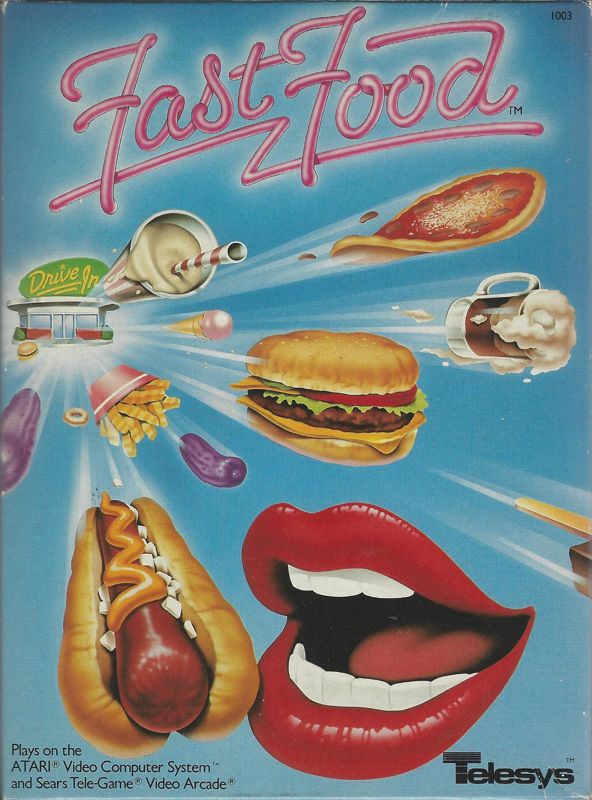
Fast Food is certainly a good example of what the company was trying to be. It's another funny game with an even more ridiculous cover than CocoNuts. There's just something undeniably fun looking about it. Look at all that food flying around! Look at those disembodied lips which remind me of old Twizzlers ads! Look at that decidedly car-less drive-in! If I had seen this one at a store in 1982, I might've bought it just because it looked like so much fun. I mean, I did see it on a store shelf at some point and buy it, but I would buy any Atari game as long as it's not too expensive. I have no idea who did the cover art for Telesys, but I hope they survived the game crash and had a long career. For all I know they really did make those Twizzlers ads. It's a shame we never really know these things. Telesys was founded by a man named Richard Taylor, and that's such a common name that MobyGames has over 700 of them in their database. That's not very helpful from a research perspective. I did find a picture of him in a vintage magazine article that also referred to Telesys games as "funny." I guess they don't really look that much different in 2024 than they did in 1982. 

(The legend himself!)

I would say that Fast Food is about as simple as it gets, but I've played CocoNuts. Fast Food is at least more complicated than that. It's a very simple premise that you might be able to glean from the cover art. You are a disembodied mouth trying to eat all of the flying food you possibly can. Fast Food ups the ante by allowing you to move vertically as well as horizontally. It's hard to get away with horizontal-only motion unless you are Space Invaders or Galaga, so it's nice that they only tried that experiment once. The only thing you are not supposed to eat are the purple pickles. Eat too many of them and its game over. Hey, you don't have to tell me twice. I can't say I've ever seen anything tubular and purple and wanted to eat it. The different types of food only move in straight lines, but they are worth different amounts of points and travel at different speeds. I appreciate the attempt at variety, but I don't see anyone strategizing in this game. They are just going to catch whatever they can. It gets frantic fast. Every so often the screen says, "You are getting fatter" and then everything speeds up. It's a shame they couldn't animate the fattening, but the fine folks at Telesys weren't exactly miracle workers. 


(I hope you weren't expecting anything else. This is just a one screenshot kind of game)

I'm going to sound like a broken record here, but the problem with Fast Food is the same one that plagued Atari 2600 games in general. It's just too simple for extended play. My games always last around the same amount of time, and I almost always get close to 1000 points. Those purple pickles start coming on fast, so even when I start out well everything goes downhill quickly. It's just hard to avoid the inevitable when everything starts moving so fast. I'm not going to be leaving behind a worse food item for a better one because there just isn't time for it. I don't know what anything is worth, and I don't really care. I'm just trying to avoid purple pickles.  

And this is going to sound like a weird complaint, but I can't get over how weird the smacking mouth in this game looks. I get that they wanted to animate something because that was always impressive in the early 80s, but that thing doesn't look anything like a real mouth. You would expect some teeth or a tongue, but those red fleshy masses barely even look like lips. They look more like two tongues covered in bubble gum flapping against each other. Or perhaps a toothless mouth covered in denture cream trying to open and close. It's shown from an odd side view which doesn't work at all. They should've done a front view and had the teeth opening or closing. Honestly a non-moving mouth would've been preferable. It's better than having what looks like two uncooked burger patties kissing. 

While definitely an improvement over CocoNuts, Fast Food is still a middle of the road Atari 2600 game. I have a little fun with it from time to time, but only being a little fun does not make a game actually good. Atari games can be thrilling and addictive, but Fast Food gets a little old after a few minutes. I can see why companies like Telesys failed so quickly. Video games were much more expensive at the time adjusted for inflation. Getting a new Atari game could run you something in the equivalent range of 80 or 90 dollars. That's a big investment for something you're going to get bored with in five minutes. I doubt any of the fringe 3rd party companies had any major hits because it was just too expensive. Luckily, this is 2024 where you can get Fast Food for only ten dollars. That's a fair price for a game based on poorly animated mouths and flying pickles. Fast food ranks at #107 overall which puts it right in the middle of the Atari section. Most Atari games in the purple section are worth playing for enthusiasts, so I'd call that a victory for now. It seems like there are a couple of Telesys games I like, so hopefully there are some hidden treasures to uncover moving forward. 

Atari quality percentage 9/19 or 47.36%

https://docs.google.com/document/d/1G01RKJ7-caaal5lgFfGgPfZRGcqWlv4E3E2E615UYKg/edit?usp=sharing

Thursday, July 25, 2024

Playstation #3: Punky Skunk


Developer: Ukiyotei 

Publisher: Jaleco

Release Date: February 14, 1998


I will always be fascinated by the early days of PlayStation. It came into a world still dominated by Super Nintendo and Sega Genesis trying to succeed where every other disc-based system had failed. Sony had a great strategy of just releasing every kind of game. It was an unprecedented quality and quantity approach that had never really been seen before. No matter what kind of gamer you were there would be something for you on PlayStation. This means that in addition to games like Twisted Metal and Battle Arena Toshinden we also got 16-bit holdovers like Cool Spot and more than one Tiny Toon Adventures game. That's where a game like Punky Skunk fits in. It was the mid 90s so people were still playing character-based side scrollers. Punky Skunk feels like it should've been on an earlier console, but that was nothing unusual for a game released so early during PlayStation's run. It was so early that it was release #409. Wait, that's not an early game at all. That's right in the middle. It came out a couple weeks after Final Fantasy Tactics and just before SaGa Frontier. What's a game like Punky Skunk doing coming out even after Sonic the Hedgehog had started to fade? I need to look this up. 


Okay so Punky Skunk was originally meant to be a Super Nintendo game, but the developers started a bit too late and had to move it over to PlayStation. It was released in 1996 in Japan but not until early 1998 in North America. I have no idea why it took so long, but that definitely wasn't in Punky Skunk's favor. Maybe the publisher Jaleco saw the success of Crash Bandicoot and thought that there was still some life in mascot games and so they decided to take a chance on an already made side-scroller. Whatever the reason, Punky Skunk is definitely an oddity in a year that saw PlayStation release some of the greatest games of all time. 1998 was the year of Gran Turismo and Metal Gear Solid. Going forward Sony would certainly encourage more games like those instead of talking skunk games. I suppose it's good to have kid friendly games that aren't based on existing properties, so that's a point in Punky Skunk's favor. But is it actually a quality kids' game?

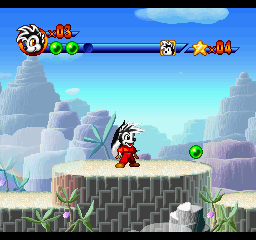
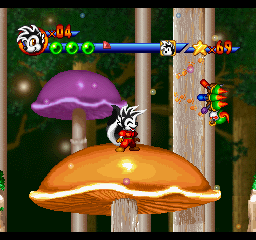
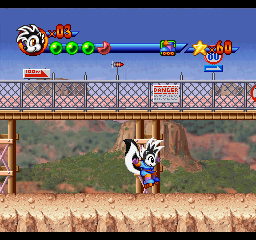
Well, that's hard to say. Punky Skunk is a game of modest pleasures that is mostly fun if you like throwbacks. Of course this is a skunk with an attitude. Of course he attacks by shooting stinky clouds at the enemies. The graphics do not look very good for 1998, but oddly enough they would fit in perfectly in 2024. They just have a wonderful 16-bit look to them. It feels like I'm playing a long-lost PC Engine game. It even has a world map which you know I love. The major gimmick is that Punky can find powerups that give him different abilities. There is a pogo stick that allows him to jump high and a parachute that allows him to glide for example. He can only have one ability at a time, but he can switch between normal attack mode and special item mode. This is important since many of the transformations don't come with an attack. The levels are largely centered around the abilities, but it can still be annoying switching back and forth to avoid damage. 


There are a few other annoyances that keep Punky Skunk from being a true winner. The biggest problem is the somewhat bland level design. There aren't that many levels that stick out in my mind after playing them. They mostly boil down to finding the special item and using it to find the end. Many of the early levels are very short. And it's not the type of game that encourages exploration. Most of the items are just for gaining extra lives. It's not the type that encourages going for 100%. There are some mini games that can eventually lead to more hit points, but the game is easy enough that they are purely optional. I wouldn't say it's too easy though. I got some game overs as I played and had to grind for lives a few times. I just with the levels had been designed with a bit more care. 


This is one of those situations where the more I thought about the game I was reviewing the more I liked it. I hadn't initially expected to give Punky Skunk a very good review, but its modest charms have won me over somewhat. I think it's been helped by the passage of time. It didn't fit in during PlayStation's heyday, but 25 years later and the charms stand out more than the drawbacks. I can't deny that I had some fun while I was playing it even if I did tend to play it in chunks. I played about a third of it at a time over the course of a few months. That's not the most responsible way to review a game, but it does show that I couldn't quite take myself away from it. I would move on to bigger and better things, but Punky Skunk would always find its way back into my brain.  

I am a bit of a failure as a list maintainer. I switched laptops recently, and for whatever reason my list didn't want to come along. If there's anyone out there who knows a good way for me to present it on my blog, please let me know. I haven't made a spreadsheet since my college technology class 20+ years ago, so I don't know what I'm doing. The list does still exist though, and Punky Skunk made it into the green section at #69. I have rated 169 games so far which means there are at least 100 games worse than Punky Skunk. Not bad for a skunk with attitude.  

PlayStation Quality Percentage 2/3

Tuesday, July 9, 2024

Atari 2600 #20: CocoNuts


Developer: Telesys
Publisher: Telesys
Release Date: October 1982


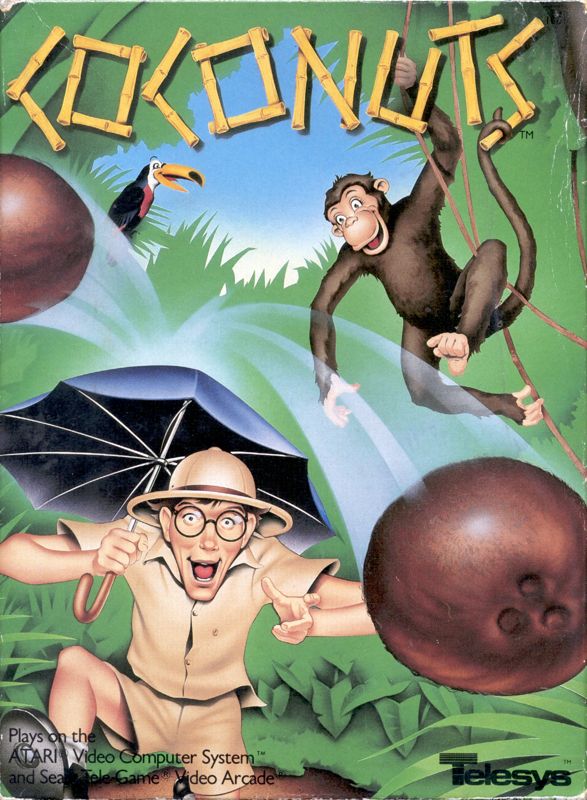
Telesys was one of the many publishers that showed up during Atari's boom years and then completely disappeared. The Atari 2600 existed for almost 15 years and had a very large library of games, but the majority of them came out between 1981 and 1983. In these years third party publishers were sprouting up everywhere and trying to find a gimmick. Telesys decided they were going to make funny games, and you can tell the games were going to be funny just by the names. See, it looks like the game is called coconuts like the tropical fruit, but there's an extra capital letter so it's actually called CocoNuts. Well, that implies this game is actually about mentally unstable people and not tropical fruit. Now that's funny! And just as a bonus it is also about coconuts. Coconuts are by far the funniest drupes. How could a game with such a wacky name not be a total romp? 

Well, the reason for that is because CocoNuts is an Atari 2600 game, and there's just not the processing power for games to be that funny. Oh, people tried, but about the best anyone could do was to make a typical generic blob actually look like something. When Megamania came out it won an award for being the funniest game of the year simply by having the player shoot at telephones and burgers instead of ships. That's about as funny as Atari games could get. Megamania is still a good game though because the developers remembered the gameplay. Fast Eddie was also fun even though its attempts at humor fell a bit flat. Telesys didn't have the talent of Activision or Sirius though, and so CocoNuts ends up being memorable but not particularly playable.


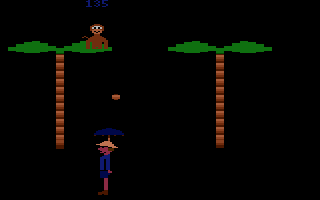
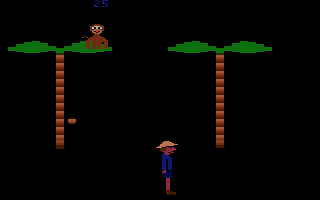
I will admit that it does look funny at firsts. You play as a man wearing both a pith helmet and an umbrella, and the trees look quite nice. The whole object of the game is to avoid coconuts being dropped by a monkey in the trees. If you get hit once you lose your umbrella, if you get hit twice you lose your helmet, and if you get hit a third time it's all over. Atari 2600 has several "avoid the falling objects" games with Kaboom! being most famous. Most of them were twitchy, high-speed paddle games. CocoNuts uses the regular controller and moves much slower. It doesn't even use the button for anything, so the whole game is just moving back and forth. It's easy to tell where the coconuts are going to fall from because they will drop below the monkey, but I still found it challenging. 

The very obvious problem with CocoNuts is that it is extremely repetitive, even by Atari standards. The coconuts get faster, and earning points will eventually earn extra lives, but there's never anything else on the screen. For CocoNuts to work it needed to be exciting to make up for the simplicity. In this regard it fails. Dodging coconuts gets old pretty quick. It might look fun and silly when you first turn it on, but it never changes. Even just having the monkey drop bonus points or objects with different speeds would've been a big improvement. 


Still, I will admit that I had fun with CocoNuts for a few minutes, so it wasn't a complete loss. I've been reviewing some bad games lately, so it's refreshing having one that goes into the purple okay section. It feels like that hasn't happened in a while. I've ranked some odd Atari games, so it's not even that low on the Atari specific list. Right now, it falls in at #116 on the overall list and 13 out of 20 on the Atari list. If you're a classic game collector you'll probably buy this one for a few dollars because it looks silly, play it for a few minutes, and then put it on the shelf forever. That's the fate that befalls so many Atari games, but there are worse fates for 40-year-old video games. At least it looks good on the shelf.

Atari Quality Percentage 9/20 or 45%


Monday, July 1, 2024

Atari Jaguar #9: Pinball Fantasies


Developer: Spidersoft
Publisher: Computer West
Release Date: June 9, 1995


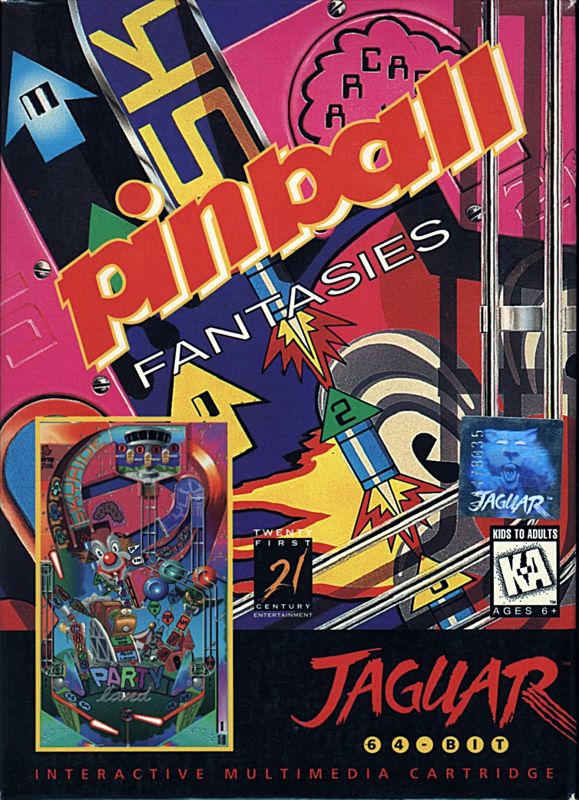
I love console pinball games, so I decided to check out Pinball Fantasies in order to rehabilitate Atari Jaguar somewhat. It's no secret that the Jaguar has had a very low batting average so far, and I have been focusing on many of the famously bad games because they are fun to write about. I'm still sitting on a few of the stinkers, but it's probably time to diversify and talk about some decent Jaguar games. In many ways Pinball Fantasies is the opposite of the Jaguar's other pinball game, Ruiner Pinball. While Ruiner Pinball featured outlandish effects that could only be done in video games, Pinball Fantasies strives for grounded, realistic play. I like how the two Jaguar pinball games are polar opposites, but I'm not sure which is the winner. Pinball Fantasies is definitely the type of game where there are good points and bad points which I need to be described in review form. Well, it's a good thing I am here then, because that's just what I do.


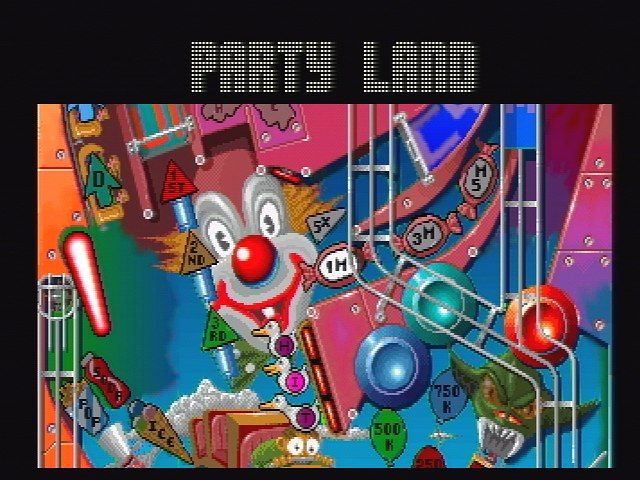
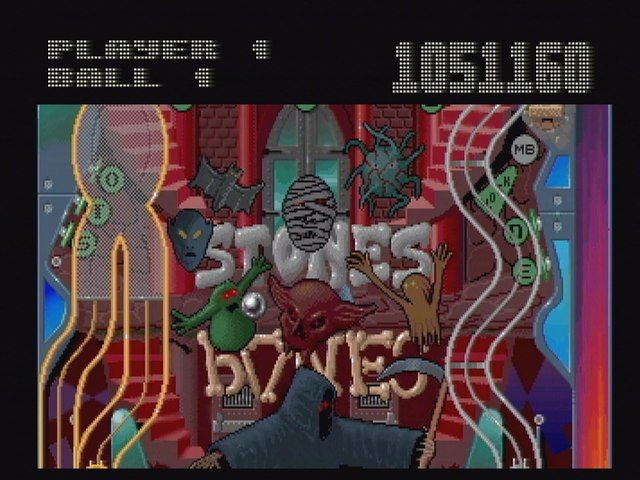
Pinball Fantasies is certainly the more generous of the two games. It has four tables compared to Ruiner's two. They are not officially based on any particular pinball machines, but their themes would be very familiar to anyone who remembers the days before tables were all licensed properties. The themes are amusement park, car racing, cheesy game show, and spooky. I think it's a law that you have to throw in a spooky table in your pinball video game. At the very least it should be. However, the tables are not quite as distinct as they could be. The two tables in Ruiner Pinball look like they could be from completely different worlds, but the tables in Pinball Fantasies all look a bit similar. It's not too egregious, but pinball tables usually feel fairly unique. I'm sure that there are common pieces that get used over and over, but I appreciate the illusion. Still, if I didn't know what any of the tables were called, I would still be able to figure out the themes. So, presentation still leans slightly positive.

The tables do have a bit of sameness to them, but I can't deny that they are fun to play. Pinball Fantasies definitely went for accuracy over frills and for the most part it works. If you are only familiar with modern pinball machines then the ones offered here might seem primitive, but they remind me of some of my favorite mid 80s tables. They are full of ramps and light-up targets. I'm sure I could play each table for hours and hours without doing everything there is to do, and for the most part I would want to. This is a game that I wanted to play more than just for my review. That's a big compliment for a Jaguar game thus far. Considering I could write a whole book about how bad most of these games have been and Pinball Fantasies leaves me at a bit of a loss for words is a good sign. It's a pleasantly bland game. I could see me and my family having a lot of fun with it back in the day. 


I just wish I had more to say about Pinball Fantasies. Jaguar reviews have been some of my favorite to write so far. They are always weird and interesting, and many of the games I have written about so far have been of the hilariously bad type. Funny reviews of poorly made media is what keeps reviewers like me in business. Pinball Fantasies is just a decently made game that I enjoyed. It doesn't stand out, but it doesn't make any serious errors either. I almost hate to say it, but this perfectly normal game is the best one I've played on Jaguar so far. Hopefully something weirder will dethrone it eventually, but every console needs a good comfort game, and on Jaguar I suppose this is it. It's ranking at #75 on the overall list and of course #1 on the Jaguar list. I hope there are some more good Jaguar games, but sadly there aren't any more pinball games. Will they be able to succeed at another genre? Only time will tell. 

Jaguar Quality Percentage: 2/9 or 22.22%


Friday, June 14, 2024

PlayStation 2 #1: Katamari Damacy


Developer: Namco
Publisher: Namco
Release Date: 3-18-2004


`

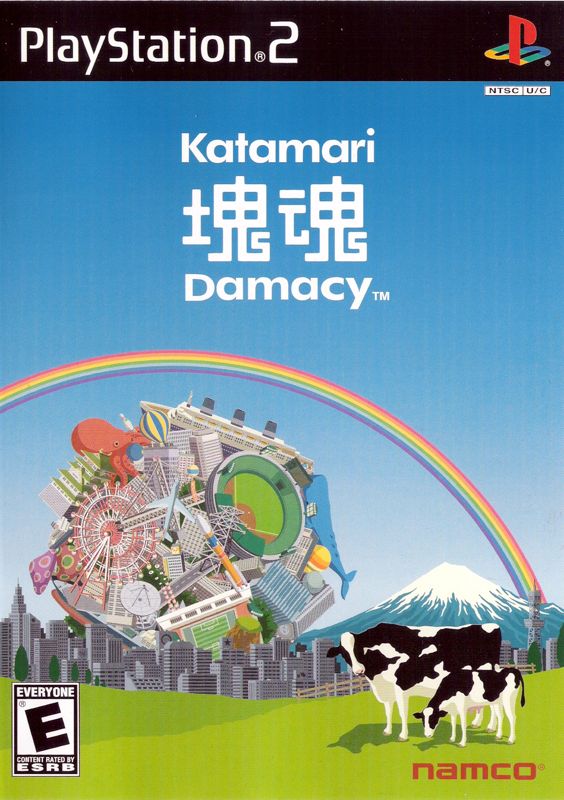
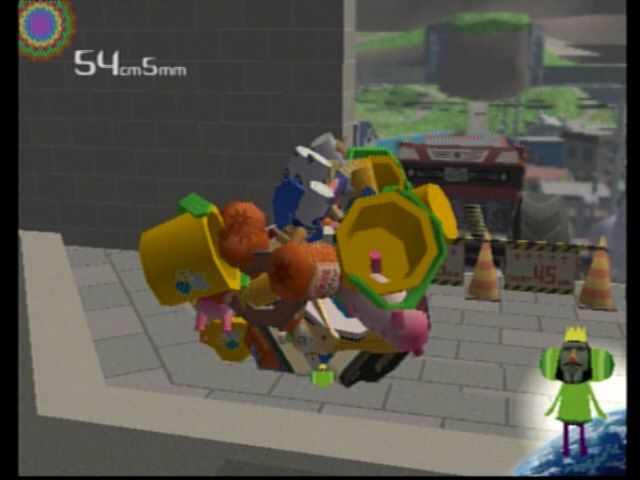
For as long as Japan had been a major player in the video game industry, there had been attempts to translate their unique sense of humor to American audiences. Many of these games are forgotten curios at best and insulting failures at worst. It's hard to play a game like Panic! and not feel some secondhand embarrassment for Japanese gamers. It's like if the Japanese only knew American humor from Friedberg and Seltzer parody films. You never want to be represented by the lowest of the cultural low. The problem with so many of these early attempts is that "wacky Japanese" was the entire game. Developers thought they could get by on mere curiosity. Luckily, Namco saw things differently. Namco, of course, made some of the greatest games of all time. They brought the world Pac-Man, Galaga, and Dig Dug just to name a few. In fact, my original goal for this blog was to rank all the Namco Museum games from the PlayStation series. That is yet another project I didn't quite finish, but Namco has still been all over my blog from the beginning. So, Namco was the prefect company to bring quirky Japanese humor into the mainstream. I suppose it might be a bit of a stretch to call Katamari Damacy mainstream, but it certainly graduated from cult classic status and spawned numerous sequels and remakes. It also spawned a whole slew of copycats, and much like Tetris many of the copycats are actually good. I don't know if there's a truer measure of success than inspiring good games. Of course, there is probably one more important reason that Katamari Damacy is successful. It is also a whole lot of fun.


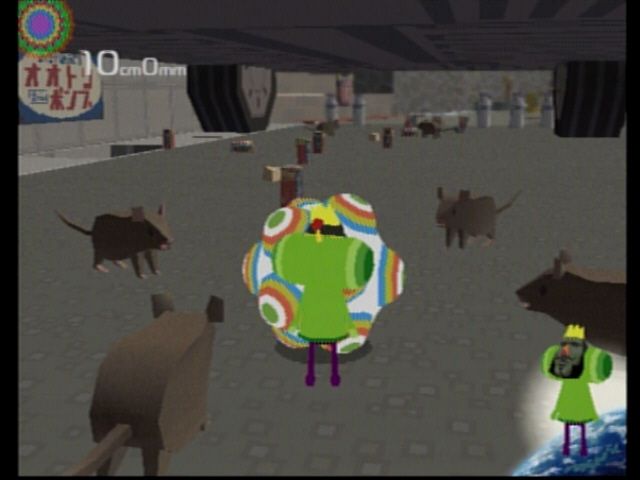
Make no mistake, Katamari Damacy is funny and weird. You can't write about this game without talking about how strange it is. Katamari Damacy is also proudly Japanese. Most of the levels take place in Japanese houses and streets full of local products and objects. They didn't even change the Japanese name. However, if everything in the game was sanded down smooth, and the game was played with circles and blobs it would still be fun. This is thanks to the simple yet addictive goal. You start with something tiny and try to make something huge. In this case you are the Prince of All Cosmos tasked by your father to remake stars. You do so by rolling your sphere, the Katamari of the title, over anything you can find. Any object smaller than your Katamari will stick to it while anything larger will either harmlessly stay put or, in the case of a moving target, knock objects off. Levels will usually have a certain size goal to reach within a time limit, so you spend your time rolling around and getting bigger and bigger. In the beginning you're collecting thumbtacks and mahjong tiles, but by the end you're collecting whole continents. 

It sounds almost too simple, but it's oddly addictive. There's just something about watching your sphere grow. The goals are modest in the beginning, but each level gets bigger. The main challenge comes in finding a logical path through the levels. If you are not careful you can end up in a dead zone without much to pick up. It's also extremely satisfying when a large object you've had your eye on finally becomes collectable. And the levels are absolutely filled with all manner of items to pick up including animals and people. Katamari Damacy manages to keep its light tone even while sending droves of people into the cold vacuum of space to become stars. Of course, much of the humor comes from how oblivious the rest of the world is to what is happening. After the final level there's not much left in the world besides oceans but still nobody seems to care much. It still manages to stay light and fun, and the always increasing growth meant that I never felt like a level was hopeless. I may only be at about 50% with a couple minutes to go, but there's still a chance that I'm going to be picking up skyscrapers. This is gameplay designed by arcade experts. 


Of course, all this rolling can get a bit repetitive. It can be a little tricky when a game only has one goal, but it is still set up in a traditional, level-based way. The classic arcade days were long gone by this point, so it couldn't be a game where you just made a bigger and bigger ball until you died. They try to balance it out by also including levels with different goals. In some you have to roll up specific objects. In others you have to find the largest of a specific object. This is good in theory, but these levels can't actually be lost. Can't lose levels are one of my least favorite video game features. It feels meaningless when the stakes are so low. They could've easily put minimums in these levels and improved things significantly. This also makes Katamari Damacy a very short game, especially by PS2 standards. It can easily be finished in 2-3 hours, and that's a bit brief for a full-priced 21st century game. Of course, you can go back and play the levels again, and you will probably want to for at least some of them, but it's still a bit on the short side. My completion rate for PlayStation 2 is terrible though, so it's nice having some games that are fun and relatively short.  

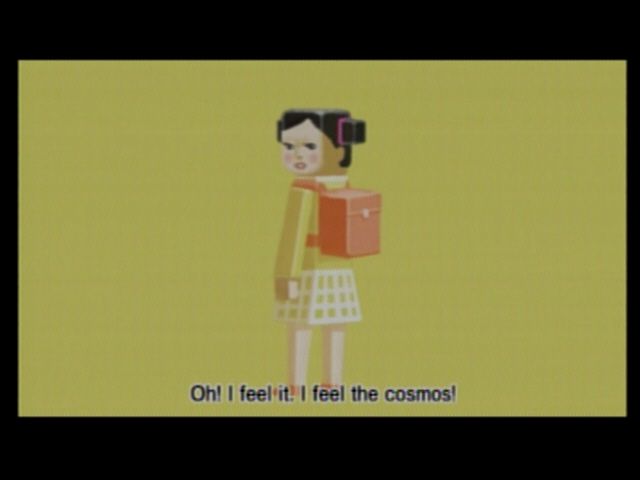
I'm not going to complain too much, however, because it is an entertaining game from start to finish. It is a fun game that is boosted by the presentation. For once, the developers were trying to be funny, and it actually worked. The King of All Cosmos can be dismissive and somewhat cruel to his son, but his dialogue is always funny. The character designs and rainbow motif are fun as well. I'm still singing the wonderfully simple theme song to this day. There is also an oddly animated side story with a pair of kids worried about their astronaut father. In another game it would seem completely out of place, especially considering how fun the story already is. It's a welcome bit of weirdness though, and it makes the game feel even more complete. Is this actually a game about absentee parents disguised as a wacky arcade game? The mere fact that I'm even asking that question shows how well made this game is. Or maybe it just means that I take everything too seriously. Either way, it's a job well done. 


So, my journey into the PlayStation library is off to a good start. Since the first game I'm reviewing is good, I can only assume that all of the 1900 or so games I need to review will also be good. Anyone know if that's true or not? Katamari Damacy ranks all the way up at #25. That's just ahead of the NES version of Galaga, which is another Namco game. Honestly, I wasn't expecting it to rank quite so high. I guess I need to start ranking more of the heavy hitters, but I'm still having fun going slightly more obscure. There will probably be a day when Katamari Damacy isn't even in the top 100, especially if I get desperate for views and start writing about all the Mario and Zelda games. As far as cult classics go though, it's hard to do much better.