Developer: Nintendo
Publisher: Nintendo
Release Date: 7-31-89
(images are from mobygames.com)
Developer: Nintendo
Publisher: Nintendo
Release Date: 7-31-89
(images are from mobygames.com)
Developed by: Lenar Co
Published by: Taito
Release date: July 1992
Pre-Pokemon RPGs on handhelds will always be fascinating to me. RPGs are usually large, time consuming quests which is just the opposite of what they were going for with handhelds in the early days. Games were typically short platformers or powered-down ports of main console games. Games like Knight Quest were limit pushing just by existing. They showed that there was no type of game that that was going to be unavailable to handheld players. Developers just needed to make them. Of course this is 1992 we are talking about so there are going to be limitations. Twenty hours is about the max for Game Boy RPGs before Pokemon, and Knight Quest divides that by almost five. It only runs six or seven hours so it's no epic. Still, shorter RPGs can be charming. So is this is charming mini adventure or lackluster title as generic as its name?
Knight Quest is an overhead turn-based RPG that takes place in a small but cramped world. You play as a youth named Will trying to become a great knight. In that way it is a very logical title. The monsters roam around freely like in Zelda 2, but they morph into regular battles when you encounter them. The strangest part of the game is in the combat. You have four attacks to chose from, each one named after a bird, and each enemy is weak to one of them. It really is necessary to know the weaknesses, but it can be a little hard to keep up with. I suggest writing them down, or this being 2021 cheating and looking it up online. Being an early RPG it comes with the typical strengths and weaknesses. It can get confusing in spots. There are a couple of obtuse puzzles to solve, and sometimes certain events won't trigger until the right people are talked too. It can be irritating going between towns just to find the right people to trigger a quest. Still, like in every good RPG getting lost is a good thing. It's not a super grindy game, but it is one that requires some extra combats. It only goes up to level thirty and the stat gains are good enough that it doesn't take that long to get Will the knight strong enough to face what's next.
This all sounds fun, and it is, but it does get somewhat repetitive. The problem is that when you have gleaned the weaknesses of the enemies combat becomes boring. There are some magic items, but they are a waste when saving up for stronger gear, so the combat is all attacking. It's probably more fun if you don't write anything down and just try to remember because then there is the tension of trying to remember everything. So you have to either take a ridiculous approach to it or be resigned to the fact that combat is never going to be anything special. Even the boss fights are just more find the weakness and attack over and over again. They are not much harder than regular enemies if you know what you are doing. Just have enough money to buy some hearts and nothing bad will happen. Luckily it's a short enough game that it never gets tedious, the and there are enough interesting locations and encounters to keep the game interesting. It's still fun, but I wish it had more tactics. They should've thrown in a magic user and made it a party based game.
This is one of those games that has gotten very expensive in the last few years. It's never been exactly cheap, but now it is regularly over 100 dollars and is in the top 10 most expensive Game Boy games. Such is the hazard of being an RPG fan. They always tend to be among the most expensive games. Both because they don't tend to sell as much and their fan base is a strange and dedicated lot. I should know being one myself. I do not, however, have a copy of this one. If I ever find an inexplicably cheap copy of it though I will buy it. I'm no too proud to buy games. Still if you do decide to shell out 120 dollars just remember that it is fun but only about six hours long.
I got to do my favorite thing with this game. I got to rank it against Metro Cross. As usual Metro Cross came out on top, but it was close. I enjoyed Knight Quest, and I would certainly play it again even though I already beat it. I love old grindy RPGs more than most any other kind of game. I love a game where you start out as a weakling and slowly turn into a bruiser. I would've loved this game back in 1992 although looking at it now I can see its flaws. Still a good game is a good game and I am happy that I started out my Game Boy reviews on the right foot.
Also, sorry about the weird formatting on my list. I am posting the whole thing because something weird is happening with my word processor and I'm afraid I'm going to lose it. Enjoy the long, weird looking list.
(Images from mobygames.com and estarland.com)
Developer: Sega
Publisher: Samsung Electronics
Release Date: 1989
Alex Kidd in the Enchanted Castle is the Genesis debut of a franchise that most people have never heard of. As a launch title for the Sega Genesis it could've been Alex Kidd's Mario moment. Instead the moment fizzled out and Alex Kidd was mostly forgotten. Of course there is more than one reason for this. One was that he just wasn't that interesting of a character. He had a boring design and a boring name. Another was that the Master System never did well enough to establish him as a familiar face. He had four games on the system, including one after Enchanted Castle, but most people hadn't played any of them. The main reason, though, was that the game just wasn't all that good. If he had been more popular than he might've weathered the storm, but for poor Alex there was just no way to survive this fiasco.
(You'd think a game where you can punch cars to death would be more fun)
All the problems from the previous games are in full display in this one. It's like they wanted to remake Alex Kidd in Miracle World but decided to only keep the bad parts. While the controls in Miracle World were somewhat loose Enchanted Castle is downright floaty. Every jump is a crap shoot, and the weird level design doesn't help matters. The game features almost constant jumping. So instead of hiding the game's shortcomings they decided to emphasize it. Be ready to miss a whole bunch of jumps. Much of the most dangerous jumping is reserved for collecting treasure chests. They are fun to collect, but the items you can get with the coins are almost useless. I used and item once the whole game and that was for the weird final boss. It feels like the treasures were put there mostly to put your character in more danger.
(bad underwater level alert!)
Of course if you know about Alex Kidd than you know what the biggest problem with the game is. For every boss and every attempted item collected you have to play rock, paper, scissors. It came up a few times in Miracle World, but in Enchanted castle it is everywhere. You might play a half dozen times in one level. Luckily the item collections don't kill you if you lose, but with the bosses one wrong move means instant death. There's nothing worse than when success is based purely on luck, and this is one of the prime examples. Imagine fighting your way to the end only to pick wrong and then having to start all over again. It's not a pleasant experience by any means. I was frustrated and I was playing with save states. My favorite part was letting my son pick which one to throw. At least he enjoyed watching me play it.
So this is a bit of a rough one. I liked the final level, the titular Enchanted Castle, but the rest of the game fell flat. I probably liked that last level because it was a fun maze and there weren't so many death falls. I wish the whole game was as well designed, but they hid all the quality in a place that most people would never see. If you played this game back in the day you probably died in the lousy first level and never got much further. Needless to say this game didn't make much of an impact, and age hasn't improved things. Alex Kidd has made a bit of a comeback in recent years, but this isn't the game from the series to rediscover.
I really thought this was going to end up in the red section, but it's not quite that bad. I got a little enjoyment out of it especially near the end. It's ending up near the bottom of the purple section at #62. You got lucky Alex. Your game is better than boring Atari 2600 games. That's not much of a victory, but this isn't really that much of a game.
Genesis Quality Percentage 1/2 or 50%
(Images are from mobygames.com)
Developer: Nintendo
Publisher: Nintendo
Release Date: June 1986
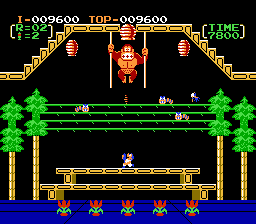
When people think of classic arcade shooters they don't usually think of Donkey Kong. However, that's just what Donkey Kong 3 is. The forgotten third game in the trilogy is memorable for just how different it is from the first two games. First off there is no Mario. By this time he had graduated from the Donkey Kong franchise and was starring in his own games. Second it eschews the platforming from the first two games for single-screen shooting action. You now play as a gardener named Stanley out to protect his flower garden from a tired-looking DK. It's an odd premise and definite departure from the first two games, but it's much more fun that people give it credit for.
The easiest way to describe it is a cross between Galaxian and Defender. The main objective is shooting DK in the crotch until he reaches the top of the screen, but besides him there are diving insects everywhere. These insects also have a mind to steal Stanley's flowers. If you can make it through the levels without losing any flowers you get a big point bonus. This is an old arcade game of course so it's important to get as many points as possible. So this game because a bug shootout like Galaxian and an object saver like Defender.
As odd as it sounds it all works. DK is a big target, but there's enough going on around him that it's always a challenge. In one level caterpillars block your shots. In another level the jumping platforms don't go all the way across in the middle which causes some new strategizing. DK will start to climb down if you don't shoot him fast enough, so you have to figure out a way to shoot him while constantly moving. It all adds up to some old-fashioned frantic arcade fun which is replicated almost perfectly on NES. That system really was great at classic arcade conversions.
I am going to rank Donkey Kong 3 fairly high. I know that it gets mediocre reviews, but I think it is a fun game. It might've done better without the Donkey Kong connection at all. Because it is a Donkey Kong game people expect a certain style. It doesn't meet that expectation so it ends up getting underrated. I can understand why people feel that way. It is, however, a fun game in its own right. I am ranking it at #34 right below Video Pinball. That's a respectable rating I think and still well into the green section. I recommend checking it out if you never have before. It's still a relatively cheap black box game, and now it's on Switch Online. You should check it out. Just don't go into it thinking it's going to be anything like the firsts two games.
NES Quality Percentage: 13/22 or 59.1%
Developer: Nintendo
Publisher: Nintendo
Release Date: June 1986
While 1986 was a busy year for the NES, it wasn't because of the games Nintendo released for it. 1986 was the first year to see third party support for the console. The fact that Bandai, Capcom, and Data East were now on board greatly improved the machine's chances of succeeding. However, as far as first party support goes it was probably the weakest year until the 90s. Since they didn't even go national until 1986 I suppose this makes sense. Most people hadn't even got to play any of the launch titles until well into the year, and as I have already written there were many good original games to select from. 1987 would be the watershed year that saw Metroid, The Legend of Zelda, and Kid Icarus make their debuts. 1986 was relegated to mostly arcade conversions. While it was nice to get such a good home version of Donkey Kong and Popeye, these were mostly games that people likely already had on an earlier console. One of the few original first party games to come out was Balloon Fight, and it's original in only the most liberal sense. In reality it plays almost identical to Williams' classic game Joust. It's a rare case of Nintendo copying some else before becoming the company that would get copied. I'm a little surprised they didn't get sued and are able to keep releasing the game over and over. I guess they changed just enough to make it okay.
The way it works is that you are a floating man with two balloons taking down groups of other men wearing single balloons. The object is to hit them higher than they hit you and thus popping their balloons. If you are reduced to only one balloon flying becomes more difficult. Hitting them again will net you some bonus points. Getting a high score is the main goal of this mode. The main difference between this game mode and Joust is that there are no eggs to collect and there is a greater variety of level layouts. The original Joust used the same layout every time and only varied in the number of platforms that were available. Balloon Fight is a richer world with platforms in all different places. It's still a single screen game, but it does more with the one screen than Joust did. Still the basic gameplay is the same.
What sets this game apart is the balloon trip mode. In this mode you move along a scrolling screen collecting balloons and avoiding electrified walls. My favorite part about it is the ranking counter in the top right corner. I love rankings in general of course, but it's a good way to have a goal. I considered this game beat when I scrolled the levels in game A and got to first place in balloon trip. It's not an easy task either. You know it's hard when you get points for simply surviving. Still I persevered and managed to get all the way to first place. It was very satisfying.
So Balloon Fight is fun even if half the game is extremely derivative. I would say it's better than any home versions of Joust out at the time even though the 2600 version is a lot of fun. It's one of those arcade games that doesn't take too long to play and is easy to improve upon. I think it would take a long time for me to reach my ceiling in this game. This is a game that I always enjoy more than I expect, and it's easily going into the green section.
NES Quality Percentage: 12/21 or 57.14%
Screenshots are from mobygames.com
Developer: Mattel
Publisher: Mattel
Release Date: October 1983
Atari was king in the early 80s, but by then they weren’t the only console on the block. Both Intellivision and Colecovision would spend time being worthy competitors with the the mighty Atari. Both consoles would be more impressive technically, but both took some wrong turns which kept them from ever being as popular as the 2600. Intellivision’s biggest problem was that it didn’t appeal as much to the casual gamer. It was filled with complicated games utilizing their difficult to use controller. That’s why a fun arcade style game can stand out so much on the console. Pinball might be a minor classic on another console, but on Intellivision it is one of the best. It’s an infinitely replayable game that is more than just a good pinball simulation. It took advantage of the video game format to include things that would be very difficult in a real pinball game.
It followed Video Pinball by less than two years, but it feels like it’s about a decade newer. Where Video Pinball had a more abstract look Pinball gets it all right. It has the look and the shape of the real thing. Anyone who has played pinball before will recognize the shape of it with the bumpers and lanes in the right place. It also has numerous ways to score points making for almost endless variety. No two games are going to feel that much alike. It has excellent ball physics too. It feels like real pinball, and you can even use the disc on the controller to nudge. It utilizes the controller well. The side buttons can be used for the flippers, but there are also corresponding keypad buttons that do the same thing because they knew pushing down on those hard side buttons starts to hurt after a while. I really don’t like those side buttons very much. Didn’t they know people were going to be using them all the time? It’s nice to have a game that avoids them. The only catch is that there isn’t a keypad button for all flippers at once so you really do have to pay attention to what side the ball is on. No lazy shortcuts in this one, well unless you want to use those painful side buttons.
What’s especially fun about this game is that with the expanded possibilities of the video game format they were able to pull off a pretty nifty move and add two extra levels to the game. That’s something that pinball tables had never been able to do in the same capacity. The 1982 game Haunted House was the first pinball table to have three levels, but it’s a main table with two smaller, less intricate playfields. In Pinball all three are of equal size and depth. There may even be more to do in the upper tables. It’s impressive that they would put so much into a part of the game that many players wouldn’t even know about without the manual. I didn’t even know about the upper table until I read about it, and yet there it is enticing people with its drop targets and uranium bumpers. I have no idea what a uranium bumper is, but I sure want to keep playing so I can find out. It’s the type of game that writing about it makes me want to go back and play it some more.
This game is the gold standard for console pinball games. It wouldn’t be topped at least until the 16-bit era and then only rarely. It’s a game that does everything right, and because of this it ranks high on the list. It’s well into the green section and is all the way up to #24. It’s the highest ranked pre-NES game so far. There are a few better ones that I will review later, but for now that’s very impressive.
1. Zelda II: The Adventure of Link
2. Super Mario Odyssey
3. The Legend of Zelda
4. Galaga
5. Donkey Kong
6. Super Mario Bros. 2
7. Exodus: Ultima III
8. Pac-Mania
9. Wrecking Crew
10. Super Pac-Man
11. Pac-Man
12. Viva Pinata
13. Dragon View
14. Excitebike
15. Drakkhen
16. Todd’s Adventures in Slime World
17. Arc the Lad
18. Clu Clu Land
19. Tails’ Adventures
20. Scrapyard Dog (Lynx)
21. Artifact Adventure Gaiden DX
22. Mickey’s Racing Adventure
23. Alex Kidd: The Lost Stars
24. Pinball (Intellivision)
25. Metro-Cross
26. After Burner
27. Double Dragon
28. Alex Kidd in Miracle World
29. Panic Restaurant
30. Felix the Cat
31. Adventure
32. Video PInball
33. Breath of Fire
34. Ice Climber
35. Gaplus
36. Dragon Spirit (arcade)
37. Pinball (NES)
38. Ninja Golf
39. Splatterhouse 2
40. Fast Eddie
41. Super Soccer
42. Gopher
43. Dracula: Crazy Vampire
44. Walt Disney World Quest: Magical Racing Tour (GBC)
45. Entombed
46. Red Sea Crossing
47. Baraduke
48. Demon’s Crest
49. Brave Battle Saga
50. Evoland
51. Tennis
52. Renegade
53. Beethoven
54. Hogan’s Alley
55. Gamma-Attack
56. The Legend of “Valkyrie”
57. Galaxian
58. Action Fighter
59. Dragon Crystal
60. Cosmic Commuter
61. Hot Pixel
62. PocketBike Racer
63. Wild Gunman
64. Defunct
65. Gyruss (2600)
66. Looney Tunes Racing
67. Squidlit
68. Gordo 106
69. Baseball
70. Space Jockey
71. Home Alone
72. Birthday Mania
73. Bad Street Brawler
74. Burly Men at Sea
75. Wayne’s World
76. WeakWood Throne
77. X-Men (HyperScan)
78. My Name is Mayo
79. Marvel Heroes
80. The Adventures of Rocky and Bullwinkle and Friends
81. Ben 10
(Images are from Mobygames)