Monday, June 2, 2025

Sega Master System #12: Phantasy Star


Developer: Sega

Publisher: Sega

Releasee Date: November 1988
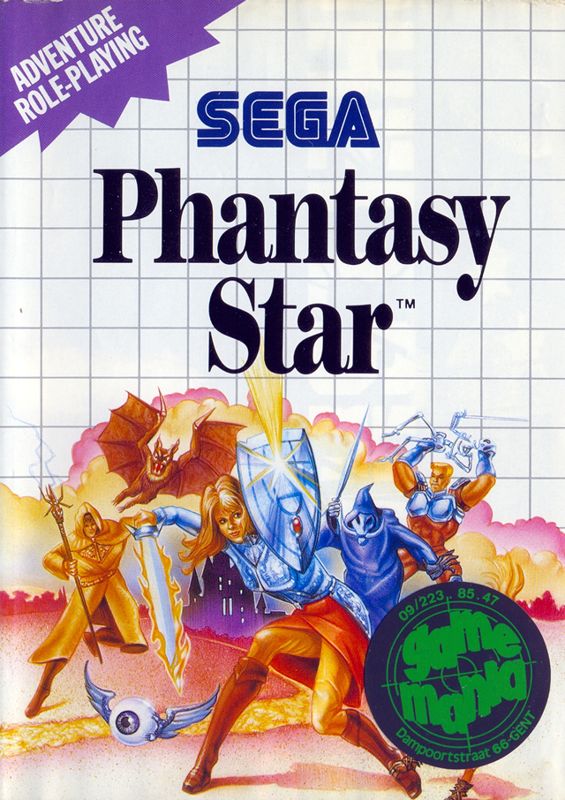


It didn't take very long for Sega to realize that their Master System was never going to overtake the popularity of the NES in America. Their market share ended up being disappointingly small which means that they had to operate on a budget. The SMS is remembered almost as much for its hilariously simple box art and cheap, black-and-white manuals as it is for the games. They had to get by mostly on self-published arcade conversions that were more often than not fun, but not revolutionary like so many NES games of the era. There were even cases like Captain Silver where they cut out a large chunk of the game itself so that they could save money. More Captain Silver wouldn't necessarily be a good thing, but it does show just how difficult it was for Sega to make any headway in America. However, sometimes they would put everything they had into a game, and the results could be incredible. Games like Sonic the Hedgehog and R-Type rank among the best of their genres. Then there is Phantasy Star, which is quite possibly the most important game Sega ever released outside of Sonic the Hedgehog. Phantasy Star is the game that showed the western world that the turn-based RPG had arrived. 
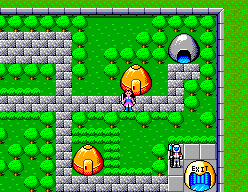


There were a few console RPGs in America before it, but Phantasy Star is certainly the game that solidified the formula, and it even beat Dragon Warrior to the states by almost a year. In Japan, of course, Dragon Warrior was released a year and a half earlier, but Phantasy Star is so large and impressive that it barely feels like it is from the same decade. It does have a similar beginning which I love, and certain modern gamers might hate. You play as a young woman suddenly thrust into the role of avenging her brother against an evil tyrant, so it's no surprise that you start out weak. Alys starts out so weak that the player can only get through one or two battles before running back to town. It's not an overly grindy game, however, and the difficult beginning allows the player to get used to the sights and sounds. The graphics and music are so good that I'm never in a hurry to make progress. The game is quite large, however, so I have to get going.

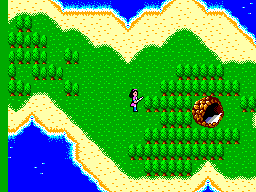
Phantasy Star very famously has three planets to explore, and Sega doesn't waste any time showing this off. While most games would have the player explore an entire planet and then send them off to the next one in a liner fashion, Phantasy Star sends them planet hopping within the first couple of hours. This gives the game an expansive feel that wouldn't be present if each planet was more isolated. In the last third of the game, I found myself going between planets frequently, and even though all three of them put together are about the same size as a Final Fantasy overworld, it feels very large. It helps that the world is full of secrets and there isn't very much wasted space. 


Also, if you like old PC games than you will probably like Phantasy Star. The dungeons are the 3d kind that you have to map yourself. This can feel strange from a modern perspective, but I find mapping to be a lot of fun. They are certainly well designed, and when I was young, I got through most of them by pure memorization. I don't think I could do that now. Of course, if you don't feel like mapping anything than you can just look them up on the internet. It's also on Nintendo Switch if you want to play a version that auto-maps. 

One thing Phantasy Star does share with Dragon Quest is that it is fairly light on plot. It stays a revenge tale throughout, and once Alys finds her three companions the game becomes more about finding items and getting stronger. There is practically no character development beyond changing Odin from a statue into a flesh and blood human. I think in Phantasy Star's case; however, this is actually a good thing. Too much plot would get in the way of exploration, and very few 8-bit RPGs are as fun to explore. Every dungeon has an important item or interaction, and they can be explored in a somewhat non-linear fashion. I didn't have too many instances after the first few hours of wandering into a new area and instantly getting killed by strong monsters. NPCs actually give good hints too, so it's not too hard to make a list of tasks. Of course, like every good RPG getting lost isn't really a bad thing. I needed all the leveling I could get, and it's nice when the leveling feels organic. Phantasy Star manages to be difficult throughout without feeling unfair. 


Phantasy Star managed to make an impact critically, although it didn't sell all that well. Because of its massive size it was just about the most expensive game on the market. I know I've seen it advertised for $80.00, which is more like $220.00 in today's money. Even buying a boxed copy today is comparatively cheaper at an average of only $150. Still, enough people played it to spread the word that Sega was really on to something. After Phantasy Star's release, every console had to have a high-profile RPG to get critics talking and attract that special breed of gamer. It wasn't too long before Nintendo started porting over Dragon Warrior and Final Fantasy games, and Phantasy Star's critical success probably helped out Sega's upcoming Genesis more than it boosted the Master System. Phantasy Star made people see the future of gaming, and it sure looked like the future was going to belong to Sega. 

Phantasy Star would certainly be near the top of my list of essential RPGs. It manages to be just about everything. It's that rare game that is just as much fun to play as it is important. It still plays great even as it approaches forty years old. And even better, it's now much more available than it was back in the late 90s when I first started tracking it down. There are numerous modern console versions, including the aforementioned Switch version which I bought for three dollars and had just as much fun as I did when I first played it twenty-five years ago. So why am I pushing you to buy this game so hard? Well, I'm looking at my list, and there's only one place Phantasy Star can go. It's going all the way up to the top. It has finally dethroned Zelda II which I reviewed almost five years ago. Also, how is this blog five years old already? Hopefully in the next five years I'll have some of these consoles completely ranked. I'll have fun ranking all the other Master System games, but it will be a little sad too. I know no other game will reach the same heights as Phantasy Star. 


Master System Quality Percentage: 8/12 or 66.66%

https://docs.google.com/document/d/1G01RKJ7-caaal5lgFfGgPfZRGcqWlv4E3E2E615UYKg/edit?usp=sharing

Monday, March 31, 2025

NES #54: Back to the Future


Developer: Beam Software

Publisher: LJN

Release Date: September 1989


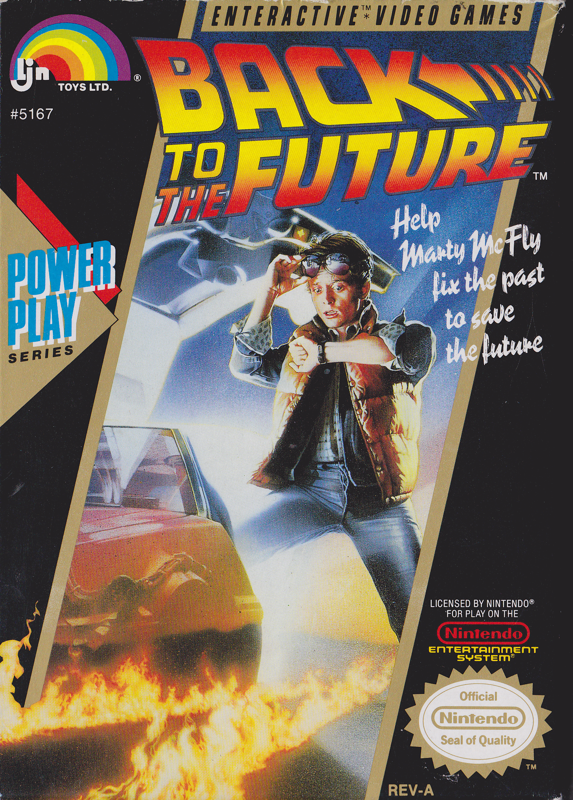
(Is "enteractive" supposed to be spelled like that. Is that a weird portmanteau?)


I can talk about Back to the Future, because I am that metaphorical kid that always comes up in licensed game reviews. I loved Back to the Future and wanted to experience everything the franchise had to offer. I was extremely excited about the video game, and I knew I was going to love it. It was my main gift on some long-ago birthday, and I spent many an hour playing it despite its poor reputation. I was that gullible target audience LJN was aiming for. Although there is an odd wrinkle to the story. I loved the franchise as a whole, but when I first played the game, I had never actually seen the first movie. I had seen the second and third installments, and maybe even the cartoon series, but never the original. I was actually going to use the game as a substitute for seeing it. Imagine my surprise when I finally saw the movie and didn't see any of the memorable enemies from the game. I expected Marty to spend some time in the movie avoiding bees and throwing bowling balls at glass movers. The movie is disappointingly devoid of bowling balls compared to the video game. The movie doesn't even have random bowling pins on the street for Marty to knock over. I'm sorry, but I think the movie would've been vastly improved with more street bowling. That's the way I felt back then anyway. Sure, the game is clunky and odd, but it was what I had. I'm probably the only person in the world who was disappointed that the movie wasn't enough like the video game. Of course, I am over forty now and can look at things a bit more objectively. Just what kind of video game is Back to the Future?


Back to the Future is a game that likes to keep the player moving. I would almost classify it as a vertically scrolling shooter. The screen is constantly moving up as you try to avoid trouble and collect and endless supply of clocks. The clocks are important as they keep Marty's picture from fading out. If his picture fades out completely, he dies. Or more accurately he fades out of existence. And also, if the regular timer runs out, he dies. How strange is it that this game has two concurrent time limits? I suppose it does fit in with the movie's theme. The enemies are mostly Hill Valley residents, but some of them do actually fight back so it's not all just passive. Marty can occasionally pick up a bowling ball which serves as his weapon, and once again I wish this is something that would've been emphasized in the movie. I love the thought of him leveling bullies with endless supplies of bowling balls. And if a few hula hoop girls get taken out in the process that's just collateral damage. 

Every four levels the gameplay changes to odd arcade-style mini games that are based on scenes from the movie. These levels are this game's version of boss fights, and they can be quite jarring. There's nothing on screen that tells you exactly what to do, and if you don't figure it out quickly you will lose. The first of these levels is by far the hardest, and I can see it turning off confused gamers. It features Marty fighting off waves of bullies in Lou's Cafe until he is thrown out. It's strange because you can get thrown out but have enough points to move on. The others include blocking Loraine's hearts and catching musical notes at the Enchantment Under the Sea Dance. 


On paper Back to the Future seems like a decent game. Unfortunately, it has a lack of refinement that is so common in LJN games. I'll give you the most egregious example. The main way Marty can get through the levels is by collecting a bowling ball and then later a skateboard. The skateboard increases Marty's speed significantly, and in the later levels it's almost necessary. The items show up after a certain amount of time has passed, but you have to have the bowling ball before you can get the skateboard. However, the items pop up in completely random places. It's not uncommon to find a skateboard right up against a fence or giant sidewalk crack where it is impossible to get. This makes Back to the Future a game of dumb luck more than anything else. Also, make sure you don't accidentally shoot your skateboard with a bowling ball, because this is also something that can happen. It is possible to get through the levels without the items, but you have to be absolutely perfect. Also, while most boss fights just toss you back a level if you lose, the final stage only gives you one chance. If you don't get the Delorean up to 88 miles per hour it's game over. If you don't like unfair game design or trolly deaths than maybe Back to the Future isn't for you. 


Back to the Future is a game I really want to like, but it is ruined by bad design and confusing gameplay. If the mini game levels made more sense and skateboards were more reliable it might just sqeak by. Instead, it's one of the many games on the NES that people point to when talking about corporate greed. It's remembered more as a symbol than as a game. This reputation isn't entirely earned, but it's not hard to see why it might be a disappointment for excited kids in the early 90s. So Back to the Future falls down into the red section, and the NES adds yet another bad game. I wanted to find 101 good ones to prove IGN wrong, but that's never going to happen if I keep profiling the worst publishers. I'll probably skip around some just so I don't do 20 LGN games in a row and drive myself crazy, but at least I know I have a ton of great games to play in the future. Back to the Future is #42 out of the 54 NES games I have ranked and #144 overall. That's only a few games into the red, so it could be worse. Just wait until I play all the other Back to the Future games. This one might actually be the overall best. How's that for a thought?

NES quality percentage: 25/54 or 46.29%

https://docs.google.com/document/d/1G01RKJ7-caaal5lgFfGgPfZRGcqWlv4E3E2E615UYKg/edit?usp=sharing
Wednesday, March 19, 2025

NES #53: Jaws


Developer: Escape

Publisher: LJN

Release Date: December 1987


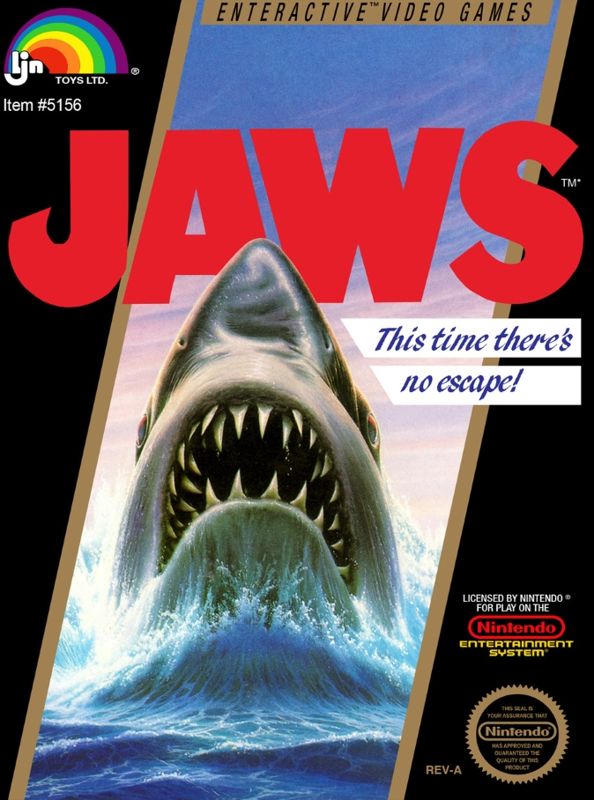
Jaws is one of the most important movies of all time. It solidified Stephen Spielberg's reputation as his generation's most popular filmmaker and practically invented the concept of the summer blockbuster. It's a character-based, claustrophobic movie that somehow spawned hundreds of generic explosion-fests. I am tempted to spend this review writing more about the movie than the game, but I have to be careful. Jaws the video game came out in 1987 instead of 1975 which means that it was meant as a tie-in for the abysmal sequel Jaws: The Revenge and not the original movie. Of course, LJN just called the game Jaws, so even they knew the more recent film was a stinker. There's not much plot in this early NES game, but it does have the later film's ending. I don't know if I've ever seen Jaws: The Revenge, but I doubt the rest of the movie resembles the game very much. This isn't necessarily a bad thing. An NES game doesn't have to exactly follow its source material. Jaws: The Revenge has a famously dumb plot anyway, so it was smart to strip it down. Unfortunately, they might have stripped it down a little too much.


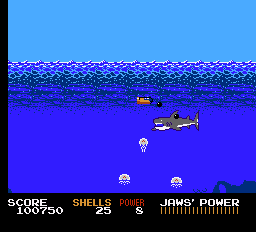
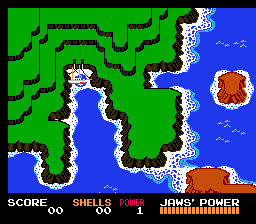
I love a game with an overworld, so it was a bit exciting booting up Jaws and seeing all those islands to explore. Unfortunately, while the game does have an overworld, it doesn't really have a world. There are only two points of interest on the whole map. These are two anchor points that sell the items needed to take down the killer shark. The currency in Jaws is conch shells collected by shooting innocent sea life during random cutaway battles. It's very odd that almost the entire game is comprised of shooting mostly harmless stingrays, jellyfish, and snails. Did that happen in the movie? Did the characters have such an axe to grind that they wanted to take out all sea life? Were they weirdly obsessed with shells? Is that why they needed a bigger boat? Did they need room for more shells? Sorry, I started to reference the better original movie again. Either way it's an odd premise for a game.  

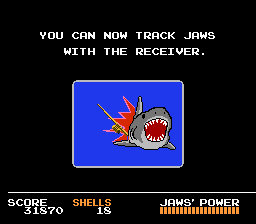
All this shell collecting really drags during the slow building first half. It's not a game with many choices. You don't get to pick out your own items and build your own shark killing strategy. The first item is always a completely useless shark finder. It's supposed to help you find Jaws, but since the map is tiny and he's always showing off that famous dorsal fin it is completely unnecessary. I hope you like annoying beeps. The other purchases are power upgrades that make killing Jaws easier. You can't buy two in a row at the same stop, so this drags things out even more. Somehow, I don't want to make more trips to the only place to go on the map. That's not a good sign. Jaws can appear randomly in a cutaway battle, and I do appreciate that you don't have to get every upgrade to be able to move on to the final battle. I think I would completely lose my patience with Jaws if I had to buy everything. 


The final confrontation with Jaws is one of those NES moments where if you don't know what to do it is impossibly confusing, and if you know what to do is ridiculously easy. It's the old "stab him with the boat" ending. Just line him up with the ship, use the strobe to make him jump out of the water, and then push B to make a Jaws-kabob. Sadly, he doesn't explode in this version. I will bump up a game a couple of points if it has an exploding shark. It does show his carcass sinking down into the water so that it at least something. 

Once the game gets going it does get a bit more fun. The cutaway levels get faster and somewhat more challenging, and the shells start dropping faster. I was worried that later upgrades would take longer to obtain, but this wasn't really the case. It doesn't save the overall experience, however. It took me four attempts to beat Jaws for this review, and I was certainly grinding my teeth during the first three. I hate only having two places to go, and the battles are boring. The only harm comes from being in the wrong place at the wrong time. I lost most of my lives from getting stung by a jellyfish while picking up a shell. I am sure this a more realistic death than dying in a shark battle, but it doesn't make for a very exciting game. Even Jaws doesn't put up much of a fight. He just passively swims back and forth while getting shot over and over. You'd think getting shot in the tailfin twenty-five times would get some reaction out him, but he just keeps on swimming. It's a bad sign when the game's boss doesn't even what to be there. And hey guess what, if you die at any point you get to buy that shark finder again. What fun!


Jaws is certainly one of the weakest games of the NES's 1987 lineup, but that's not to say it's a total disaster. My fourth and final attempt was entertaining enough to bump it up into the purple section. It's a little too short and easy to make that much of a negative impression, but it's long enough to not feel like a ripoff. The cutaway battles do get better, and sometimes the deaths were more from challenge than just bad luck. It's just too tiny and simple to be considered a good game. It certainly has the tossed-off feel of a cheap cash in. If you played this back in the day, it was almost certainly because of the name on the box, and I can't imagine too many Jaws fans being too enthusiastic about it. Still, I'm sure most people would rather play the game than watch Jaws: The Revenge. It comes in at 128 on the overall list, and 36 on the NES list. It's not great, but if they close the beaches and you have nothing else to do it might still help you get through the day. 

NES Quality Percentage: 25/53 or 47.16

Monday, February 17, 2025

NES #52: The Karate Kid


Developer: Atlus

Publisher: LJN

Release Date: December 1987


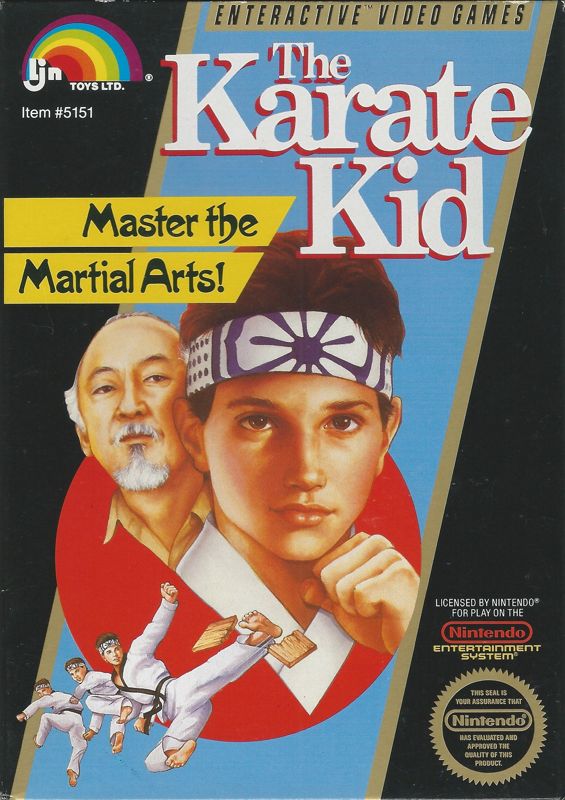
(This cover art certainly gets bonus points for having the most Pat Morita of any game so far. Did you know he's only in 26 episodes of Happy Days? That's half as many as Ted McGinley)


My THQ profile went so well last year that I figured I would go all out and look at some LJN games. I've always wondered why LJN has such a terrible reputation compared to THQ considering their games barely even work and look like they were drawn by little kids. LJN games at least look professional. I think it's partially because LJN came along so early in the console's run. There weren't very many games by the end of 1987, and these early LJN games were everywhere. If you were there at the time, you probably saw some of these games at video stores for years even if you never played them. I certainly never played The Karate Kid when I was a child. I never saw the movie, so it's not a game I would've played because I was a fan. I certainly saw it around though. December 1987 was before we had a Nintendo and just a little bit after I was potty trained, so to me it's a game that has practically always existed. No wonder LJN games have such a large cultural impact despite not actually being that interesting. People my age grew up with that rainbow logo. Also, much like how THQ utilized a very young Bethesda, The Karate Kid was made by Atlus. Their name is on quite a few of my all-time favorite games including the Etrian Odyssey and Persona series. It's another case of a future great getting their feet wet on a licensed NES game. 


(Despite what they tell you online, head shots were in fact legal in the movie)


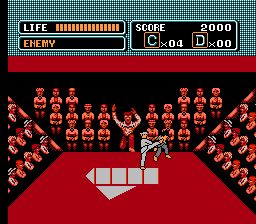
As we go through LJN we will see some instances where the developers made some strange games. The Karate Kid, however, plays it safe. The game starts with a karate tournament, but after this brief section it turns into a mostly standard martials arts side scroller. If you've ever played Kung Fu or Black Belt than you probably know what to expect. The levels are dotted with bonus games that earn you special movies. I always accidentally use my special moves the second I leave the bonus rooms, but I'm not going to fault the game for that. I can't complain too much about the controls. It's an up-to-jump game, but most martial arts games from the era are, and I certainly didn't have any trouble controlling Daniel-San. It's also a very nice-looking game for such an early release. 1987 was still dominated by chunky neon sprites. The Karate Kid has much more realistic character designs and a muted color palate that makes it look like it actually takes place in our world. This is something I would expect from a game a few years newer. If you're looking for a nostalgic game that doesn't come up as often this might be a decent choice, especially since it's still fairly cheap. Of course, it does have some major flaws.


(Most of the game looks like this. I appreciate the map.)

Recently I saw The Karate Kid on a list of the top ten most difficult NES games. I have a feeling that the person who made the list didn't actually play it. It's the kind of inexplicable pick that can only come from one source: The Angry Video Game Nerd. The Karate Kid was one of his earliest videos, and sure he struggled with it. But it was a scripted video and not an authentic playthrough. You guys know he exaggerates the difficulty of games for comedic effect, right? He really dwells on those bonus levels which are purely optional and don't cost any health. My major complaint with The Karate Kid is just the opposite. It's too easy and too short. I had a bit of trouble finishing it now that I am an old man, but when I was young I beat The Karate Kid the same day I first played it. There are no continues, but the whole thing only takes about twelve minutes, and there are plenty of health drops. I believe the only enemies that require more than one hit are the bosses, and they're just like the regular enemies except stronger. Many of my deaths were of the cheap variety. Sometimes I'll get stuck on the scenery and can't fight back and one unlucky time I respawned above a hole and experienced instant death. If all goes well this really is one of the shortest platformers on the whole console. I can see why someone might feel ripped off by The Karate Kid. Imagine getting this as a full-priced game in the late 80s. Games were closer to $100 in today's money, and there weren't that many to choose from. You would certainly want a game that lasted. It's too repetitive to be one you'll want to play over and over, so it really is just a one-and-done. I can definitely see 1987 kids taking this game back to the store and getting The Legend of Zelda instead. That was even before rental stores were that common. Difficulty on NES is a balancing act, and unfortunately The Karate Kid swings too much in the easy direction. 


(Here's that funny thing. It's not so interesting out of context)

Not surprisingly, The Karate Kid is right in the middle of my listings. On the NES-specific list it is 27/52. I can't believe I've ranked 52 NES games without hardly writing about any that people actually care about. When all 700+ games are ranked The Karate Kid will likely be a bit farther down than the middle, but it's not a complete disaster. This was a game made for rentals and cheap thrift stores. A lot of people who got into collecting around the time I did likely bought it as one of their earliest used games. Even now it's only about $12, which is about as cheap as it gets for non-sports titles. It's not a great game, or hardly even a good one, but it certainly has its place in the world of NES. 


NES Quality Percentage: 25/52 or 48.07%

https://docs.google.com/document/d/1G01RKJ7-caaal5lgFfGgPfZRGcqWlv4E3E2E615UYKg/edit?usp=sharing
Saturday, February 8, 2025

Neo Geo Pocket Color #7: Samurai Shodown 2


Developer: Saurus

Publisher: SNK

Release Date: 1999


SNK had a very noble goal when releasing the Neo Geo Pocket Color. They wanted to actually make good handheld fighting games. In the late 90s that seemed like an impossible task. Ever since Street Fighter II became a game changing hit, fighting games became a staple on just about every console. Even venerable consoles like the NES and Master System had some interesting fighting games near the end of their lives. Game Boy and Game Gear had plenty of fighting games as well, but they were almost always universally panned. They must've sold alright because there really are a lot of them, but it was difficult taking something so famously 16-bit and shrinking it down on a much less powerful system. Thankfully, SNK was here to save the day. They were very confident in their abilities too, because fighting games take up almost a sixth of the console's scant US library. It's what SNK was most known for, so of course they were going to flood the market. So, was it a success? The handheld's quick death would imply that it was not, but the Pocket Color's death had nothing to do with the quality of the games. This is a very complicated was of saying that Samurai Shodown 2 is a quality game.


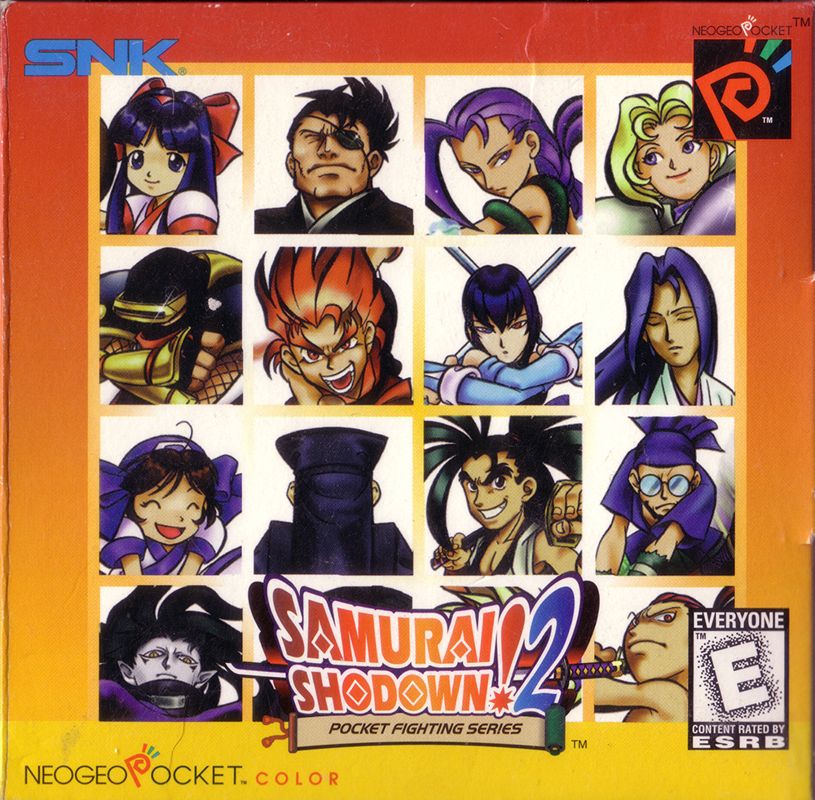
I am not very familiar with the Samurai Shodown series, so I can't judge it by the series as a whole, but the handheld version is certainly well-executed. In a way it's the opposite of Double Dragon V. Samurai Shodown 2 has a much more varied roster of fighters who feel unique. There are fifteen characters to choose from, and with each one having two different fighting styles it's more like having thirty fighters. That may be a slight exaggeration, but fifteen was still an impressive roster at the time. It's funny that Samurai Shodown is mostly humans and Double Dragon V is cartoonish monsters, but Double Dragon V is still the one that feels more generic. It doesn't matter how wacky your characters look if all they're going to do is spam weak punches. 

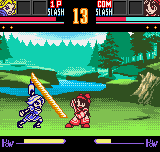
Samurai Shodown 2 remembered to focus on the combat, and it works surprisingly well with only two buttons. I am certainly a more casual fighting game fan, so I don't know how a Sushi-X type might feel about it, but I would have a hard time faulting a game for being easy to execute. I could pick any player and grow comfortable with their moveset fairly quickly. Special moves were fairly easy to figure out on my own, and some are gained on cards earned throughout the game. Characters have a boost gauge that fills over the course of the battle, and this can be used for devastating special moves. The moves are not automatic, so there is still some skill needed for them to land properly. I enjoy that there are no cheap moves. The game manages to be fairly challenging as well. It's not a punch spamming game in the slightest.  I always felt that I could improve with practice, so nothing ever seemed hopeless. It's easy to play and offers a decent challenge. That's a recipe for success.

I always thought I would get back to Neo Geo Pocket Color sooner. I reviewed that big chunk of terrible casino games all at once, and never did get around to reviewing any of the more significant games. The only good review I have given out so far is for Pac-Man, and that is a game I'm sure you're all getting tired of reading about. Well, the redemption starts today. Samurai Shodown 2 is now game #71 on the list. It's easily in the good section, and it won't be the last good fighting game I play for the NGPC. I'm only ten games away from having a full hundred good ones, and if I focus, I'm sure the Pocket Color will help me get there. Of course I've never focused before, but you never know. Maybe 2025 will be my year. 


Neo Geo Pocket Color Quality Percentage: 2/7 or 28.57%

Wednesday, January 29, 2025

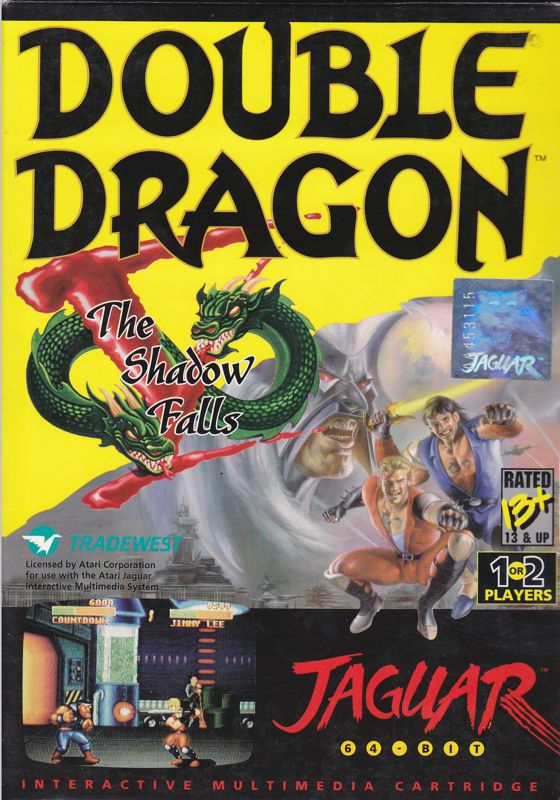
Atari Jaguar #11: Double Dragon V: The Shadow Falls


Developer: Telegames

Publisher: Williams

Release Date: April 5, 1995


Having a blog based on my own whims can get me into trouble sometimes. For example, I probably shouldn't have written about Fight for Life already. In the hierarchy of Atari Jaguar fighting games, it's the Plan 9 From Outer Space. It's a game made to be written about and studied. I got Jaguar's worst and funniest fighting game out of the way first so I could spend the rest of my time talking about the boring leftovers. How am I going to get an interesting article out of Double Dragon V? The only thing that's interesting about it is the franchise it's connected to. Double Dragon was a powerhouse in the NES era, but by 1995 it had fallen onto hard times. It feels like Double Dragon should've been riding high. There was both a cartoon series and live action movie based on the franchise around the same time, but Double Dragon V would be the end of the road for the main series. I wish there was a terrible 3D Double Dragon game on PlayStation because I'm sure that would be fun to talk about, but alas, it mostly ends here. Of course, after playing it I can see why.


Double Dragon V tries something that almost never works. It switches genres from the previous titles. Fighting games were all the rage in the mid-90s, and the Double Dragon team probably felt like they helped create the genre, but all the previous games had been side-scrolling beat-em-ups. It's a type of game they were quite good at making. By 1994 the gaming world was awash with mediocre fighting games, and I don't think anyone wanted to see their beloved franchises turn into one. This wasn't a spin-off after all, it was the next main game in the series. Of course, all would be forgiven if they made a high-quality game, but unfortunately it has the same shallowness of previous Double Dragon games with none of the charm. 

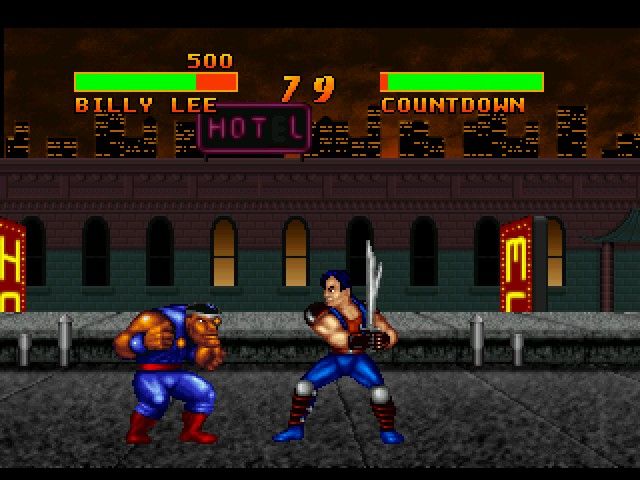
The first thing I noticed booting up the game was that I didn't recognize any of the characters besides protagonists Billy and Jimmy Lee. Apparently, most of the other characters are from the cartoon show, which I never saw despite being obsessed with both video games and cartoons at the time. I mean, I saw the Mutant League show, and that one was obscure and terrible. However, I can tell that they didn't bring over all the characters from the cartoon because the women characters are oddly sexualized. I don't have a problem with games including a playable dominatrix on general principal, but it does show that the developers weren't quite sure what they wanted to do with this game. It's a mature game based on a children's show that it hardly even references. They really just wanted to turn into Mortal Kombat without the conviction to actually do so.


This attitude crosses over to the gameplay. It doesn't have the martial arts focus of the earlier games or the over-the-top violence and special moves of Mortal Kombat. I honestly couldn't figure out how to do any of the special moves. I think they require the keypad which only adds to the confusion. Luckily, the opponents don't know the special moves very well either. So, this one becomes an oddly slow-paced button masher. It moves quickly enough, but none of the attacks seem to do much damage. Most of the matches I played ended with the timer running out, which is never good in a fighting game. I did wonder if I could take advantage of this. I tried spamming a couple of hits and then avoiding damage for the rest of the match, but that didn't work. So at least this is a game you actually have to pay attention to. I will say that much. It just doesn't end up making much of an impact. I don't want my Double Dragon game to be a skeleton dude mashing out punches until time runs out. It just doesn't work, and since this is a game nobody's ever heard of despite being released for SNES and Genesis, I suppose the world agrees with me. 

My Jaguar journey has now gotten into a slow, boring grind. I have reviewed many of its most infamous games and have to get through the garden variety bad ones. I'm afraid that if I want to keep my sanity, I might have to do something that I have been avoiding. I might have to actually start reviewing some good Jaguar games. I know that's not what anyone wants, but it's going to happen eventually. Unless you want me to review White Men Can't Jump first. That's definitely the funniest game I have left. Of course that's a discussion for another day. Double Dragon V is in the red section, but it's the new benchmark for bad Jaguar games. It's the highest ranked one at #7 and #153 overall. It splits the two racing games being worse than Atari Karts and better than Checkered Flag. I can't say I have all that much confidence in Jaguar's racing and fighting games. Too bad they didn't make more pinball games. Apparently, they are the only ones I like.

Atari Jaguar Quality Percentage: 2/11 or 18.18%

Saturday, January 11, 2025

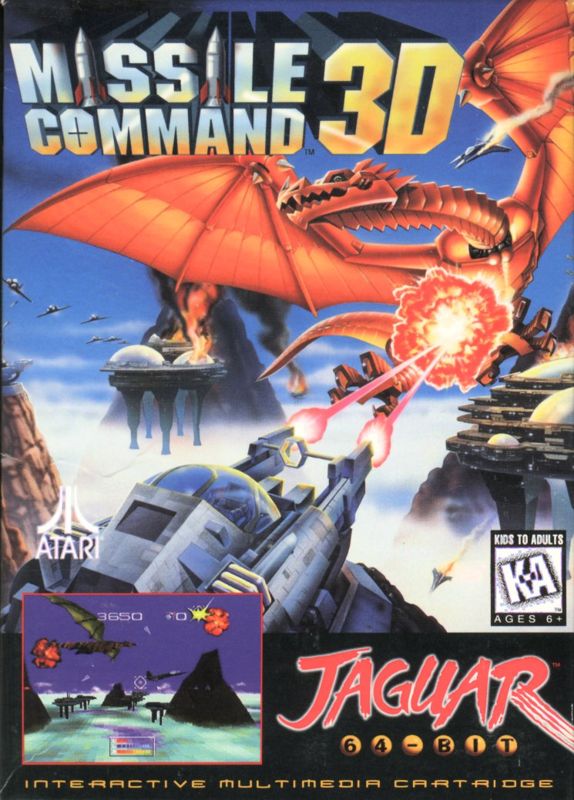
Atari Jaguar #10: Missile Command 3D


Developer: Virtuality Entertainment

Publisher: Atari

Release Date: December 12, 1995


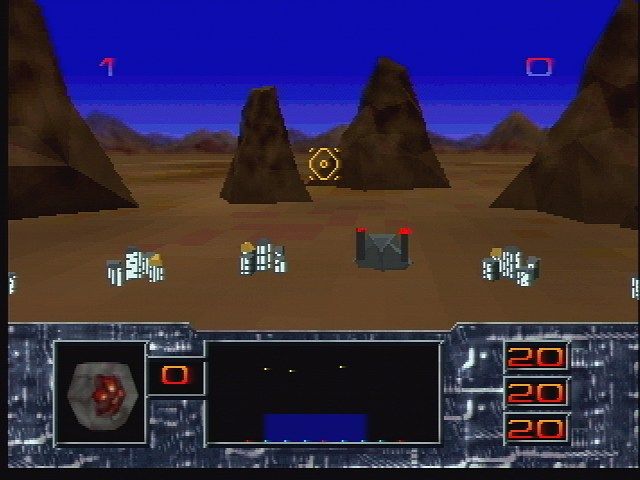
Atari has always loved nostalgia, so it's surprising how little of an impact their classic games had on the Jaguar. There is one notable exception that I will get to eventually, but most of their attempts at updating classic games came out at the tail end of the console's life with practically no one noticing. Maybe it was just too soon. Atari would find success in the late 90s with a wave of nostalgic updates, but maybe during the Jaguar era that demographic was just too young. Or maybe the Jaguar was just cursed and nothing would've ever worked. That's a distinct possibility as well. Missile Command 3D is one of three Jaguar games directly based on a popular Atari 2600 game, and it was certainly a game that still had legs in the 90s. I know I had the Game Boy version of the original, and I used to play it all the time. It was one of my favorite old arcade games, and I would've loved an updated version. So how could Missile Command 3D Fail? It's not like every Jaguar game is a sad mess that shows just how lost Atari was. They're not all failures in the same predictable ways. That's only true for 95% of them. Maybe Missile Command 3D will be the exception.


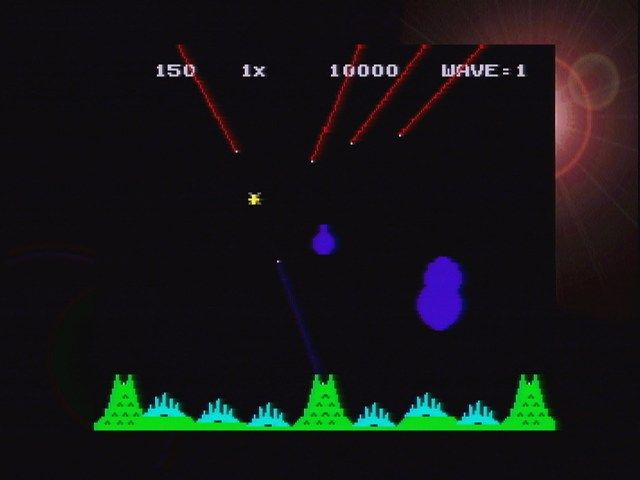
Missile Command 3D is not the exception. It's not as much of a disaster as we've come to expect from the Jaguar, but the errors become apparent very quickly. It's the same story as so many other Jaguar games. It looks great, but the developers just didn't know how to turn it into a good game. Missile Command is a game that is meant to fit all on one screen. The whole fun of it is that you can see the missiles coming and watch them blow up with satisfying chain reactions. You can discover this too if you have a copy of Missile Command 3D. They very wisely include a version of the original game. It's fun on Jaguar, and if the enhanced version was just the original game with better graphics and tighter controls it might be a minor winner. Unfortunately, they had to go and get cute with it. 

The developers decided to make everything bigger in the main 3D mode, which sounds like a good idea but does nothing except slow the gameplay down. Now the levels scroll, and there is a large amount of space between the cities and top of the screen. This would be alright if the game was still fast and exciting. I think they overcompensated a bit to make up for the bigger space. Everything is slowed down to a ridiculous degree, especially in the earlier levels. Those enemy missiles inch along giving you plenty of time to aim, and your missiles take a couple of seconds to reach their targets. For an arcade game this is just too slow. Things do get hectic a few levels in, but it still feels sluggish. There are just more slow things happening at once. It's not painful to play, but it certainly doesn't come anywhere close to the classic original game. 


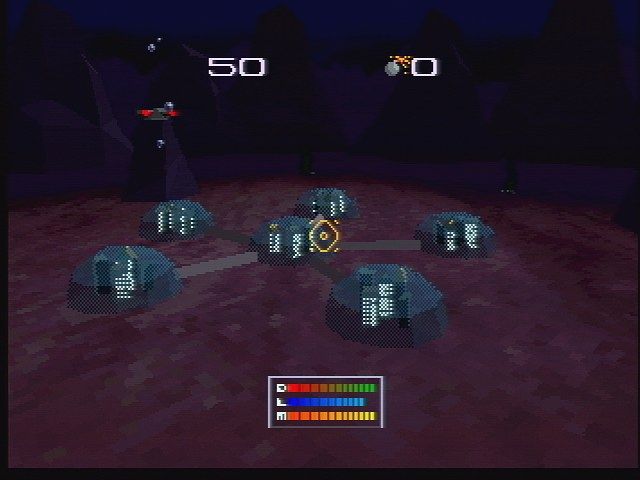
Because this was the mid 90s, the other included game is inexplicably called virtual mode. I have no idea what is supposed to be virtual about it other than the first-person perspective, but it's a little bit better than the 3D mode. It moves the action underwater with a variety of different enemies and weapons to choose from. This mode is closer to the Missile Command expansion I was looking for. It's an update of the original formula that includes more modern touches like power-ups and boss fights. It even has multiple environments including outer space. I couldn't progress that far thanks to a couple of difficult bosses, but it's certainly a step in the right direction.


Sadly, Missile Command 3D did not keep my attention for very long. Even virtual mode played like a slowed-down version of the original arcade game, and that's only going to be interesting for so long. I'm just not sure Missile Command is a game that can be adapted well. It's such a specific game that needs specific mechanics to function. The developers here tried out making the screen slightly bigger and it messed everything up. I'm sure I have other Missile Command sequels to play that will hopefully change my mind, but Missile Command 3D sure makes me feel like some games are best left in the past.

Of course this is a Jaguar game, so while it might rank lower on a different console, Missile Command 3D is in the middle of my Jaguar rankings. It's in the "bad but not shameful" section right above Atari Karts. I guess I'd rather play an iffy arcade update than a poorly made kart racer. Someday this list will include a good Jaguar game that isn't pinball, but that day will have to wait. I have now reviewed 20% of the Jaguar cartridge games, so at this rate there should be 10 good ones. I sure hope that isn't an overestimate. There must've been something Atari did right. 

Atari Jaguar Quality Percentage: 2/10 or 20%


https://docs.google.com/document/d/1G01RKJ7-caaal5lgFfGgPfZRGcqWlv4E3E2E615UYKg/edit?usp=sharing
Monday, December 16, 2024

Atari 2600 #25: Stargunner


Developer: Telesys

Publisher: Telesys

Release: 1983


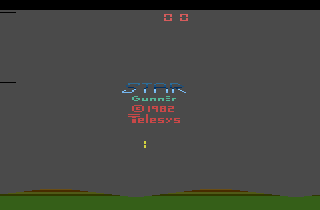
Stargunner has everything I have come to expect from a Telesys game minus one important thing. It doesn't have a funny name. Didn't they get the memo? Telesys games are supposed to have silly puns in their titles. The box art isn't funny either. It just looks like a Stargunner. I don't know what order the games were released in, but I know that at the very least Demolition Herby has a later serial number. Perhaps with Stargunner they were just taking a break from funny titles and not abandoning them altogether. At least it gave me something to talk about in the first paragraph. I already mentioned that Stargunner gave me everything I expected. What I meant by that is they simplified a much more famous arcade game so that it could run quicker on the 2600. 


In this case their inspiration in the classic Defender. I loved the Atari 2600 version of Defender when I was a kid, and it has such sentimental value to me that I have no idea if it's good or not. I think it gets a mixed response, but it's also not a game that was done so bad that people needed a replacement. Telesys didn't add something missing like they did with Demolition Herby. They just took a very famous game and used it as the inspiration for their much less famous game. It's not purely plagiarism, but it doesn't take very long to see where they got the idea for their game. 

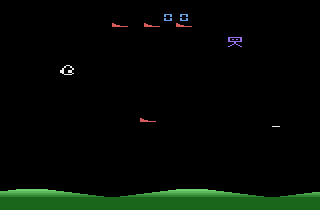
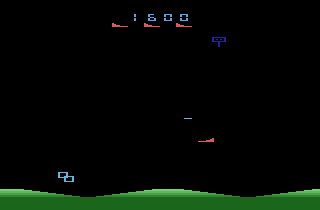
Stargunner is a much more stripped-down experience than Defender. While Defender featured an entire city complete with a map, Stargunner only has one screen. The rolling hills at the bottom of the screen give the illusion of size, but if you fly to the edge of the screen, you just pop up back on the other side. The targets on the screen are also more passive. They don't shoot at you and can only attack by colliding. There is a ship at the top of the screen that shoots down at you, so there's plenty of action to deal with. The objects on the screen are a bit abstract so I'm not sure how to describe them. Maybe an onigiri and an enzyme? Well, whatever they are they must be eliminated. So, you shoot one target, it turns into another target, and you keep doing that until you die. It's simple, but it plays well. It has a certain addictiveness to it. 


My main problem with Stargunner is the poorly balanced difficulty. On the default easy setting the game can get almost boring. The targets move slow, and the shots coming from above are easy to avoid. Of course, this is the starter difficulty, so it's supposed to be easy. What of the other difficulties? Things get too intense too fast. Even the second option is much too hard. The ships suddenly zip across the screen, and their one goal is to collide with you. I could barely get a shot off without having some kamikaze aliens blow me up. I could easily get 30,000 or more points on the easiest setting, and on any higher difficulty I could barely break 1,000. I just wish there was a difficulty between the two extremes where the ships were more of a threat but not constantly suicidal. It's a shame because if it was well-balanced, it might be a true hidden gem. 

When I'm comparing every game ever made, 2600 games have to really be good to break into the green section. Stargunner doesn't rise up to that standard, but it's still alright. It's sad that of the three highest ranked Telesys games, two of them were adaptions of already existing arcade games. I feel like Telesys was a company that wanted to have big ideas and memorable games, but they fell short. It could've been that they ran into the crash just about the moment they started and just had to do whatever they could to survive. I'll probably never know for sure, but they weren't phoning it in either. Stargunner comes in at #115 which is almost halfway up the list. I'm already up to 184, which means I'm getting close to 200. I should play something special for my 200th, but that's a story for another day. 

Atari 2600 quality percentage: 9/25 or 36%

https://docs.google.com/document/d/1G01RKJ7-caaal5lgFfGgPfZRGcqWlv4E3E2E615UYKg/edit?usp=sharing
Wednesday, December 4, 2024

Atari 2600 #24: Ram It


Developer: Telesys

Publisher: Telesys

Release Date: January 1983


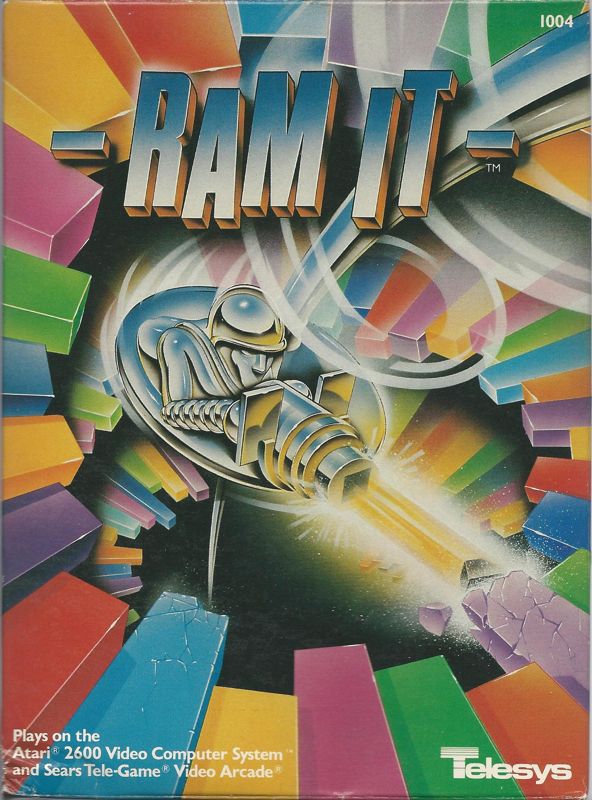
(The box art implies the existence of circles. Sadly, none are featured in the actual game.)


I pride myself on being able to make a good essay out of anything. I love to take insignificant things and turn them into interesting written pieces. However, 2600 games can push me to my limit sometimes. So many of them are single screen games that have simple goals and were made by phantoms who were in business for about six weeks and left behind no digital footprint. I can't even pad them out with biological information because there is none to be found. It's even more difficult with a company like Telesys that I have already covered and have nothing new to say. I've already told what little of their story I can tell, and now I have to fall back on the hope that their last couple of games are at least interesting to talk about. Well, Ram It is an essayists worst nightmare. It's not a terrible game, but it is about as simple as games get. I think I could get some more interesting stories out of a tic-tac-toe simulator than I can out of this game. I guess the name is a little funny. Of course, I've already talked about how they made boring games with funny titles. I guess I'll just get into it, and we can all make the most of what we have.


(One thing I will say about Ram It though. It is definitely this game.)


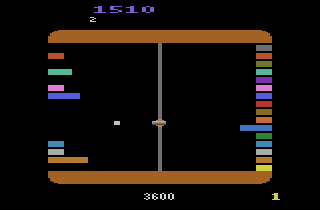
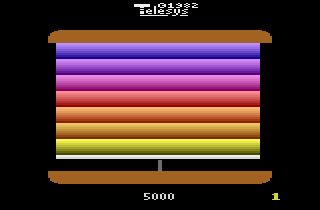
Ram It has you controlling a gun attached to a rail in the center of the screen. You can move up-and-down and shoot either direction, but you are otherwise stuck. Your goal is to take out all the colorful rectangles that are slowly filling the screen. They start out tiny, but they will randomly grow until you are trapped. There is also a countdown that will cost you a life if it runs out, so you have to hurry. Once you destroy all the rectangles you get to move on to the next level which is a little bit harder. It's the standard Atari setup. I can tell their main goal was to have as many colors on the screen as possible. It looks very nice, and it certainly shows off how far the Atari had come during its lifespan. I like how the top and bottom are curved with makes it look like you are trapped in a big, colorful burger. 

It looks nice, but there is something unsatisfying about shooting at passive rectangles. They don't do anything but grow, and even the growing is random. My main strategy on easy mode is to start from the top-left, shoot my way down to the bottom, and then shoot my way back up from bottom-right. If I aim just right, I can take out two rectangles at once and then turn around and take out two on the other side. In fact, this is just the strategy they recommend in the instructions. I can practically ignore the length of the rectangles and just focus on the system. It's a successful system, but not a very exciting one. It is more frantic on higher difficulty settings, and they add in bonus blocks that will disappear completely if you shoot them while flashing. It's some much needed variety in an otherwise very repetitive game, but the straight-line strategy is still fairly effective. 

And that's about all I can say about Ram It. I hate it when my reviews become nothing more than describing the gameplay, but Ram It doesn't give me much material to work with. The name is funny I guess, but not funny enough to keep a review going. Ram It came out in the era when dozens of amateur companies started making terrible 2600 games and flooding the market with junk, so it actually looks fairly good stacked up against the competition. It's well made, and there is something mildly addictive about the gameplay. Unfortunately, all those terrible games are much more interesting to write about. Ram It is a competently made mediocracy that was probably appreciated in the dark days of 1983, but nothing special when stacked up against the whole library. 


(Suddenly I am hungry for a Pride Burger. Is that a thing?)


Ram It is very comfortably in the purple section just like most Telesys games. With their weird titles and fun box art I expected more. The only one I have left to review is the one with the least interesting name, so maybe it will be the most fun to play. I may write about some more boom-era publishers because I think their stories are interesting even if the individual games are not, so get out your Atari bingo cards. Ram It ranks in at #127 overall and #15 on the Atari list. I have a feeling the majority of the less famous third-party games are going to be about as good as Ram It, so I have quite the journey ahead of me. I hope you like reading about boring old Atari games, because I probably still have hundreds of them to go. 

Atari 2600 Quality Percentage: 9/24 or 37.5%

Tuesday, November 26, 2024

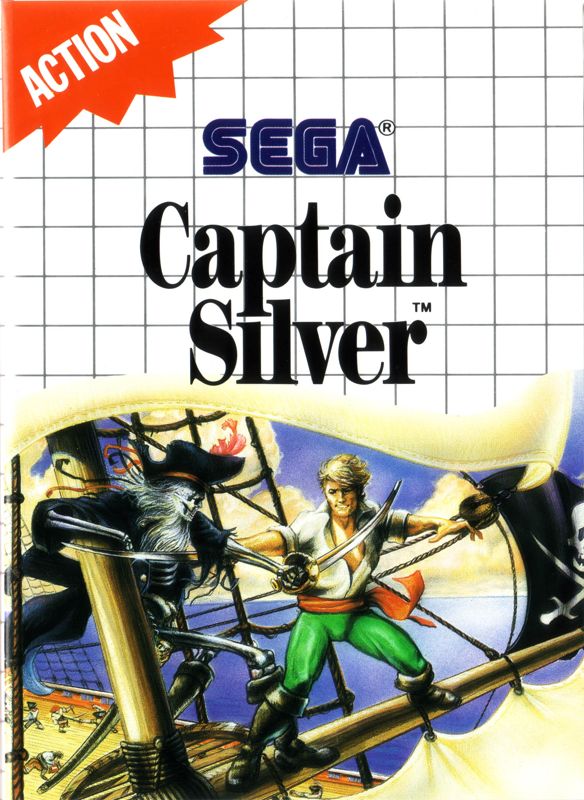
Sega Master System #11: Captain Silver


Developer: Data East

Publisher: Sega

Release Date: September 1989


Recently I was thinking about how positive I have been toward the Sega Master System. 70% of them have been good so far? That's way too many. I've got to find some lesser games to balance things out. To do this I decided to go back to a game I have a bit of a history with. Captain Silver was one of the first SMS game I ever owned. I found it thrifting in my tiny hometown which I always thought was odd. It's hard to believe anyone in my town ever owned a Master System, but we had an Atari 7800 so I guess it's not that strange. I didn't have many SMS games at the time, so I played it enough for form a fairly strong opinion. That opinion was that it had to be one of the worst games on the console. Acquiring more games didn't change my opinion much either. It was always one I ranked near the bottom. Several years after buying it I was playing some games for Twin Galaxies. My main goal was setting the record on Hang-On, but I had some extra room on my VHS tape. I decided to get a high score on Captain Silver since none had been submitted so far. My Hang-On record was beaten fairly quickly by someone with more focus than me, but my Captain Silver record stood for years. I spent nearly a decade being the Captain Silver world champion. In spite of this, however, I'm not sure if I fully understood the game. I play it now and it's not quite the trainwreck I remember. Is it actually a better game that I had thought, or am I just getting soft in my golden years? 


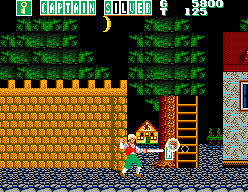
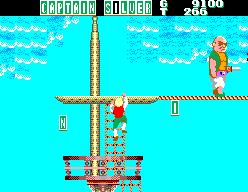
I can certainly tell that Captain Silver started life as an arcade game. It comes from the post-crash and pre-Street Fighter era where shooters and intense platformers ruled. Master System was full of arcade adaptations, and for the most part they tried to keep them authentic. Captain Silver certainly feels like a game that is still trying to eat your quarters. You move slowly and the enemies just keep coming. In the first level they are mostly dispatched with one hit, but as the levels go on, they become more difficult to defeat. I've never been a huge fan of these slow-moving side-scrollers, but I can't say it doesn't execute. The controls are fine, and I never had trouble attacking or jumping. I just find the whole thing a bit dull. There's nothing too exciting about slowly swinging a sword at a slow-moving enemy, even when there are several slow-moving enemies on the screen at the same time. There are a few branching paths and moving platforms that add some much-needed variety, and I enjoy earning extra lives by collecting letters that spell out Captain Silver from defeated enemies. There are also shops that sell a few power-ups, but unless you haven't upgraded your weapon all the way they are pretty useless. It just doesn't make much sense saving up 30,000 coins to buy an invincibility potion that only lasts about thirty seconds. Nothing they try keeps it from being uninteresting. It's certainly not one of the worst things I've ever played. However, there is another big problem with the American version of the game. 

In most regions Captain Silver came out in 1988 with six levels. The American version came out a year later, and for some reason they took out two of the levels. The instruction manual even says there are six levels, but they are nowhere to be found. With the two levels missing Captain Silver takes a miniscule ten minutes to play through. Nobody is going to beat it on their first try, but it's not a particularly hard game either. By 1989 this kind of brevity was unacceptable. I can't think of a shorter game that wasn't insanely hard. Cybernoid only lasts about ten minutes, but it would take hours to get good enough to finish it. Captain Silver just doesn't have the challenge level to justify being so short. It is novel having an SMS game that I can actually finish, but it's not the most satisfying win. 


I started this review by predicting that I was going to like Captain Silver more than I expected. I enjoyed it for the first couple of minutes, so I actually thought that it was better than I remembered. I suppose it was to a degree, but that's only because I thought it was one of the worst games of all time. At the very least I can say that it's not the worst game on Master System, and it probably won't be the worst game released in the US either. The controls and graphics are fine, and it can be entertaining in short bursts. As a complete package, however, it is too short and too basic to generate much interest. The Master System was known for its arcade ports, and Captain Silver was released after so many better ones had already been released. It even came out a month after the Genesis was released. Nobody was thinking about Captain Silver when there was 16-bit Altered Beast to play. Of course, it could be a better game than I'm giving it credit for. Maybe I'm just bitter because someone beat my record. 

So, after all that Captain Silver still ends up in the bad section. At least it's near the top, and I'm even putting it above Robodemons. It is 138 overall which makes it the third best bad game I have ranked so far. On the Master System specific list, it ranks 10 out of 11. It's better than 20-em-1, but it is the worst of the American games I have played so far. There are 114 US games, so we'll have to get through 104 more to see if that dubious record holds. That would make it stronger than my Captain Silver record, but at least I'm not bitter about it. I just think about how somewhere out there someone played Captain Silver even more than I did. This is one of those stories where nobody wins. 


Sega Master System Quality Percentage: 7/11 or 63.63%

Tuesday, November 19, 2024

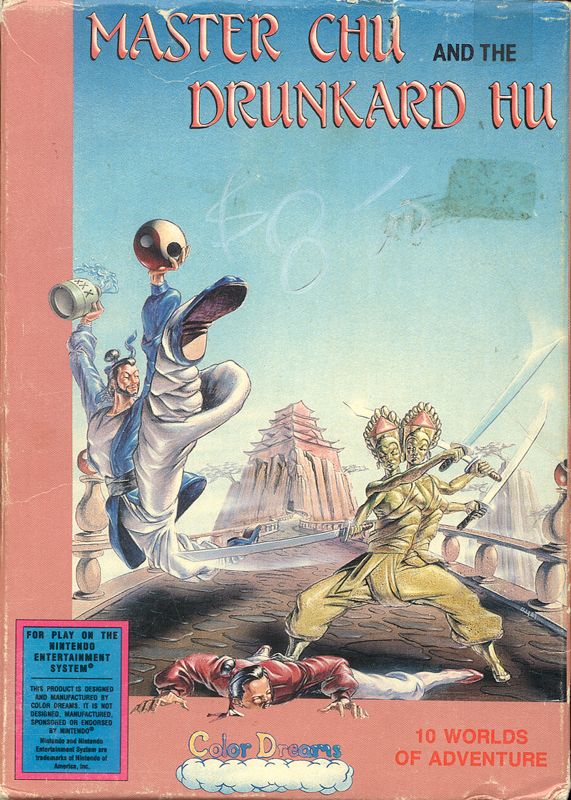
NES #51: Master Chu and the Drunkard Hu


Developer: Joy Van

Publisher: Color Dreams

Release Date: 1989


("10 World of Adventure" is only accurate if you consider taking a nap an adventure)


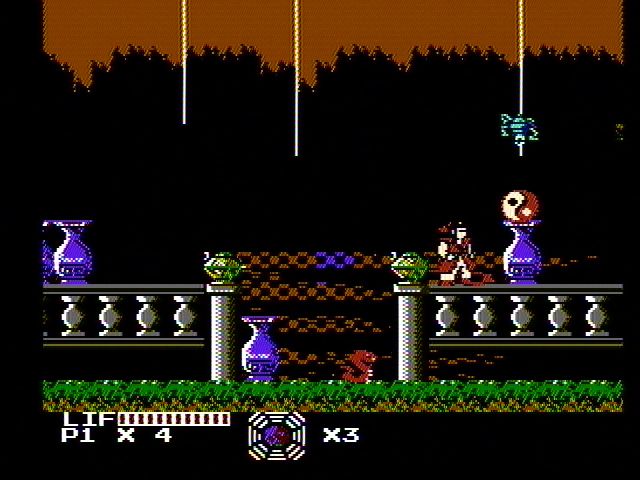
If you know anything about Master Chu and the Drunkard Hu, it's probably from the Angry Video Game Nerd. He covered the game in one of his earliest videos, and it was strange going back and watching it after so many years. For one thing it's only around four minutes long. That was fairly normal for early YouTube, and remembering the earlier short form days makes me feel a little old. Hey kids, did you know back in the day YouTube videos could only be ten minutes long? I used to watch Mystery Science Theater 3000 episodes cut up into 10 parts with sneaky titles so they wouldn't get flagged. Anyway, it was one of his shortest reviews, and one of the most obscure titles he covered back then. There were so many iconic bad games out there yet to be reviewed that Master Chu and the Drunkard Hu just felt out of place. Why did he pick it over every other game? It had to be that title, right? Nothing else on NES has a title even close to being that strange. I remember seeing this game at my local video store for years but always being afraid to actually rent it. Would my parents get mad at me if I rented a game about a drunkard? It's only the first paragraph and already I'm rambling. You know a game is boring when I start talking about the good old days. I didn't even like the good old days that much. Okay let's get on with it.


There's not much you can say outside of "it has a funny name and it's bad." That's about all AVGN had to say. It's not even bad in a very interesting way. Many of the Color Dreams games were developed in house, and those are fun to talk about. They get increasingly strange and amateurish as the company got more and more desperate. Their strategy of quickly releasing game after game backfired spectacularly, and it's the stuff of bad video game legend. Master Chu and the Drunkard Hu was made by Taiwanese company Joy Van who would later merge with the slightly more familiar Sachen. They specialized in cheap, tiny games usually made to be in multi-carts. If you've played many unlicensed games than you've probably seen their name. They were very prolific and ended up on just about every cartridge-based system in the 90s. Sometimes their games were properly licensed, but usually they went the bootleg route. Master Chu and the Drunkard Hu certainly feels like a game meant for a multi-cart. It's simple, repetitive, and extremely short. It looks more like a real game than a typical Color Dreams release, but it's not going to fool anyone.

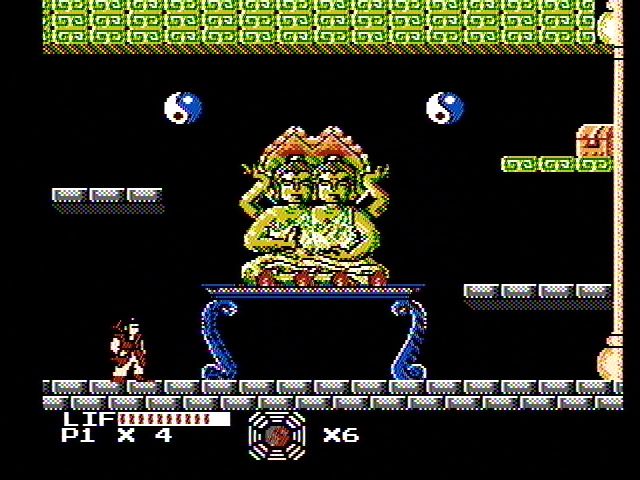
Master Chu and the Drunkard Hu is a side-scroller that requires you to find eight yin-yang symbols and then fight a boss. Sometimes the symbols are out in the open, but more often they are hidden in completely random places and have to be shot to be revealed. Once you collect all eight of them you are whisked away to a boss fight. I do like how you are instantly flown to the exit even if the last symbol you collect is on the other side of the level. Why drag this out any longer than it has to be? It's mostly unremarkable outside of a couple of annoying quirks. For some reason they mapped the A button as a projectile shot and the B button as a fan wave which I think is supposed to be a melee attack. It makes me think that they had originally planned for projectile ammo to be limited and then changed their minds because there is no reason to ever melee attack. Most of the enemies start from far away and shoot things at you. Waiting for a close-up attack would be suicide. This also means that jumping uses the up button. It's not the worst "up for jump" game I have ever played, possibly because it never gets all that intense. I never got confused by it. Sadly, this means that it's not all that interesting. Almost interesting, but not quite.


After the collect-a-thon part of the level you are then taken to a boss fight. This too is very boring as they are all basically the same. They usually move back-and-forth while shooting forward. You just have to hang out on a platform until they turn and then shoot them in the back. Sometimes the platforms above you will have fire, but oddly you can shoot the fire to put it out. Still not very interesting. You repeat this formula five or six times and then fight an uninspired final boss that was just as easy and boring as the rest of the game. At least the game has an actual end screen instead of just text on a field of black. There were plenty of professionally made games that can't say that. 

I always feel weird ranking a game below Rocky and Bullwinkle. I was always under the impression that it was the worst game of all time. Now it's not even in the bottom ten, and Master Chu and the Drunkard Hu slots in just below it. It all comes down to being interesting. Rocky and Bullwinkle is bad, but it's bad in an unusual and unforgettable way. All the levels put in a new type of badness that I had never dreamed of before. Master Chu and the Drunkard Hu is just plain ol' boring. Once you've played it for five minutes you've seen everything. It's still better than Wayne Gretzky Hockey because there's more to look at than fields of blue ice. So, for now Master Chu and the Drunkard Hu is in my NES top 50 at a nice round 50/51. I plan on doing some more unlicensed games in the near future, so maybe it won't get knocked out as quickly as I expect. It's also 171 out of 181 on my overall list only saved from oblivion by a bunch of HyperScan and boring casino games. Nothing dooms a game more than being boring, and Master Chu and the Drunkard Hu should be put in the boring game hall of fame. 

NES Quality Percentage: 25/51 or 49.01%


https://docs.google.com/document/d/1G01RKJ7-caaal5lgFfGgPfZRGcqWlv4E3E2E615UYKg/edit?usp=sharing
Sunday, November 17, 2024

NES #50: Dragon Warrior II


Developer: Chunsoft

Publisher: Enix

Release Date: September 1990


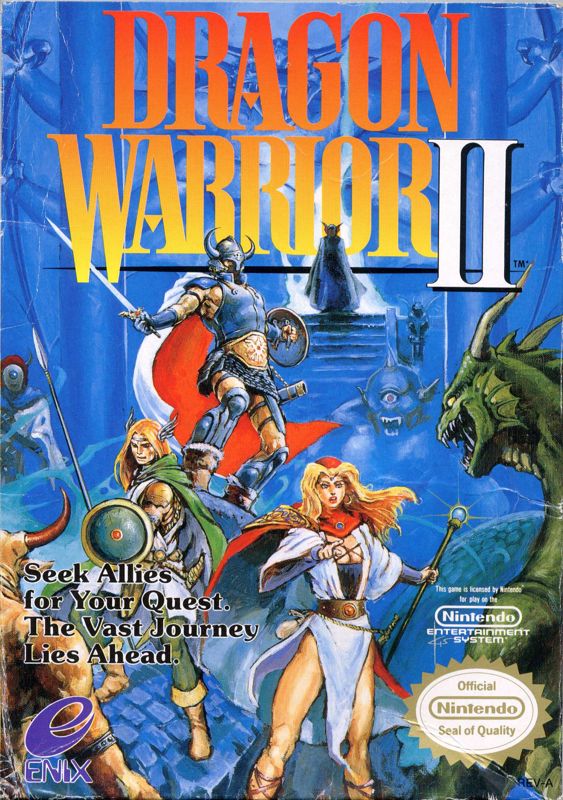
I feel like Enix was powered by pure stubbornness before their merger with Square. At least that's what it felt like in America. How else can you explain them releasing four Dragon Warrior games in the United States? There are not a lot of series on NES that had four or more games, and you certainly wouldn't expect one of them to be a quirky RPG series that didn't even start getting released until 1989. Even Final Fantasy skipped a few games in the west. Enix decided to forge ahead, however, after the original Dragon Warrior became a surprise hit. Of course, that was with Nintendo's marketing. For the rest of the series, Enix would self-publish leading to a much more obscure trio of games. Every used game store has a copy of Dragon Warrior, but I rarely see the sequels anywhere. I know I saw at least one copy of Dragon Warrior II at a store, because I remember buying it many years ago. I also remember nearly pulling my hair out trying to finish it. Dragon Warrior II isn't a game for the faint of heart. It's big, it's confusing, and it is difficult. It's one of the most difficult turned-based JRPGs I have ever played. It's certainly more difficult than Enix's The 7th Saga. It's much more difficult, and everything is bigger compared to the first game, but not all the expansion makes for a better gaming experience. Dragon Warrior II is very much a transitional game.


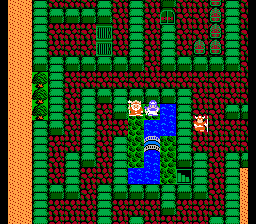
Some of the lessons they learned from the first game translated into a better gaming experience. If you've played any games from later in the series, this one will look and feel more familiar than the original. While the original Dragon Warrior had a much more PC feel with its dark, mazelike dungeons, Dragon Warrior II has the bright, room-based dungeons that would influence the rest of the series. There are significantly more monsters, so fans of the series will see even more familiar faces. For people who obsess over tiny things, using stairs now happens automatically. I was especially happy that they fixed the key problem from the first game. Locked doors are opened by permanent keys that are found out in various places around the world. You don't have to go back to a specific town to buy keys that break after one use. Dragon Warrior II is the first game in the series to have a multi-character party and also the first to have multiple monsters in battle. I will talk more about these later, but they are certainly more in line with other Dragon Quest games. It even has cutscenes thereby expanding the narrative possibilities. It's impressive when an NES game has any kind of story, so the expansion from the excuse plot of the first game is quite welcome. 


It's also much, much bigger than the first game. The original landmass is just a small portion of a much larger map, and they were certainly proud of their bigger space. The first section of the game has your character travelling around a large section of map looking for companions. I feel like just this first continent is bigger than the entire first game. Luckily there are also multiple places to save. You still can't save in dungeons or on the world map, but most large towns have a place to save. If you were driven crazy by the claustrophobic grind of the first game than you will certainly appreciate the expansiveness of Dragon Warrior II. There's a bit less mindless grind and a bit more exploring. Of course, with battles as difficult as they are I've never been able to get into much of a mindless state. There is even a boat for more exploring. It was very impressive for 1987, and three years later it certainly still held up. I don't think it felt as old as the first game did despite its release gap being about the same. It's nothing like the multi-planet madness of the first two Phantasy Star games, but it certainly showed off the potential of RPGs even in an 8-bit setting. It all sounds great, but yet I just can't rave about Dragon Warrior II. I want it to be a masterpiece, but in spite of the developers attempt to make an expanded experience they fall short in some very critical areas. They had many great ideas, but they faltered in the execution. 


I already mentioned the expanded world map, and it's both a good and a bad thing. In the pre-boat section of the game the set-up is at least fairly logical. The main problem is that towns and dungeons are too far apart. There are big sections where there is simply nothing to find. And while the first few towns are clumped fairly close together, as the game goes on, they get farther and farther apart. After the party gets their boat things become extremely confusing. Most of the new areas are shaped oddly with the important points hidden deep within the continents. It's very easy to get lost out there looking for a new area to explore, and it doesn't help that there is no in-game map. Hopefully you bought this game new and had your fold-out map handy, or you exist in the internet era and looked one up. I can't imagine renting this game thirty years ago with no instructions or map to help me. Also, the teleporting item, wings of wyvern, only takes you back to the last town you saved in. The second half of the game features a lot of traveling, and it's hard when there's no quick way to travel between towns. All the while you have to put up with a downright brutal encounter rate. I can't tell you how many times I encountered battles within five steps of each other, and it's not unusual to fight two battles back-to-back. Just about every Dragon Warrior game going forward would have great world maps, and big quality of life improvements would be on the horizon, but in this early state it doesn't quite come together.

And it's the game's biggest innovation that I have the biggest problem with. I certainly love the concept of having multiple party members. Later in 1987 Final Fantasy would show gamers what was possible with a multi-party system. Every type of character had unique skills and weaknesses. Chunsoft would copy this model to great effect with Dragon Warrior III. Unfortunately, with Dragon Warrior II they had no idea what to do with the extra party members. They basically took the versatile hero from the first game and split him up into three people. The main character is only good for attacking with no magic or other skills. The prince, who you pick up second, is mixed character who can fight and cast spells but never gets that good at either. He doesn't get any of the good combat equipment and never gets enough MP to be used as a pure magician either. He is mostly good for casting healing spells. The princess, the final character of the trio, is only good for spells. She has almost no equipment and is constantly vulnerable to attack. Her combat spells are nice, but there is practically no way to restore MP outside of towns, so they constantly need to be rationed. This makes for a lot of battles where two thirds of the party are either going to be blocking or doing scratch damage. 


The game's difficult combat makes the situation even worse. There are groups of monsters to contend with, and you are not able to select which monster in a group each character attacks. This makes it hard to strategize in battle. You can't focus your strong attack on one monster in a group and two weaker attacks on another for example. This leads to many wasted attacks. Of course, sometimes monsters will appear as individuals in battle, but when this happens you can't use group spells on them. Both situations make combat extremely difficult. I've already touched on this, but it bears repeating. Dragon Warrior II is just hard. Battles will see the screen fill up with the most difficult enemies in the area, and they seem to have all the advantages. Monsters are not shy about casting all manner of status spells including those trees that cast instant death spells over and over. Exploring the open world is tempting, but because of the high difficulty you pretty much have to go everywhere in the correct order. Also, why did they make antidote a non-combat only spell? That doesn't connect to the main point of this paragraph. It's just another cruel thing about combat I just thought of.

Now that I've said all that I will admit that I do have fun playing Dragon Warrior II. The formula is just too strong for a Dragon Quest game to be a total failure. Sure, it's difficult and there's a lot of grinding, but there's still something appealing about it. Having three characters that all start at level one means that there's always someone relatively close to leveling up. In a game like Final Fantasy the party is complete from the very first moment, and they all gain levels at the same time unless a party member dies and misses some battles. I like the staggered system better. The difficulty can be frustrating, but that only makes the victories sweeter. Even games I love will sometimes fade from my mind, but I'll never forget playing through Dragon Warrior II for the first time. And while exploration can be dangerous, it's still exciting to attempt. It's not the series' greatest world, but it's still one I want to fully experience. There are enough hidden items and secrets to make it worthwhile. I also enjoy that it is a distant sequel to the first game and even features the original landmass as a late game easter egg. Continuity is rare with RPG series. 

It's a testament to how good these Dragon Quest games are that my least favorite game in the whole series is still my 25th highest ranked game. Of course, my tastes could change as I play through the other ones, so make sure you read those reviews too. It's an awkward and difficult game that is full of great ideas but hindered by its disappointing execution at times. If you are a fan of RPGs and want to play some of the historic ones than I certainly recommend it. If you're a more casual gamer than it's only going to lead to pain and frustration. I am a completely lunatic who has to play everything and even I got frustrated at times. Of course, game #26 on my list is Teenage Mutant Ninja Turtles so I guess that's just the pain and frustration section of the list. That might be the best description of the NES. They made games that were equal parts fun and painful. That might sound odd, but it was obviously a formula for success. 

Nintendo Entertainment System Quality Percentage: 25/50 or 50%


https://docs.google.com/document/d/1G01RKJ7-caaal5lgFfGgPfZRGcqWlv4E3E2E615UYKg/edit?usp=sharing
Thursday, November 14, 2024

NES #49: Robodemons


Developer: Color Dreams

Publisher: Color Dreams

Release Date: December 20, 1989


It's finally time to talk about Color Dreams, one of several unlicensed companies that flourished for a couple of years in the early 90s. Actually, Color Dreams was three of several unlicensed companies. They would also go on to release games as Bunch Games and Wisdom Tree. The fact that they kept having to change their name shows that they had a troubled history. Of course, they were operating illegally according to Nintendo. If you don't know, Nintendo consoles originally came with a lock out chip that would keep unlicensed titles from working. The idea was that Nintendo would only release games they approved of, and this would avoid the glut of shovelware that sunk the Atari 2600. Third party publishers were only allowed so many releases a year with quality being a factor in the number. This explains the Nintendo Seal of Quality. It also explains why games would blink when you turned them on. That was the lockout chip getting confused. It is obvious that Nintendo let plenty of stinkers get released. However, very few of the Color Dreams games raise to the level of the worst licensed games. It's hard to say who were the good guys during the unlicensed era. The people who figured out how to bypass the lockout could be seen as rebels getting around Nintendo's greedy policies because they had something to say and wanted to do things there way. However, outside of Tengen and Camerica, who both had famous companies behind them, most unlicensed games were purely amateur. Collectors usually don't even count them as part of the full set. I do, however, and I will review them along with any normal game. Nintendo ran them out of stores by 1991, but they managed to release 21 games during their brief window. Could a tiny inexperienced company have any sort of quality when they were releasing so much so quickly? Well, let's look at Robodemons.
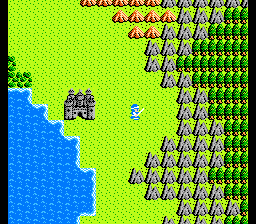
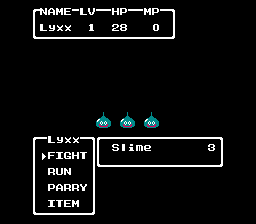
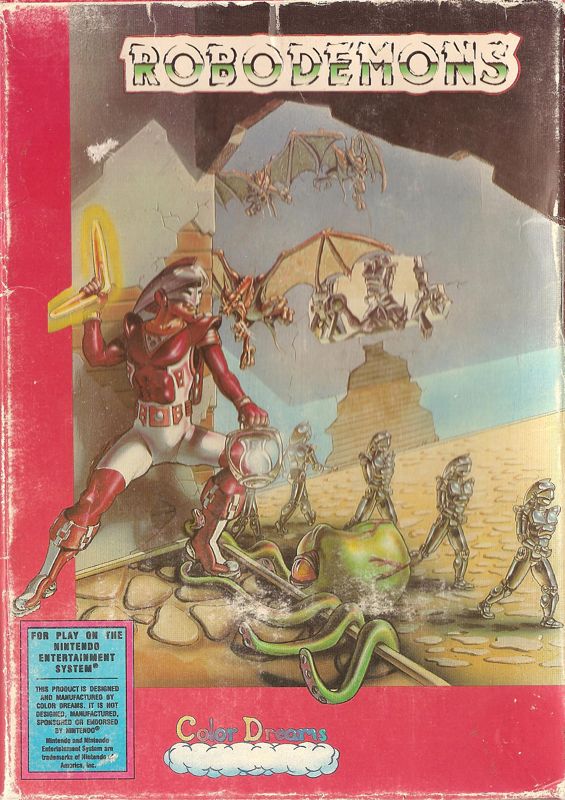


Robodemons is an amateurish oddball, but one that at least plays like a real game. I think if I had rented this game in 1990, I wouldn't have felt ripped off. I sure did that time I rented Crystal Mines and couldn't get it to work, but that's another Color Dreams story. Robodemons is about evil King Kull who took over the Earth by transferring the souls of demons into robots. The don't look like robots though, so the game should probably just be called Demons. They were obviously trying to showcase imagery that Nintendo wouldn't normally allow, so it's full of devils, body parts, and scantily clad women. It's nothing too over the top, but it's still a bit jarring seeing a tied-up woman in a bikini in a Nintendo game. Each level is split into two parts with the first being a shooter and second being a side-scroller. The goals can change slightly from level to level, but typically you are fighting a specific demon in the shooting part and collecting a key to unlock the exit in the second part. It's a decent set-up, and I like how strange and different the side-scrolling parts look. One level you are walking on body parts and another you are in a robot factory. There were plenty of licensed games that didn't get so creative with their level design. The player's weapon is probably the most obvious flaw. It's a slow-moving boomerang that has to either hit something or complete its arc before it can be shot again. It can take a couple of seconds to finish which can be a lifetime in a theoretically fast-paced action game. There are no power-ups to be found, so it's just slow boomerang for the game's entirety. 

The more I played it, the more I noticed how unprofessional it was, but luckily the design flaws mostly worked in my favor. This is a nice change of pace for unlicensed games. Usually there will be glitches and errors that make games unwinnable. With Robodemons, if you can learn how to take advantage of the system than you can actually win. For example, practically no monsters respawn except for a couple of tiny demons. I usually dislike a game with too high of a respawn rate, but it still feels like they only left this feature out because they didn't really know how to do it. The demons don't even respawn after you die, so if you still have a life left your next try will be much easier. There is also a much higher limit on hearts than what appears. The screen only shows five hearts, but I'm not even sure if there is a limit. There are plenty of demons that drop hearts, so I made sure to actually kill them all and save up hearts. I felt fairly invincible after a while. Also, there is usually a powerful enemy guarding the locked exit doors. I discovered very quickly that the best strategy is to just ignore them. You can usually jump right over them and go through the door as long as you have the key. The only bosses that are necessary are a couple in the shooter sections and of course King Kull at the end. I feel like these are all flaws that would've been fixed if the game was professionally made. They are helpful flaws, but they definitely give away the truth behind the game. 


Expectations for unlicensed games are exceedingly low, so the fact that I was able to wring any fun out of Robodemons is no small feat. I can't say it's good exactly, but it's a decent way to start my Color Dreams journey. Maybe if it had a better weapon and it was longer it would be a hidden gem. I beat the game in about two hours, but there's only about ten minutes worth of game. If I knew all the tricks going in, I doubt it would've taken even that long. It does have a plot, but it's all told by text that is extremely difficult to read. Once again, it shows that these guys didn't know what they were doing.

I started this review by saying that most unlicensed games aren't as good as the worst licensed titles. I'm already going to contradict that statement by ranking Robodemons higher than a few of them. I thought it might sneak up into the okay section, but instead it's one of the elite bad games. I ranked it at #137 just behind Mario's Time Machine. It's hard to rank Robodemons above any game with Mario in it, even an iffy educational one. That means there's seven NES games I like less than Robodemons, including one, Baseball, released by Nintendo themselves. I'm not that familiar with the Color Dreams games, so it will be interesting to see where Robodemons ranks overall. Did I just get lucky and play the best one first? Only time will tell. 

NES Quality Percentage: 24/49 or 48.97%

Wednesday, November 6, 2024

NES #48: Frankenstein: The Monster Returns

Developer: Tose

Publisher: Bandai

Release Date: July 1991


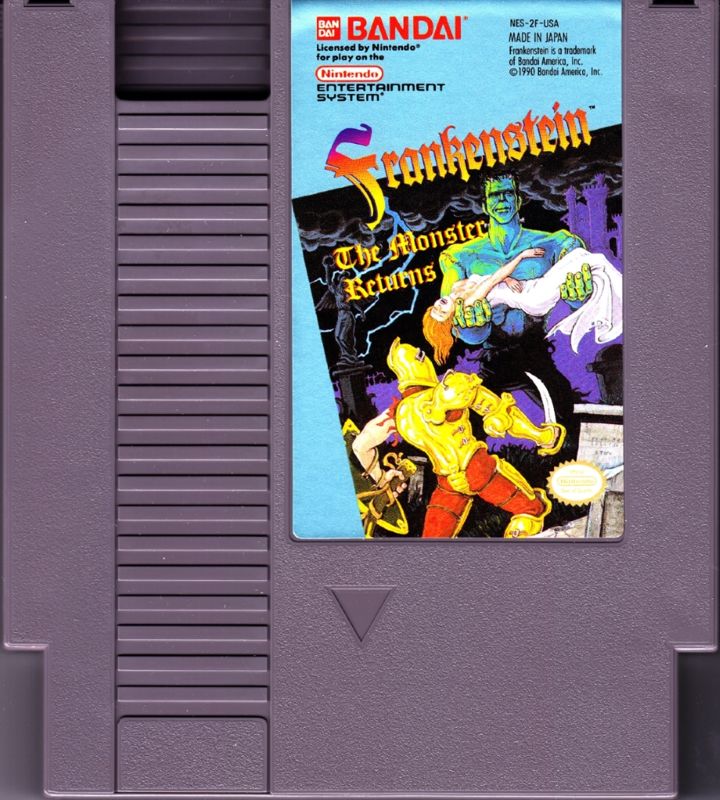
(Unlike this cover, Frankenstein in the game has no chill)


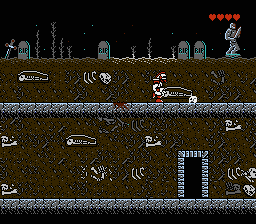
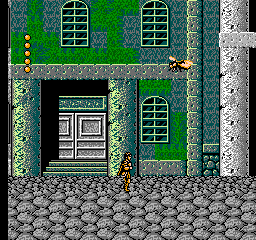
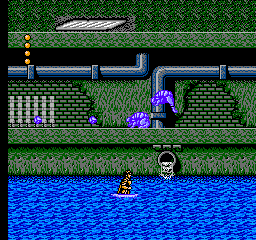
Hey, did you know that Frankenstein is the name of the doctor and not the monster? It's a little-known fact that only gets brought up every time anyone mentions the character. If you imagine a know-it-all man saying this to a woman, then you would probably get along well with Frankenstein author Mary Shelly. It's a book about a lot of things, but it's hard to look past her critique of male privilege. The doctor is allowed to create a life and then quickly abandon it the second things get too hard with no immediate consequences. The monster feels that because he is intelligent, he should automatically be accepted into society. When his forcefulness frightens people, he takes it out on society instead of blaming himself. It's a world where the men make mistakes and expect sympathy while the innocent women in their lives end up being punished. Of course, Hollywood in 1931 wasn't ready for a monster that practically talked his victims to death, so they made the monster a silent brute. The themes of innocent women being punished for man's mistakes still shows up in the movie, but it is much more remembered for Boris Karloff's look and odd pathos. His version of the monster is a killer for sure, but more sympathetic than the chatty, calculating novel version. I bring this all up because 60 years after the famous movie Bandai released a game that throws all the famous interpretations out the window and creates an all-new version of the monster now presented as a cackling super villain. He's more Dr. Doom than Dr. Frankenstein with a new motivation to terrorize and countryside and destroy all who oppose him with an army of possessed minions. Of course, he sets all this in motion by kidnapping and innocent woman. Even with a much wilder premise, the themes of the original book and look of Karloff's movie monster are intact. Also, he's straight up called Frankenstein so just get used to it. What else would you call him anyway? His name is about the least strange thing about this strange game. 


Of course, what else would we expect from Bandai? They were by far the oddest publisher for the NES. They made games that looked primitive and jettisoned typical structures for open-ended strangeness. They adapted little-known IPs and rarely turned them into what we would consider normal games. Bandai is where we got such oddities as Ninja Kid, Dragon Power, and the most infamous of them all, Dr. Jekyll and Mr. Hyde. Just seeing that Banai logo on a game made you know that you were probably going to play something like you had never played before, and it had a very good chance of being garbage. Tose made several of these games, and much like Bandai they had a much brighter future after getting all the weirdness out of their system. They work with Square-Enix now mostly doing remakes of my all-time favorite games. They certainly feel like a company that was in it to last. Even their strangest early games feel like they were made by a team that was really trying. Frankenstein: The Monster Returns is a strange game that is hard to define, but it's certainly not a lazy one. 

The name alone made me think this was going to be a Castlevania clone, and while this comparison comes up in reviews almost constantly, it only resembles Castlevania in its spooky tone. Even then the resemblance is only surface level. Sure, they both have skeletons and ghosts, but Frankenstein is much more varied. Castlevania games are typically grounded in stone castles. Frankenstein takes the protagonist on a journey through much more varied environments. There is a castle, but you'll have to trek through forests and sewers to get there. The gameplay is more like a simplified River City Ransom. It is a somewhat open-ended side scroller with beat-em-up elements. It is divided up into levels, but the levels are full of secret passages and hidden items. They're not all good secrets either. Sometimes a bad jump will send you to an annoying mini boss. I enjoy the presentation though. Environments are vastly different from screen to screen keeping things from ever getting boring. I can't deny it's entertaining. The monsters are odd and challenging, and the overall strangeness of it helps it stand out from countless other NES side scrollers. 


Of course, this is the NES, and Frankenstein's biggest drawback is its difficulty. This is not a game you're going to make much progress on the first time. You start with a weak punch and difficult-to-execute jump kick. Monsters will drop upgrades, and Frankenstein would be practically impossible without them. The problem is that getting hit causes you to lose them. Weapons can be regained if you act quickly, but projectiles are lost for good. The way to beat Frankenstein is to get a projectile early in the game and then never get hit. Luckily backtracking is possible within levels, but it can get a little annoying going back to the beginning of a level to regain a projectile. Frankenstein does have a password and a few continues, but the continues don't reset when you enter your password on your next attempt. It's better to just try the level again if you get a game over and save the continues for later levels. After a few tries I was able to make some progress, so it doesn't cross the line into impossible to play territory. However, the difficulty can be disheartening if you're not used to NES difficulty or just want some goofy game to pass the time. 

I'm pleasantly surprised to say that I had fun with Frankenstein: The Monster Returns. I just love the kooky presentation. I don't think you're going to remember the awkward gameplay moments as much as you are going to remember the over-the-top dialogue and level design. Not every game has hopping tombstones and green-haired medusas. I enjoy the eccentric bosses that branch out a bit from a typical NES horror game. It's not just skeletons and giant bats. It was fun fighting a flying chimera and evil tree spirit for a change. They also have dialogue which gives them actual personalities. It even sneaks in some sympathetic moments as the monsters try to escape from Frankenstein's control. And while it certainly isn't the best-looking game on the system, the levels have enough personality to make up for it. 


So, Frankenstein: The Monster Return somehow sneaks into the good column. I was not expecting much and was pleasantly surprised. It's not super high on the list, but it's still a bit of a hidden gem. I'm ranking it at #82 right above Dracula: Crazy Vampire which was another oddball spooky game. That's a game I feel like I overrated, but I still think it's where Frankenstein belongs. With so many NES oddballs sneaking into the good section I feel that I will have no trouble getting past 100 good ones. I doubt Frankenstein: The Monster Returns is going to make it into the top 100 NES games, but it's certainly worth checking out. 

NES Quality Percentage: 24/28 or 50%

https://docs.google.com/document/d/1G01RKJ7-caaal5lgFfGgPfZRGcqWlv4E3E2E615UYKg/edit?usp=sharing