Saturday, February 11, 2023

Atari Jaguar #1: Trevor McFur in the Crescent Galaxy

Developer: Atari

Publisher: Atari

Release Date: 11-23-93


(I seriously love this box art)


Leading up to it Trevor McFur in the Crescent Galaxy looked like a wild ride. The advertising made it sound like it was going to be a furry James Bond. Was this the kooky mascot game that would propel Atari back into relevance? Was it going to be Metal Gear with more cat puns? The beautifully absurd box art made it look even more exciting. Trevor is a ladies' man as well as a feline spy. Who doesn’t want to play that game? Unfortunately, Trevor McFur in the Crescent Galaxy is not that game. It turns out to be a mostly generic, horizontal scrolling shooter. Now I love these types of shooters, but there were only four games released before Jaguar’s first Christmas, and three of them were shooters. It’s hard to make a big splash at such a critical time when all of your games are so similar. Of course, the Atari Jaguar only managed 50 carts in four years, so lack of games was always a problem.


(The first level plays like a game of Asteroids. It's better just to ignore the big rocks entirely.)


Its release does make some sense, however. It is certainly a technical marvel. At the time of its release, it was one of the best-looking side scrolling cartridge games ever. It’s hard not to look at the photo realistic backgrounds, large sprites, and gigantic fast-moving bosses and not think that Jaguar showed a lot of promise. Huge objects cover the screen with no hint of slowdown or lag. It’s a game that rivals any of the CD-ROM systems of the time on a console that was much, much cheaper. It makes me wonder if Atari would’ve had more success advertising themselves as a cheaper alternative to high-end consoles than going directly after Nintendo and Sega. Of course, asking how the Jaguar could’ve been a success is one of the oldest questions in the retro community. Still, it’s hard to deny that there was potential there.


(Now this is what the whole game should've looked like)


I just wish that Atari had put as much into the gameplay as they did in the visuals. It’s not a bad game, but it’s a game that shooter fans had seen a thousand times before. It has plenty of enemy spaceships, one hit kills, abundant power-ups, and lots of enemies attacking in formation. One of the better mechanics is the ability to save up different types of special weapons and toggle between them. Often in shooters one power-up will replace another. In Trevor McFur you can save them up and use them strategically. You can use your shields in asteroid fields and save the big guns for the boss fights. It’s a nice touch for a game that needs some innovation.


Sadly, Trevor McFur never quite rises above average. It never becomes frantic enough to reach bullet-hell territory, but there’s also not enough variety to keep the slower pace interesting. The levels are too long and unchanging. However, it’s certainly not a worthless game. I am not very good at it, but I still want to get better. It’s engaging enough that I still want to play, so that has to count for something. As far as the ranking goes, I really wanted to push this one into the good section, but it just falls short. It’s right near the top of the okay section in a group of games that are still worth playing even if they are not of high quality. It’s sliding in at #68 just behind that overrated cult classic Demon’s Crest. Hey at least that game made a star out of its wacky main character. It’s a shame that Trevor McFur was kept inside of a spaceship the whole game. Could you imagine if this had been a furry version of Metal Gear?


 Jaguar Quality Percentage: 0/1


The Whole list: Ranking List

Tuesday, January 31, 2023

NES #28: Magic Johnson's Fast Break

Developer: Software Creations

Publisher: Tradewest

Release Date: 1990


 (The jersey is just a generic one, but in a couple years there would be a team called Magic. That's kind of fun)


There are two reasons I wanted to review Magic Johnson’s Fast Break even though old sports games don’t get many clicks. The first one is that Pat Contri claimed, in what just may be the end of his Amico coverage, that it is a one-star game. That’s enough to make me want to play it right there. I love playing games that are old, bad, and that I already own despite having no recollection of playing. The second reason is that I live in Magic’s hometown of Lansing, Michigan. He’s probably Lansing’s most famous native son, and the competition is surprisingly stiff. Lansing was also home to Malcolm X, Burt Reynolds, and Stephen Seagal. That’s impressive for such a modest sized city.  Sadly, there aren’t too many games based on other famous Lansingites, so I was excited to revisit Magic Johnson’s Fast Break as a tribute to my adopted hometown. Of course, just like everything he said about the Amico, Pat Contri was right about this one. No wonder I forgot about this game. It’s about as slight as a basketball game can be.


Magic Johnson’s Fast Break is a 2-on-2 basketball game that feels more like a tech demo than a complete game. I feel that the only reason it exists is because four people can play it at once. Being able to play with three other people is a fun concept, but you still have to make a quality game if you want people to actually buy what you are selling. Unfortunately, outside of four-player action and Magic Johnson’s disembodied head, this game has nothing going for it. There are only two unnamed teams that you don’t even get to choose, and all four characters play exactly the same. Every player is equally adept at stealing the ball and shooting three pointers, and I didn’t notice much difference in speed. The only option besides number of players is difficulty which makes for very little variety. It probably won’t surprise you by now, but there is also no season or tournament mode. So if you’re playing one player it’s just one game per difficulty level. How anyone thought such a skimpy game was acceptable so late in the NES’s lifespan is beyond me.


I might be more forgiving if the gameplay was solid, but there are problems with this too. This may be the only time that a sports game on the NES is too fast. I suppose fast is in the title, but the speed comes in annoying ways. After a shot is made it goes instantly to the inbound pass. It’s so quick that half the time I didn’t even realize what was happening. Stealing and passing are both done with the B button, so often possession would change mid steal and I would accidentally inbound it to the wrong team. This isn’t helped by the lousy shot animation. The net doesn’t move, the fans don’t cheer, and the shots are so low angled that it’s hard to tell if a shot is good or bad until possession changes. The NES was already five years old at this point. There’s just no excuse for such bad execution.


Like most branded sports games from the era, you don’t actually get to play as Magic Johnson. Instead, you are merely encouraged by him. When you do something impressive like making a three pointer, he will pop up and say something like “nice bomb kid.” Honestly the only good strategy in this game is to shoot a three every time, so you’ll see Magic a lot. It’s a good likeness, but it gets in the way more than anything. Sometimes he won’t pop up until the other team is running down the court which messes up the timing. It’s hard to defend when the action suddenly stops mid drive. This is a strange case where the game would be better with less of its star. He gives very generic advice between quarters which is fine but pointless. He will congratulate you if you win the game. Being congratulated by Magic Johnson does have a certain thrill to it, but I wish this was a game that made me feel more accomplished. In the end Magic’s compliment rings hollow, much like the game itself.


There were a few moments when playing that the score was close, and the game was somewhat exciting. I will admit that I enjoyed myself in these moments. This might be more because of the inherent fun of basketball than the game itself, however. The slight fun I had keeps it out of the cellar though, and it ends up right under Fester’s Quest on both lists. The fact that there are already eight games on my NES list under this one is either a bad sign for the console or the result of my questionable game selection. At least I know that many good games lie ahead.


NES Quality Percentage: 14/28 or 50% 


https://1drv.ms/w/s!AvR1pVOGMfAniEZub_KTCsR7twUv?e=cG7vSp

Wednesday, January 25, 2023

NES #27: Fester's Quest

Developer: Sunsoft

Publisher: Sunsoft

Release Date: 1989


(That is some appealing cover art. I wish the game actually had the mansion in it.)


There are some things in life that annoy me far more than they should, such as when IGN released their list of the top 100 NES games well over a decade ago. It was fairly obvious that they did not play the nearly 800 North American games for the system and create an honest list. They simply took the most famous ones and threw in a couple of ultra-rare ones for good measure. It’s something I should really stop thinking about. I know video game lists are meaningless. Well, besides mine anyway. I suppose it bothers me because their rankings seemed to be based more on memory than merit. How else do you explain IGN ranking a game like Fester’s Quest, one that’s much more famous for its flaws than its strengths, all the way up at #45? Either the folks at IGN hadn’t played it since the early 90s or there just aren’t as many good NES games as I thought there were. Honestly, I don’t like either of those options. I’m ranking around 800 of them, so having so few good games to play would be a depressing slog. So, I played Fester’s Quest at the end of 2022 just a few weeks within me writing this review. I’m not clouded by nostalgia and can talk about it honestly. Sorry IGN, but Fester’s Quest is just not that good. It’s not the worst game on your list, but it sure is a flawed gaming experience.


Fester’s Quest is a game that every gamer around my age played and enjoyed for about fifteen minutes. It starts out looking like a Zelda inspired adventure game. That’s certainly an exciting prospect when most licensed games at the time were boring side scrollers. Fester’s gun is upgradable, and there are items and money to collect. Why, this game looks like it’s going to be complex and interesting. There are even other Addams Family characters to find in random houses that give Fester helpful items. Sadly, if you make it very far past the first boss, which is no easy feat in itself, you start to realize that all the complexity is just facade. It doesn’t get much more basic and repetitive than Fester’s Quest, which is really strange considering it’s a game where Uncle Fester is fighting aliens. How can a game with such an interesting premise end up so boring?


(I thought this was really cool when I was eight)


Some of this game’s flaws are very famous. Fester’s gun is only effective at its highest level, but getting all the upgrades can take a while and there are enemy drops that lower the gun’s level. If you get a pile of enemy drops at once, it’s best just to stand still and wait for them to disappear. What kind of a game makes you scared to pick up items? It’s also famously difficult in large part to the constantly respawning enemies. I like a good challenge, but not a boring one. The main difficulty in Fester’s Quest comes from being too slow to avoid the onslaught of enemies. There are a few times where strategy and skill come into play, but it’s mostly just slowly inching forward while constantly shooting. I highly recommend using a turbo controller for this game. Yes, even though I don’t like it much I still think you should play it. Play everything!


(Usually I love games with keys and hot dogs. I guess there's always an exception.)


What surprised me the most about this game, however, is just how shallow it is. Sure, it looks like an expansive world, but it’s depressingly linear. A street scene leads to a hole which leads to a sewer. There are a few houses to visit, but they are on the normal paths and only need to be visited once. All the sewers look the same and mostly have the same enemies. Even when a new enemy is introduced there will soon be a thousand of them making the novelty wear off quickly. The bosses are hidden in Wizardry-esque 3D dungeons, but each one is comprised of gray, smooth walls and floors. Even a couple of the bosses are strangely similar which is sad since there are only six of them. Even the UFO at the end of the game plays just like any other sewer section with different graphics. Everybody hates the sewer sections, and yet by the halfway point they start to take over the whole game. The streets only exist to house items and give Fester a chance to buy a life restoring hot dog. Never underestimate the healing powers of meat in old video games. There are less items to collect as it goes on, so by the end it’s just pop into one sewer, kill a thousand slime monsters, pop back out of the sewer, and go to the boss maze.


(Sewers made a big comeback after TMNT got big. I'm not joking. I was there!)


Sunsoft has a good reputation with retro gamers, but honestly, I’m not sure if I like any of their NES games all that much including Blaster Master. Fester’s Quest fits into that Sunsoft mold of taking way too long to finish because it all has to be done in one sitting. I don’t know what they were thinking making a game that takes hours and hours to complete without being able to stop and come back later. In Fester’s Quest when you die you go all the way back to the beginning. You keep your items, and the bosses stay dead, but you still have to slowly trek back to where you left off. If you think those sewers are tedious the first time, just think about having to go through them a dozen times while your weekend quickly melts away. I love video games more than anything, but I don’t want to get stuck in a tedious loop for hours. It gets old fast.


As you can already tell, Fester’s Quest is not going to rank particularly high. Sure, it’s in my top 45 NES games, but that’s just because I haven’t ranked 45 yet. It’s not quite bad enough to fall into the red section, but It’s still in the middle of the blue section. It’s not as tedious as Hogan’s Alley so I’ll give it that. Hopefully more and more NES games I review will end up in the green section. I play so many bad obscurities on here because the great games have been reviewed to death, but I might play some classics in the near future just to remind me why it’s my favorite console of all time. I still believe in you NES. I just hope after I review them all I don’t feel differently.


https://1drv.ms/w/s!AvR1pVOGMfAniEZub_KTCsR7twUv?e=GCICZP

Thursday, December 8, 2022

Sega CD #1: Panic!

Developer: Office I, Sega AM7 R&D Division

Publisher: Data East

Release Date: 1993


The Sega CD was a platform that had all the potential in the world. It was the first relatively affordable CD system to make it to market in the US, and it was released during the height of Sega’s popularity. Sure, it connected awkwardly and needed and extra plug but think of all the possibilities for sound and video. It was also home to some truly great games. So why did it fall short and become mostly the butt of jokes today? Well, it’s probably because of games like Panic!. Sega thought that consumers would be more interested in the novelty than the gameplay, so too many games fall into the “push a button, watch something happen” category. Panic! doesn’t have the grainy visuals or C-list actors like all too many Sega CD games, but it may be the ultimate anti-game on the console. It’s a game that does the opposite of what a game is supposed to do. If you like gameplay or coherence stay far away. It’s hard to even say you play this game. In true anti-game fashion, Panic! plays you.


The humor is juvenile even though the game is not for kids


So, here’s how the thing works. You play as a kid who has been sucked into a TV and has to traverse a series of rooms to deliver an antidote to the main computer in order to stop a horrible virus. You do this by standing frozen in random rooms and pushing buttons that hopefully take you to the next room but usually give you some weird skit that is supposed to be funny but fails every time. Basically, it’s push a button, hope for the best, receive the worst. It’s a game of little comedy scenes that never fail to be unfunny. I’m sure the funniest thing was the look on my face as I watched the supposed hilarity unfold. You might push a button in an elevator and some telephones walk by. You might push another button and a sumo wrestler with a high voice might walk by. The developers were under the impression that if anything happens in a certain situation that would not normally happen in that situation it is automatically funny. The timing is all off too. Some things that might be amusing, like the screen shrinking on the poor protagonist, if they didn’t take so darn long. Other weird gags happen so fast you can’t even comprehend them. I suppose that’s the point in some cases, but don’t the developers know that comedy is all about timing? The gags are so unfunny, and the situation is so dire that I was actually relieved to see a mountain turn into a giant farting butt. At least this is something that may be recognized by someone as humor. At least it wasn’t, like, the Mona Lisa except she starts singing or something like that. When you’re praising a giant farting butt you know a game doesn’t have much to offer.


Isn't this hilarious and random!


 Oh, but it gets even more random. Do you want to finish this game? Well good luck, because the whole game is one giant, extremely confusing maze. Every room has two teleport buttons. They will each send you to a different room with no way to tell if you are getting closer or farther from the exit. It’s not the type of game where you improve as you go, because there’s no indication of progress whatsoever. Do you need to go through some of the same rooms more than once sometimes? Who knows. There is no way to tell. I know they want to be random and unexpected, but it’s just one frustrating mess. Who wants to keep popping up in the same room over and over once they have seen all the gags? Movement is slow because of all the classic Sega CD load times. I’m not even sure how to map this thing because there’s no way to tell which room is closer to the exit and which one is farther. You could wander through this purgatory for hours. How anyone thought this was a good idea is beyond me.


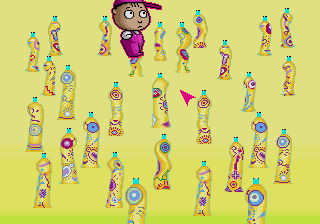
Mutant toothpaste tubes maybe?


I find it hilarious that Panic! Is one of the few games to use the Sega CD mouse. All you do is push buttons in a grid. It’s not like you need to move fast or use any precision whatsoever. It is a completely pointless peripheral in a completely pointless game. So, as you can tell, I didn’t care for Panic! much. Maybe I’m looking for different things than other gamers, but it would take a very impressive presentation for me to rank a gameplay-free video game particularly high. I play video games to get away from passive entertainment. I want to be involved in what happens on the screen. It would take an amazing story or some very unique visuals to impress me when there’s nothing actually for me to do. What’s not going to impress me is dogs with boobs and bicycles with triangle wheels that aren’t doing much beyond existing. So this game is going low. Very, very low. I would be stunned if this didn’t turn out to be the worst game on all of Sega CD, or at least the worst that actually presents itself as a game. It’s all the way down at 116, which is seventh from the bottom and only ahead of a couple of Hyperscan games and the NGPC casino games. I can’t really buy the excuse that it’s just too Japanese for the American audience. There’s plenty of Japanese humor that makes me laugh. Panic! is unfunny in any language. Don’t blame the Japanese when a game falls flat. Maybe it really is just bad. 


The List! Ranking List.docx - Microsoft Word Online (live.com)


(Images are from mobygames.com)


Tuesday, December 6, 2022

Atari 2600 #14/Atari 5200 #1: Keystone Kapers

 Atari 2600 #14/ Atari 5200 #1: Keystone Kapers


Developer: Activision

Publisher: Activision

Release Date: April 1983


 I always enjoy video games with very old IPs, and it doesn’t get much older than than the Keystone Cops. Their origins go back to 1912 right at the dawn of movies and modern pop culture. The Keystone Cops was one of the first popular comedy series in all of cinema. Many of the greats, including Charlie Chaplin, Harold Lloyd, and Roscoe “Fatty” Arbuckle spent time as Cops before breaking out on their own. They had such an impact on pop culture that although the original series ended in 1917, they are still commonly referenced today. That’s impressive, especially since their movies are very seldom seen and not all that good. It’s as if all the slapstick greats watched the Keystone Cops to learn what not to do in their own movies. Still, Americans love their icons and idioms, so bumblers are often still called Keystone Cops, and it makes perfect sense that a video game seventy years later would draw its inspiration from the bawdy comedy troupe.


 While the game does feature a cop, the character in this game is the opposite of your typical Keystone Cop. The cops in the movies were hopeless goons who usually ended up causing life-threatening disasters through their own incompetence. Keystone Kelly, on the other hand, is practically a superhero. He is super-fast, super nimble, and laser-focused on his task of catching Harry Hooligan. The game is a fast-paced early platformer that is set up like a multi-tiered Pitfall. There is only one task in the game, catching Harry Hooligan as he tries to escape a shopping mall. He starts on the floor above Keystone Kelly, but he is much slower. A timer counts down during the chase so it’s imperative to catch Harry Hooligan as quickly as possible. Almost all the points are gained by how much time is left. There are a few suitcases to pick up that are worth a few hundred points, but it’s really about the chasing and catching. There are also several types of obstacles to avoid. Some take away time while some will cause you to lose a life.


Keystone Kapers is a fast and exciting game. It has similarities to a racing game because points are earned by learning how to get around quickly. New and more difficult obstacles will appear in every level, so it’s also important to pay attention to the upper screens and learn the layout. The most important thing is getting to the elevator at just the right time. It is faster than taking the stairs, but it moves up and down automatically, so good timing in key. The 2600 version is the most well-known, and it’s certainly the one I have played the most. It is fast and precise, and I feel that I can always do a little better when I play. The graphics are good for the most part, but those radios look like glowing piles of money, so everyone always runs into them the first time playing. I also enjoy that there is a map at the bottom of the screen keeping track of the characters and elevator. It’s not the most useful map in history, but it’s a nice touch.


Characteristically, the 5200 version looks better but doesn’t play quite as well. The 5200 is remembered for its nice graphics but awful controls. It’s not egregious here, but obstacles can be harder to avoid, and jumping isn’t quite as precise. The worst part, however, is that the elevator moves very, very slow. This is supposed to be a game about speed, and it’s disappointing standing around for an elevator to slowly appear. It’s still faster and safer than taking the stairs most of the time, but it can get annoying. The elevator situation caused me to get lower scores per level, but I still ended up doing better than I did on the 2600. This is probably because the developers caught the elevator problem and threw in some extra lives to balance it out. In a strange way it’s both easier and more difficult at the same time. Confusion is fairly typical with 5200 games.


I feel a little bad introducing 5200 with a double review, but it just doesn’t have a lot of original games. About 2/3 of its library came from 2600, and many of them, like Keystone Kapers, are too similar to merit a separate review. Thankfully both versions are fun, so 5200 starts out with a winner. So far, I’ve been avoiding reviewing multiple versions of the same game, but it’s something I couldn’t avoid forever. Get ready to see many of the same games clumped together on the list. In fact, there are other versions of Keysone Kapers I have yet to review. As always, I will make them insightful and entertaining. Hey, it’s what I do. The two versions are numbers 44 and 45 on the overall list, and the 2600 version ranks as number three on the console list. Even though I have been an Atari fan all my life, it’s still surprising how much fun I’m having with the venerable system. Here’s to more good games in the future.


Atari 2600 Quality percentage: 8/14 or 57.14%


The Big List:  Ranking List.docx - Microsoft Word Online (live.com)


(images are from mobygames.com)

Tuesday, November 15, 2022

Atari 2600 #13: E.T. The Extra-Terrestrial

Developer: Atari

Publisher: Atari

Release Date: December 1982


Okay I guess it’s time to talk about E.T. I’m sure you all know the story by now. Howard Scott Warshaw was given five weeks to develop an E.T. game for release during the Christmas season. It ended up being such a disaster that it ruined the whole video game industry, and unsold copies were buried in an Arizona landfill. Legends of the landfill were big talk in Atari circles for years until that part of the legend was confirmed to be true. However, it’s still somewhat untrue. Sure, there were E.T. carts buried in the desert, but that’s likely the fate of most unsold games. Warehouse space is limited, so there are probably copies of Final Fantasy VII and Ocarina of Time buried out there somewhere. However, the most relevant legend about this game is that it is the worst of all time. Now, I’ll say right up front that it is not the worst game of all time nor is it the worst game on Atari 2600. However, it is still a very, very bad game. If you think I am going to take a sympathetic, apologist view than you are greatly mistaken. I strive for honesty around here, so even though Howard Scott Warshaw hangs around on the AtariAge Facebook page and wrote a book that its members won’t stop spamming, I still have to concede that his game is, in fact, quite bad. Just as in the Atari of old I come to bury E.T. not praise it.


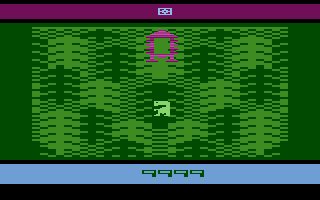
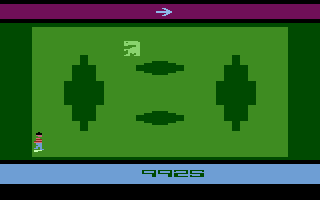
 E T. is a game all about holes. When you first turn it on and haven’t read the manual than you will probably move over a screen and instantly fall in a hole. Then you will try to get out and fall again. Then you will eventually get out only to walk a couple steps and fall in another hole. E.T. will fall if any part of his body comes in any contact with a hole. I think everyone who plays this game thinks that there must be some mechanic they are missing. Surely the object is to avoid the holes and get over to where the actual game starts. Sorry Atari players, but you are actually supposed to be falling in the holes. That’s how you win the game. E.T. must find the three parts to his phone so he can call his spaceship and get the heck out of this hole-filled planet. All of the pieces are, of course, hidden in holes. There is a question mark that shows up from time to time that will show you the location of a phone piece if you push the button, so at least there’s that. Although because Warshaw couldn’t quite get anything right in this game sometimes the question marks are on screens where there are no phone pieces. The instructions also state that there can be more than one phone piece per screen, so you still have to check them all. Some say that the game is only considered bad because people don’t understand how to play. However, falling into a bunch of identical holes and slowly floating out of them just isn’t fun. It’s not like there are any monsters to fight or even different colors to look at. It’s just the same thing over and over.


Strangely during the second half it becomes a game of avoiding holes. While E.T. is wandering around his health is quickly deteriorating. When he runs out, and after Eliot has used up all his resurrections, it’s game over. Nothing depletes his health more than levitating, so watch out. The next task is finding the spot to use the phone. As E.T. moves around various icons will pop up at the top of the screen which all have different functions. It can be confusing if you don’t know what to look for because some of them seem to contradict each other. I thought the arrows pointed the way to a phone piece, and so I got quite confused when I would take a couple of steps and the arrow would suddenly change directions. It turns out they are actually warps. Different icons appear depending on what part of the map E.T. is standing on. The goal in this part of the game is to find the one tiny spot on the map that has an icon that kind of looks like a phone if you squint. So now the strategy is to traverse every spot on the map looking for the phone icon while trying to avoid energy depleting holes. This is still not very much fun. E.T. can’t do anything besides slowly walk, and there are no bonuses to be found except for tiny dots of candy. The first time I tried this I found the phone easily, but the second time I looked just about everywhere, and it never turned up. Nothing’s more irritating than looking for one tiny spot on the map that doesn’t even have any clues to its whereabouts. So you call your spaceship, and what do you suppose you have to do to actually ride it? Yep, you find another tiny spot on the map. At least this one is always on the same screen.


That is basically the game. On harder difficulties a scientist and F.B.I. agent will chase you around which at least adds a little action to the game but also makes it more frustrating. So now I’ve done everything I could possibly do to give E.T. a fair chance. I read multiple strategy guides and played it several times so that I could understand it well. I’ve spoken to Warshaw a bit and he seems like a nice enough guy and not someone I would want to insult just for the sake of insulting. However, what it all boils down to is a game that’s simply not fun. I know Warshaw only had five weeks to make the game, but dude, you didn’t have to make a complicated adventure game. You made Yars’ revenge, so I know you had the skills to make a great action game. Even a halfway decent shooter would’ve pleased the kids at Christmas time. He did have some adventure game success with Raiders of the Lost Ark, which I will review when I find another Atari controller, but that game was aimed at a more mature audience and garnered extremely mixed reviews. It’s ironic that the whole point of E.T. was to make a game for kids and he made a game so complicated that even adults have trouble figuring it out.


 E.T. probably doesn’t deserve its reputation as an industry killer. It was just one piece in a complicated puzzle of what turned out to be merely a temporary setback in the video game market. Atari would go on for many more years and had some arcade success even if they never had another truly successful console again. If I was going to look at one single game that was even more responsible for the crash, I would pick Apollo’s Skeet Shoot. However, what gives E.T. such a bad reputation is its prominence. It was an adaptation of a cultural phenomenon made by the biggest game company of its era. There are worse 2600 games, but most of them were made by small companies that didn’t have much traction in the industry. Sure Fire Fly is a bad game, but it was made by Mythicon, a company that had never been heard of before and disappeared just as quickly. I’m sure it’s more well-known now than it was in the 80s. E.T. is one of those games that caused kids to lose their innocence somewhat. It made them realize that video games were products that weren’t all being made for with love and fun in mind. The main goal for Atari was to get something out by Christmas. Nobody cared if it was good or bad. It just had to exist. Atari would pay a great price for this hubris, probably too big of a price, but at least it made gamers smarter. Movie games would always have a bad reputation, but by the NES era everyone expected them to. People started to pay attention to reviews more and could separate the good games from the bad. Rentals would rise to prominence in the late 80s so people could play before buying. E.T. might not be the worst game, but it will always be the most important bad game of all time. For better or worse it’s a game that changed everything.


AS far as rankings to it’s certainly not going all the way to the bottom. It’s better than anything on Hyperspin and I would rather play it than a single game gambling simulator. Actually, it’s not even the worst Atari game on the list. That honor goes to Birthday Mania, a game that carried no cultural relevance on account of it selling approximately two copies. It’s crawled all the way up to #102, which like Mario Mendoza’s lifetime .215 batting average is still very bad but better than expected. Hey at least it’s not Ben 10. 


Atari 2600 

  1. Yars’ Revenge 
  2. Adventure 
  3. Video Pinball 
  4. Fast Eddie 
  5. Gopher 
  6. Entombed 
  7. Red Sea Crossing 
  8. Gamma-Attack 
  9. Cosmic Commuter 
  10. Gyruss 
  11. Space Jockey 
  12. E.T. 
  13. Birthday Mania 
The whole list: https://1drv.ms/w/s!AvR1pVOGMfAniEZub_KTCsR7twUv?e=OfeAtm

(images are from Mobygames.com)

Sunday, November 13, 2022

Atari 2600 #11: Yars' Revenge

 Atari 2600 #12: Yars’ Revenge


Developer: Atari

Publisher: Atari

Release Date: May 1982


I gotta read that comic book!